Blog

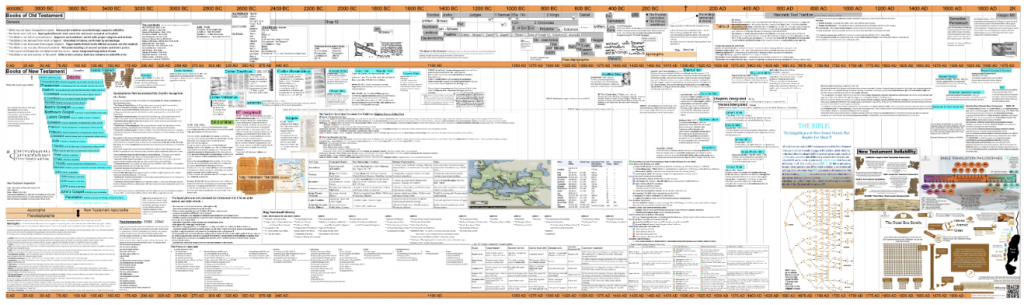
  • Bible Formation Chart (NEW)

    Download: PDF

    Download: .PNG image
    Use Policy: Free for personal and church use. Not for sale or commercial distribution.

    Author: Neil Baulch


    How to Read the “How We Got Our Bible” Chart — From Revelation to Your Translation

    Purpose: explain how to read your Bible Formation chart, show how each panel fits together (revelation → inspiration → canon → preservation → textual criticism → translation → today’s usage), and give you a reproducible workflow to teach or study it—without drifting from a conservative, grammatical-historical approach that honours Scripture’s authority.


    1) What This Chart Is (and Is Not)

    What it is: a single-page map of how God’s word moved from God to us:
    Revelation (God speaks) → Inspiration (God-breathed Scripture) → Recognition/Canon (God’s people receive and recognise the books God gave) → Transmission/Preservation (scribes, copies, manuscripts) → Textual Criticism (careful comparison of copies to recover the earliest text) → Translation (Hebrew/Aramaic/Greek into living languages) → Publication and Use (reading, preaching, discipleship).

    What it is not: a defence of any one English translation, nor a story of perfect scribes or magical processes. God gave an inerrant word in the autographs; He has faithfully preserved it in the manuscript tradition so that we possess the word of God reliably today (2 Tim 3:16–17; Matt 5:18; Isa 40:8; 1 Pet 1:24–25).


    2) The Big Picture: Four Rings and a Timeline Rail

    Think of the chart in four rings wrapped around a left-to-right historical rail.

    Ring 1 (Core): Revelation & Inspiration (God → Prophets/Apostles → Scripture)

    • Revelation: God discloses truth we could not discover unaided (Heb 1:1–2; Exod 34:6–7).
    • Inspiration: “God-breathed” graphe (Scripture) by the Spirit through human authors (2 Tim 3:16–17; 2 Pet 1:20–21).
      Reading cue: Arrows flow from God to text, not from community to text. The church/synagogue recognises Scripture; it does not create it.

    Ring 2: Canon (Recognition of the Books God Gave)

    • OT canon emerging within Israel’s history (the Law/Prophets/Writings pattern; Luke 24:44).
    • NT canon recognised by the apostolic churches: Gospels/Acts, Pauline letters, General Epistles, Revelation—circulated, copied, read publicly, tested for apostolicity, orthodoxy, catholic usage, and antiquity (1 Thess 5:27; Col 4:16; 2 Pet 3:15–16).
      Reading cue: Solid arrows show recognition milestones; dashed arrows show usage/citation links (e.g., Fathers quoting NT books widely).

    Ring 3: Transmission & Preservation (Manuscripts)

    • OT: Hebrew Masoretic tradition (Tiberian pointing), evidence from Dead Sea Scrolls (DSS), the Samaritan Pentateuch, Targums, Septuagint (LXX).
    • NT: early papyri, major uncials (e.g., Sinaiticus, Vaticanus, Alexandrinus), minuscules, lectionaries.
      Reading cue: This ring is copying over centuries. Expect variant readings (mostly minor). God’s providence used abundance of witnesses to preserve the text.

    Ring 4: Textual Criticism, Translation, and Today’s Bible

    • Textual criticism compares manuscripts to identify the earliest recoverable wording.
    • Translation renders that text into receptor languages via formal/optimal/dynamic equivalence.
    • Publication & Use places the Bible in the hands of the church for reading, preaching, discipleship, mission.
      Reading cue: The arrows here point from text to language to reader, with side-panels noting translation philosophies and major translation families.

    Timeline rail (bottom): Moses → Prophets → Post-exilic scribes → Second Temple period (DSS/LXX) → Christ & Apostles → Early church copying → Late antique & medieval transmission → Reformation vernaculars → Modern critical editions and translations. Use the rail to locate each panel in time.


    3) Legend—Colours, Lines, and Markers

    • Colours = category
      Gold = Revelation/Inspiration;
      Blue = Canon;
      Green = Transmission/Preservation;
      Purple = Textual Criticism;
      Teal = Translation/Publication;
      Grey = Methods/notes.
    • Solid arrows = causal/derivational flow (e.g., God inspires → church recognises → scribes transmit).
    • Dashed arrows = cross-links (e.g., a NT book quoted by Fathers; LXX used in the NT).
    • Superscripts/labels mark key exemplars (e.g., 1QIsaᵃ; ℵ, B; NA28/UBS5; MT; LXX).

    Reading the legend first prevents you from mistaking, say, LXX (a translation used in the NT era) for the inspired autographs themselves.


    4) A 20-Minute Reading Plan (First Pass)

    1. Start at Revelation & Inspiration (center). Read 2 Tim 3:16–17 and 2 Pet 1:20–21.
    2. Move to OT Canon: Law/Prophets/Writings (Luke 24:44). Note public reading and prophetic deposit (Deut 31:24–26; Josh 24:26).
    3. Shift to NT Canon: Gospels/Acts → Paul → General Epistles → Revelation. Watch the usage arrows (public reading, church lists, citations).
    4. Follow to Transmission:
      • OT: MT, DSS, LXX, Targums, Samaritan Pentateuch.
      • NT: papyri, uncials, minuscules.
    5. Open Textual Criticism: why variants occur; how comparison works; why conclusions are high-confidence for virtually all verses that matter.
    6. Finish with Translation & Today’s Bibles: translation philosophies, major English lines (Tyndale → KJV → NKJV; RV/ASV → RSV → ESV; NASB; NIV; CSB; etc.), and how to choose/compare.

    5) Worked Examples (Read the Chart Like This)

    A) Isaiah in the Dead Sea Scrolls and the Masoretic Text

    • What you’ll see: an arrow linking 1QIsaᵃ (Great Isaiah Scroll) to the Masoretic tradition.
    • How to read it: this shows substantial stability of the Hebrew text across centuries, with expected minor differences (orthography, small slips).
    • Takeaway: Preservation is providence plus plurality (many witnesses), not a myth of perfect copying.

    B) New Testament: From Papyri to Printed Greek

    • What you’ll see: a stream from early papyri (2nd–3rd cent.) → great uncials (4th–5th) → minuscules (later) → printed editions (Erasmus/Stephanus/Beza → TR; modern critical NA/UBS).
    • How to read it: the chart distinguishes textual bases (e.g., TR/Byzantine vs. eclectic NA/UBS) and notes that substantial doctrinal content is unchanged—differences rarely affect doctrine and are footnoted in good translations.

    C) The LXX’s Role

    • What you’ll see: the Septuagint (LXX) as a Greek translation used among Jews and cited in the NT.
    • How to read it: LXX is not the autograph, but a significant witness to OT text and an aid for understanding first-century quotations and wording.

    6) Exegesis Layer (Why the Chart Stays Text-First)

    Original Language Anchors (sample prompts to keep definitions contextual)

    • Hebrew: torah (law/instruction), nĕbî’îm (prophets), ketûbîm (writings); kātav (write).
    • Greek: graphē (Scripture), theopneustos (God-breathed, 2 Tim 3:16), pheromenoi (“carried along,” 2 Pet 1:21), kanōn (rule/measure, later usage).
      Rule: lexical entries help, but context defines meaning. The chart nudges you to read whole pericopes, not cherry-pick glosses.

    Grammar/Syntax Cues

    • 2 Tim 3:16 explicitly treats Scripture (not merely prophetic moments) as God-breathed and sufficient.
    • 2 Pet 1:20–21 guards against private origin; Scripture comes by Spirit-carried men.
    • NT usage of OT demonstrates functional canon already in the first century.

    Textual-Variant Discipline

    • Significant variants are flagged where meaning plausibly shifts (e.g., endings/omissions in select passages).
    • Most variants are spelling/order and do not change sense. Conservative handling: note, weigh, footnote—while maintaining confidence in the established text.

    7) Canon Recognition (What the Chart Means by “Recognise”)

    • Old Testament: Israel’s Scriptures were received as they arose (e.g., Deut 31:26), then acknowledged as the Law and the Prophets (Luke 24:44).
    • New Testament: Churches read apostolic writings publicly (1 Thess 5:27), collected and circulated letters (Col 4:16), and treated them as Scripture (2 Pet 3:15–16).
    • Historical lists and Fathers’ citations reflect recognition; they don’t bestow inspiration.
      Key balance: “The church’s fallible recognition of Scripture” vs. “Scripture’s infallible authority from God.”

    8) Textual Criticism (Why It Serves, Not Threatens, Authority)

    • Goal: recover the earliest reachable text by comparing witnesses.
    • Tools: external evidence (age, geography, text-type), internal evidence (authorial style/context), and conservative canons of probability.
    • Outcome: a highly stable text; where uncertainty remains, good Bibles mark it so readers aren’t misled.
      Pastoral line on the chart: “Because God preserved His word across many independent lines, we can test and confirm it; our confidence rests in God’s providence and the mass of evidence.”

    9) Translation (From Source Text to Your Bible)

    • Philosophies:
      • Formal equivalence (word-for-word leaning; e.g., ESV, NASB, LSB);
      • Optimal/mediating (CSB, NIV);
      • Functional/dynamic (thought-for-thought leaning).
    • Process: base text (Hebrew/Aramaic MT with LXX/DSS notes; Greek NA28/UBS5/Byzantine notes), translator committee, review, footnotes, cross-refs, publishing.
    • Guidance panel on the chart: use one primary translation for memorisation/study (ESV per your preference) and compare others for nuance; keep an interlinear or original-language tools handy for word-study checks.

    10) Practical Workflow (Turn the Chart into a Repeatable Study)

    Use this five-move loop:

    1. Pick a node: e.g., New Testament Canon.
    2. Collect texts: 1 Thess 5:27; Col 4:16; 2 Pet 3:15–16; Luke 1:1–4; Rev 1:3; 22:18–19.
    3. Trace recognition: how were these writings used/received? what do the arrows show (public reading, circulation, citations)?
    4. Connect to transmission: which early witnesses preserve these books (papyri/uncials)?
    5. Synthesize & apply: one sentence of doctrine; three lines of practice (read publicly; copy and teach; guard the text; translate faithfully).

    Quality check (print this):

    • I started from revelation/inspiration (not community preference).
    • I followed recognition, not creation, of canon.
    • I accounted for preservation via multiple witnesses.
    • I used textual criticism as a servant, not a master.
    • I explained translation choices and why my church uses X.

    11) FAQs (Search-Oriented)

    Q1: Did the church decide the canon?
    No. God inspired the books; the church recognised them. Historical lists reflect that recognition.

    Q2: If scribes made mistakes, is the Bible still reliable?
    Yes. With thousands of manuscripts across centuries and regions, we can compare and recover the original reading with very high confidence. Differences rarely affect meaning, and are marked.

    Q3: Which translation is “best”?
    Choose a transparent, committee-produced translation anchored to standard critical texts (with notes), suitable for study and public reading. ESV fits your specified use; compare NASB/CSB/NIV for nuance.

    Q4: What about the LXX and DSS—do they change the OT?
    They illuminate the OT text and its ancient reception. Where differences arise, translators and scholars weigh evidence and context; many modern Bibles note significant places.

    Q5: Does textual criticism undermine inerrancy?
    No. Inerrancy applies to the autographs; textual criticism helps us locate their wording. Preservation by abundance is a mark of God’s providence.


    12) Representative Scripture Index (ESV)

    • Revelation & Inspiration: 2 Tim 3:16–17; 2 Pet 1:20–21; Heb 1:1–2; Jer 1:9; Exod 34:27–28
    • Canon & Public Reading: Deut 31:24–26; Josh 24:26; Luke 24:44; 1 Thess 5:27; Col 4:16; 2 Pet 3:15–16; Rev 1:3; 22:18–19
    • Preservation: Ps 119:89; Isa 40:8; Matt 5:18; 24:35; 1 Pet 1:24–25
    • Use: Neh 8:1–8; 1 Tim 4:13; 2 Tim 4:1–2; Acts 17:11

    13) Final Study Counsel

    Keep the chart beside your Bible. Each session, pick one panel (e.g., NT Canon or OT Transmission), run the five-move loop, and write one doctrinal sentence plus three practical implications for your church’s reading and teaching. Over time you’ll build a clean, evidence-aware understanding of how God’s word came to us—strong enough to teach, gentle enough to reassure, and faithful to Scripture.


  • Bible Formation Timeline Chart (OLD)

    The photo did not come out very well, so I have uploaded 2 of them.

    Click on the image, hold, and drag to you desktop:

  • Kings & Prophets Timeline Chart

    The photos of the chart did not come out that well, so I have posted 2 of them.

    Click on the image, hold, and drag to you desktop:

  • Bible & Church History Timeline Chart

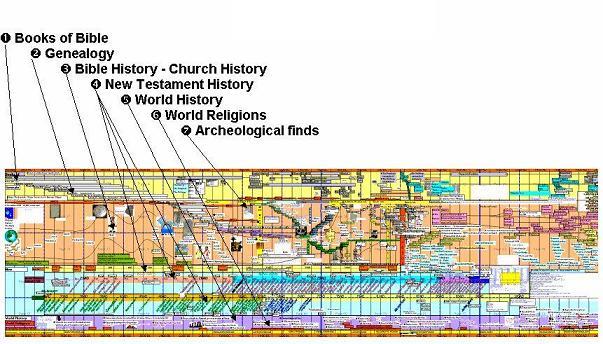
    Bible & Church History Timeline

    A Suggestion:

    Try reading or listening to a whole book of the Bible with the timeline in front of you.  If you find this too difficult, ask a friend or friends to do it with you.

    It is an exciting adventure to discover God in a much deeper way. It is as if, it all miraculously falls into place: who God really is; how God thinks and works; when did the people and events occur, and in relation to all the other people and events…

    Use Policy: Free for personal and church use. Not for sale or commercial distribution.

    Author: Neil Baulch

    How to Read the “Bible & Church History Timeline” — From Scripture to the Present

    Purpose: explain how to read your Bible & Church History Timeline (from the biblical era through major church eras to the present), how its components fit, and how to convert the graphic into a reliable study/teaching workflow. Built for a conservative, grammatical-historical approach (ESV), it keeps Scripture central while situating later history as response to—not source of—biblical authority.


    1) What this timeline is (and isn’t)

    What it is: a panoramic map that lays out (1) the biblical storyline (creation → patriarchs → Israel → Christ & the apostles), (2) the formation and preservation of Scripture (revelation, canon, transmission, translation), and (3) key church-history epochs (persecution, councils, missions, reformations, revivals, global expansion). It uses bands, milestone pins, and color coding so you can see what happened and why it mattered for the Bible’s use in the church.

    What it isn’t: an exhaustive chronology or an endorsement of every figure or movement shown. It is a learning scaffold—a way to locate people and events in relation to the Bible’s authority and the gospel’s advance.


    2) The big picture: four stacked bands plus a storyline rail

    Most readers grasp your timeline best by treating it as four long horizontal bands resting on a storyline rail:

    1. Biblical Era Band (top)
      Creation → Patriarchs → Exodus/Sinai → Conquest/Kingdom → Exile/Return → Second Temple → Jesus & the Apostles.
      Reading cue: This band anchors revelation and redemptive history. Every later band should be read as response to this one.
    2. Bible Formation Band
      Revelation → Inspiration → Canon recognition → Transmission/Preservation → Early versions/translations → Printed/modern editions.
      Reading cue: Arrows run from God to text (inspiration) and from text to church (recognition, copying, translating). The church receives Scripture; it does not create it.
    3. Church History Band
      Early persecution & mission → pastoral/theological consolidation → councils & creeds → monastic/missionary movements → Eastern/Western developments → reformations & confessions → awakenings/revivals → modern global mission & Bible societies.
      Reading cue: Milestones are placed under the biblical-authority stream to show how Christians guarded doctrine, carried the gospel, or (at times) drifted—prompting reform and renewal.
    4. Doctrinal & Missional Themes Band
      Short ribbons for: Trinity & Christology, Canon & Scripture, Justification & sanctification, Worship & sacraments, Mission & Bible translation, Israel/Church and eschatology.
      Reading cue: Thin ribbons cross multiple centuries, reminding you that the same doctrine is clarified repeatedly in different contexts.

    Storyline rail (bottom): century marks (or dated ticks). Use it to place any pin in time, then look upwards to see what it sits beneath (Bible formation; biblical era; doctrinal theme).


    3) Legend—colors, lines, icons

    • Colors by band (example):
      Gold = Bible Formation; Brown: Bible & Church History; Blue = BNT Era; Purple = Contemporary History.
    • Icons:
      Scroll/book = Scripture/canon/text;
      Globe/arrow = missions/translation;
      Gavel/columns = councils/creeds/confessions;
      Church building = ecclesial developments (polity, worship practice).
    • Solid arrows = derivation/causal flow (e.g., Inspiration → Canon recognition → Transmission).
    • Dashed arrows = influence/cross-link (e.g., a creed informing later confessions; a revival fueling missions).
    • Superscripts/labels mark representative texts, councils, creeds, or translation lines.

    Read the legend first so you don’t misread a doctrinal ribbon (theme across time) as a single-date event.


    4) A 20-minute first pass (how to read the whole page)

    1. Start at the Biblical Era band. Trace Creation → Christ & apostles with the ESV references you’ve placed (e.g., Gen 12; Exod 20; Isa 53; Luke 24; Acts 1–2).
    2. Drop to the Bible Formation band. Follow Revelation/Inspiration → Canon → Transmission (Hebrew MT, DSS; Greek papyri/uncials → printed/critical editions) → Translations.
    3. Move down to the Church History band. Note clusters (persecution; councils/creeds; reformations; awakenings; missions).
    4. Scan the Doctrinal/Missional ribbons and notice where they thicken (times of controversy or renewal).
    5. Pick one century on the rail, and read upward through all bands to see everything happening at once (Bible in use, doctrines clarified, mission expanding).

    5) Worked examples (three ways to use the timeline)

    A) “Where did our English Bibles come from?”

    • How to read:
      1. In the Bible Formation band, find Transmission → Early versions → Vernacular translations.
      2. Watch the arrows from Hebrew/Greek base texts into translation families (e.g., one line leading toward KJV/NKJV; another toward RSV/ESV; others toward NASB, NIV/CSB).
      3. Tie this to the Doctrinal ribbon for Scripture & authority—times when translation and textual decisions were front-and-center in church life.
    • Takeaway: God’s word moved from God-breathed originals to faithful copies to transparent translations, so congregations could hear, read, and obey.

    B) “How did core doctrines stay orthodox?”

    • How to read:
      1. On the Doctrinal ribbons, locate Trinity & Christology and Justification & sanctification.
      2. Look down to the Church History band at moments of creed/confession or controversy/clarification (you’ve marked them with a gavel/columns icon).
      3. Look up to the Bible Formation band to remember: the Bible governs doctrine; creeds are summaries, not sources, of truth.
    • Takeaway: The church confesses what Scripture teaches; when drift occurs, reform calls the church back to the text.

    C) “Why do renewals often spark missions and translation?”

    • How to read:
      1. Find Flame (renewal) icons on the Church History band.
      2. Follow dashed arrows to Globe/arrow icons (missions, translation).
      3. Note the Doctrine/Mission ribbon thickening where evangelism, Bible societies, and cross-cultural work accelerate.
    • Takeaway: Renewal that is Bible-anchored tends to propel Bible dissemination and world mission.

    6) Scripture anchors (why the timeline stays text-first)

    Even in a history chart, Scripture is the norming norm. The diagram quietly encodes these anchors:

    • Revelation & Inspiration: 2 Tim 3:16–17; 2 Pet 1:20–21; Heb 1:1–2.
    • Canonical shape (OT/NT): Luke 24:44; 1 Thess 5:27; Col 4:16; 2 Pet 3:15–16; Rev 1:3; 22:18–19.
    • Preservation confidence: Ps 119:89; Isa 40:8; Matt 5:18; 24:35; 1 Pet 1:24–25.
    • Preaching, teaching, mission: Neh 8:1–8; Matt 28:18–20; Acts 1:8; 20:27; 2 Tim 4:1–2.
    • Doctrinal fidelity: 1 Tim 6:3–5; 2 Tim 1:13–14; Jude 3.

    When you teach from the timeline, read the relevant pericopes aloud so the text leads the history, not the other way around.


    7) “The flow of authority” (a key diagram inside the diagram)

    Your timeline likely includes (or implies) a small flowchart:

    God → Revelation → Inspired Scripture → Church hears/receives → Confesses/guards/proclaims → Translates/sends → Hears/obeys again

    • One-way authority: authority flows from God through Scripture; later history has ministerial (servant) authority.
    • Checks & balances: when practice runs ahead of text, reform recalls the church to Scripture (“Ad fontes”—to the sources).
    • Unity and charity: many secondary differences exist (polity, worship forms, eschatological details), but Scripture’s supremacy is non-negotiable.

    8) Teaching with the timeline (templates you can reuse)

    Template A: “A century in view” lesson (30–45 min)

    1. Pick a century tick on the rail.
    2. Read upward through all four bands.
    3. Ask: What Scripture practices were central? Which doctrines were clarified or contested? What mission/translation shifts occurred?
    4. Conclude with three applications (e.g., public Scripture reading restored; catechesis renewed; missionary prayer mobilized).

    Template B: “One doctrine across time” (30–45 min)

    1. Choose a doctrinal ribbon (e.g., Scripture’s authority; Trinity; justification).
    2. Walk across the centuries, stopping at thickened segments or icons beneath.
    3. For each stop, read one governing passage and summarise what the church confessed in that moment.
    4. End with today’s practice: how will our church hear and do this doctrine now?

    Template C: “From text to tongue” (20–30 min)

    1. In the Bible Formation band, start at Inspiration → Canon → Transmission.
    2. Drop to Church History: translation and mission moments.
    3. Finish with how to choose and use translations in your church (primary translation for reading; compare others for study).

    9) Quality controls (how the chart avoids pitfalls)

    • Avoiding hagiography: figures are servants, not heroes to canonize. Measure impact by fidelity to Scripture and fruit in gospel mission.
    • Avoiding cynicism: acknowledge sins and failures without dismissing God’s ongoing providence and renewal.
    • Keeping proportions: major doctrinal clarifications receive larger labels; secondary disputes are smaller so readers don’t lose the forest.
    • Distinguishing levels: Bible → Canon/Transmission → Church practice are different layers; don’t let practice masquerade as new revelation.


    10) A printable study loop (use with any pin on the chart)

    1. Identify the pin (event/figure).
    2. Read the governing Scripture(s) connected to that topic.
    3. Summarise the doctrinal theme in one sentence (text-first).
    4. Name the historical contribution/problem in one line.
    5. Apply: one action in worship, one in teaching, one in mission.

    11) Representative Scripture index (ESV)

    • Revelation & inspiration: 2 Tim 3:16–17; 2 Pet 1:20–21; Heb 1:1–2
    • Canon & public reading: Deut 31:24–26; Luke 24:44; 1 Thess 5:27; Col 4:16; 2 Pet 3:15–16; Rev 1:3; 22:18–19
    • Preservation & confidence: Ps 119:89; Isa 40:8; Matt 5:18; 24:35; 1 Pet 1:24–25
    • Teaching & mission: Neh 8:1–8; Matt 28:18–20; Acts 1:8; 20:27; 2 Tim 4:1–2
    • Guarding the faith: 1 Tim 6:3–5; 2 Tim 1:13–14; Jude 3

    12) Final counsel for using the timeline

    Keep the timeline beside an open Bible. Each session, pick one century or one ribbon, run the study loop, and finish with one concrete practice (e.g., restore public reading of Scripture, catechize on the Trinity, support a translation/missions project). Over time, your people will not only know the dates and names—they’ll see how God preserved His word and advanced His gospel through imperfect servants in every age.


  • What Happens When Children Die?

    Do Children Go To Heaven When They Die?

    Another aspect of God’s wonderful love and mercy.

    Luke 18:15 Now they were bringing even infants to him that he might touch them. And when the disciples saw it, they rebuked them. 16 But Jesus called them to him, saying, “Let the children come to me, and do not hinder them, for to such belongs the kingdom of God.

    God placed a safety mechanism in life for children, so that any child who died, would go to heaven, not hell.

    How wonderful that God designed life with ‘accountability’ measures.
    A child who has not reached the age of accountability, will be saved if they die.
    This is a great comfort to me, when I hear about the multi millions of abortions, and the brutal murder, and of trafficking of dear, little, innocent children.

    I strongly believe that Jesus is not just referring to our need to be like little children, but also that heaven already belongs to little children. Or to put it another way: these children are already property of heaven, they belong to God, and will go to heaven if they die now, until they reach the age of accountability.

    Greek for to such belongs the kingdom of God

    The Greek Text and Its Implications
    The Greek phrase in question is:
    Τῶν γὰρ τοιούτων ἐστὶν ἡ βασιλεία τοῦ Θεοῦ.
    “For of such is the kingdom of God.”
    • Τῶν γὰρ τοιούτων (tōn gar toioutōn) – “For of such”
    • ἐστὶν ἡ βασιλεία τοῦ Θεοῦ (estin hē basileia tou Theou) – “is the kingdom of God”

    A. The Meaning of “Τοιούτων” (toioutōn) – “Such as These”
    The word toioutōn can mean “such ones” or “such as these.” It can refer either to:
    • A comparison (i.e., those who possess childlike characteristics).
    • A direct identification (i.e., actual children themselves).

    The phrase is somewhat open-ended, which allows for both meanings. However, if Jesus had meant only a simile (i.e., “you must be like children”), He could have said ὡς παιδίον (hōs paidion), meaning “as a child.” Instead, the phrasing suggests that children themselves are included in the Kingdom of God.

    Dual Meaning: Both Literal and Figurative

    The best interpretation considers both dimensions:

    1. Literal: Children themselves belong to the Kingdom of God, meaning they are covered by divine grace if they die before moral accountability.
    2. Figurative: Adults must become like children in humility, trust, and dependence to enter the Kingdom.

    The Greek grammar, context, and broader biblical theology support the idea that:

    1. Children themselves belong to the Kingdom of God, not just their qualities.
    2. Infants and young children are under God’s mercy until they reach moral responsibility.
    3. This passage aligns with the doctrine of the age of accountability, meaning that if a child dies before reaching an age where they can willfully reject or accept God, they are received into His presence by grace.

    Thus, Luke 18:16-17 is a strong biblical foundation for arguing that infants and young children are saved by grace if they die before the age of accountability.

    Mat 18:1 About that time the disciples came to Jesus and asked, “Who is greatest in the Kingdom of Heaven?” 2 Jesus called a little child to him and put the child among them. 3 Then he said, “I tell you the truth, unless you turn from your sins and become like little children, you will never get into the Kingdom of Heaven. 4 So anyone who becomes as humble as this little child is the greatest in the Kingdom of Heaven. 5 “And anyone who welcomes a little child like this on my behalf is welcoming me.


    The Bible shows over and over that humans are accountable for what they know, not what they do not know:

    Romans 5:13  “Sin is not imputed where there is no law.”
    Deuteronomy 1:39  Speaks of the children of Israel who were too young to be held responsible: “your little ones…who today have no knowledge of good and evil.”
    2 Samuel 12:23  David, after his infant son’s death, says, “I shall go to him, but he shall not return to me,” suggesting the child was in God’s presence.

    Just what age is that transition to accountability is an ongoing debate. Some say early like maybe 6 years old, others say around 20 years old. But, I tend to think it around when the Jewish boys became a man 12 years old. Each child would be a different age.

    So, a child who has not reached the age of accountability, will be saved if they die, in this stinking, sinful world.


  • What Happens To Those Who Never Hear The Gospel

    All People Can Be Saved – God’s Design

    At creation, God provided for every single person to be saved, even those that would never hear the gospel. So, even those today in those regions that have not been touched by gospel, God provided for them at creation:

    • God created the world as evidence that He existed for all future generations – Natural Revelation.
    • God placed in every single person a ‘Conscience’ a given knowledge of moral law and a knowledge of God. He created a ‘God-shaped vacuum’ or a ‘homing device’ in each person.
    • God also built into humans, known weaknesses: the knowledge that man is weak to save himself, even fear
    • God also provided ‘Special Revelation’ through His speaking to humans and His written Word.

    From the beginning, He designed humanity with an innate awareness of the divine, a moral compass pointing toward righteousness, and a yearning for something beyond the material.

    And, the Bible says that:

    Romans 1:20 – “For the invisible things of him from the creation of the world are clearly seen, being understood by the things that are made, even his eternal power and Godhead; so that they are without excuse.”

    If they are ‘without excuse’ then they must have the ability to connect to God and be saved.

    Natural Revelation That Shows God’s Existence:

    Rom 1:18 For the wrath of God is revealed from heaven against all ungodliness and unrighteousness of men, who by their unrighteousness suppress the truth. 19 For what can be known about God is plain to them, because God has shown it to them. 20 For his invisible attributes, namely, his eternal power and divine nature, have been clearly perceived, ever since the creation of the world,g in the things that have been made. So they are without excuse. 21 For although they knew God, they did not honor him as God or give thanks to him, but they became futile in their thinking, and their foolish hearts were darkened. 22 Claiming to be wise, they became fools, 23 and exchanged the glory of the immortal God for images resembling mortal man and birds and animals and creeping things.

    Rom 2:1 Therefore you have no excuse, O man, every one of you who judges. For in passing judgment on another you condemn yourself, because you, the judge, practice the very same things. 2 We know that the judgment of God rightly falls on those who practice such things. 3 Do you suppose, O man—you who judge those who practice such things and yet do them yourself—that you will escape the judgment of God? 4 Or do you presume on the riches of his kindness and forbearance and patience, not knowing that God’s kindness is meant to lead you to repentance? 5 But because of your hard and impenitent heart you are storing up wrath for yourself on the day of wrath when God’s righteous judgment will be revealed.

    6 He will render to each one according to his works: 7 to those who by patience in well-doing seek for glory and honor and immortality, he will give eternal life8 but for those who are self-seekinga and do not obey the truth, but obey unrighteousness, there will be wrath and fury. 9 There will be tribulation and distress for every human being who does evil, the Jew first and also the Greek, [Greek = gentiles. So, those who have not heard the gospel10 but glory and honor and peace for everyone who does good, the Jew first and also the Greek [Greek = gentiles. So, those who have not heard the gospel]. 11 For God shows no partiality.

     12 For all who have sinned without the law will also perish without the law, [Not judged by the Law of Moses] and all who have sinned under the law will be judged by the law13 For it is not the hearers of the law who are righteous before God, but the doers of the law who will be justified. 14 For when Gentiles, who do not have the law, by nature do what the law requires, they are a law to themselves, even though they do not have the law. 15 They show that the work of the law is written on their hearts, while their conscience also bears witness, and their conflicting thoughts accuse or even excuse them 16 on that day when, according to my gospel, God judges the secrets of men by Christ Jesus.


    Those that have never heard of God, Scripture or the gospel, have ‘the Law written on their hearts’. a ‘Conscience’ a knowledge of moral law and a knowledge of God. A ‘God-shaped vacuum’ or a ‘homing device’ in each person.

    God does not ‘show partiality’ or have favourites -the Jews and Christian nations. He will judge Jews and Christian nations on the basis of what they heard and knew. Their ‘times of ignorance’ (Rom 2:30) have passed and they are hearing ‘Special Revelation’. Hence, they are commanded to repent. Now, hugely responsible.

    But, those who lived in ‘times of ignorance’, who have never heard and will ‘perish without the law ‘ will not be judged like those who have heard, they will be judged by what they did know (which was not much); the Law written on their hearts, and the evidence of God in His creational wonders. It will be a very, very different judgment measure.

    Psa 19:1 The heavens declare the glory of God,
    and the sky abovea proclaims his handiwork.
    2 Day to day pours out speech,
    and night to night reveals knowledge.
    3 There is no speech, nor are there words,
    whose voice is not heard.
    4 Their voiceb goes out through all the earth,
    and their words to the end of the world.
    In them he has set a tent for the sun,
    5 which comes out like a bridegroom leaving his chamber,
    and, like a strong man, runs its course with joy.
    6 Its rising is from the end of the heavens,
    and its circuit to the end of them,
    and there is nothing hidden from its heat.

    It also needs to be understood that until modern times, when mankind came up with the very-flawed theory of Evolution,  and that supposedly, our knowledge of science is so advanced that we now know how everything came into being without the need for God.

    In all previous times, humans knew there had to be a God or gods, but in the Modern era, we have been falsely led to believe that our limited knowledge, surpasses all the unanswerable questions our science still has. No, these unanswerable questions place us still, in the same position of the unknowing ancients and pre-modernists.

    How did huamans get here?

    No, it cannot be answered by ‘parallel universes’ for where did the first universe come from.

    No, science cannot answer where ‘love’ and every other personal attribute come from in a cold, indifferent, only-material universe. These things do not happen by chance.

    No, science cannot answer how so many prophecies from ancient Scripture have been fulfilled. These things do not happen by chance.

    No, science has not knowledge of how structured and extremely complex the human DNA is, an information system beyond any known on earth. These things do not happen by chance.

    No, science cannot account for the minutely, fine-tuned universe that we live in, a complete system where if even one dynamic changed from it’s minute setting, no life could exist on earth.


    The apostle Paul said this in a speech to the Greek philosophers:

    Acts 17:22 So Paul, standing in the midst of the Areopagus, said: “Men of Athens, I perceive that in every way you are very religious. 23 For as I passed along and observed the objects of your worship, I found also an altar with this inscription: ‘To the unknown god.’ What therefore you worship as unknown, this I proclaim to you. 

     24 The God who made the world and everything in it, being Lord of heaven and earth, does not live in temples made by man,c 25 nor is he served by human hands, as though he needed anything, since he himself gives to all mankind life and breath and everything. 26 And he made from one man every nation of mankind to live on all the face of the earth, having determined allotted periods and the boundaries of their dwelling place, 27 that they should seek God, and perhaps feel their way toward him and find him. Yet he is actually not far from each one of us28 for

    “‘In him we live and move and have our being’;d

    as even some of your own poets have said,

    “‘For we are indeed his offspring.’e

    29 Being then God’s offspring, we ought not to think that the divine being is like gold or silver or stone, an image formed by the art and imagination of man. 30 The times of ignorance God overlooked, but now he commands all people everywhere to repent, 31 because he has fixed a day on which he will judge the world in righteousness by a man whom he has appointed; and of this he has given assurance to all by raising him from the dead.” (https://biblehub.com/esv/acts/17.htm)

    That all humans should seek God, out of the ways that God built into humans; a deep knowing that there is a God. And that we should be better people. If one chooses to be self-righteous and not humble themselves, knowing that we are not perfect, or one chooses to treat others with arrogance rather than humble themselves, considering that they themselves are flawed creatures.

    Every person, in whatever period of time they were born, can connect to God and be saved.

    The Bible says that God normally interacts with humans:

    Revelation 20:12: Judgment is based on deeds recorded in books, implying individual accountability.

    Jeremiah 17:10 “I, the Lord, search the heart, I test the mind, even to give every man according to his ways, according to the fruit of his doings.”

    Psalm 7:9 “O let the evil of the wicked come to an end, but establish the righteous; For the righteous God tests the hearts and minds.”

    Job 34:21-23 “For His eyes are upon the ways of man, And He sees all his steps. There is no darkness or deep shadow Where the workers of iniquity may hide themselves. For He does not need to consider a man further, That he should go before God in judgment.”


    The Bible even says that God puts the fear in the heart of man so that he will seek God as a protection:

    Jer 32:39 I will give them one heart and one way, so that they will always fear Me for their own good and for the good of their children after them.

    40 I will make an everlasting covenant with them: I will never turn away from doing good to them, and I will put My fear in their hearts, so that they will never turn away from Me.

    Interestingly, God also put fear of man into animals, as a protection. But the fear of man that animals now have, will be removed in the Last Days. A form of protection for mankind, for 6000 years.

    How Does It Work?

    God having created humans in a universe displaying His own greatness (natural revelation); and placing in every single person a ‘conscience’ knowledge of morality,  a ‘homing device’; and with the knowledge of self imperfections, as the foundation to be connected to God.

    Of course then, sin robbed God of mankind, but He made a way to win back as many as possible.

    Even in the fallen state of mankind, each person has the design and ability to reconnect with God.

    Now, as they grow, experiencing all sorts of feelings, thoughts and situations, God prompts, speaks to, and tests each one. How are they going to respond to these thoughts? Will they do, what they instinctively know is right? Will they seek answers to troubling questions? Is there enough desire in them, to look for what is good. Or as Scripture says ‘are they found worthy of looking for salvation’ so that God gives more light.

    When they do, God WILL give more knowledge, more insight into who He is, and what He wants, even if they do not know His Name.

    The more they seek, the more God will give them. And God will give them ‘special revelation’ either by speaking to them in dreams, visions or clear thoughts, or even audibly.

    The opportunity to respond is universal, all people, any time in history, in all the world.

    This is what is called ‘Prevenient Grace’.

    Prevenient Grace

    Some conservative theologians hold to prevenient grace—the idea that God sovereignly draws all people to Himself and, if someone responds to the light they have, God will provide them with further revelation of Christ.

    • Acts 10 (Cornelius) – Cornelius was a righteous Gentile who feared God, but he still needed Peter to bring him the Gospel.
    • Acts 17:26-27 – Paul says that God has arranged history so that people might “seek Him and perhaps feel their way toward Him and find Him.”

    This means that if someone in a remote tribe sincerely seeks God, God will ensure they receive the Gospel—whether through a missionary, a vision, or another means.

    Countless examples from all over the world, have been written about over many years.

    A few examples:


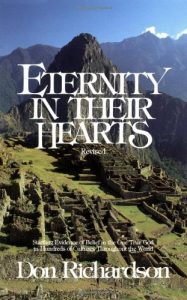
    Eternity in Their Hearts
    This seminal work by Don Richardson documents how various cultures have had historical beliefs and traditions that prepared them for the message of the Gospel, suggesting a divine imprint in diverse societies.​

    Eternity In Their Hearts

    Bruchko
    Bruce Olson narrates his journey into the jungles of South America, where he encountered the Motilone Indians. Remarkably, he found that their legends and beliefs had parallels to biblical truths, which facilitated their acceptance of the Gospel.​

    Bruchko

    The Peace Child
    In this book, Don Richardson recounts his mission to the Sawi people of New Guinea. He discovered that their cultural concept of a ‘peace child’ provided a redemptive analogy to explain the sacrificial role of Jesus Christ.​

    Peace Child

    Dreams and Visions: Is Jesus Awakening the Muslim World?
    Tom Doyle shares numerous accounts of Muslims who, without prior knowledge of the Gospel, experienced dreams and visions of Jesus, leading them to seek out Christian teachings and ultimately embrace the faith.​

    Dreams and Visions: Is Jesus Awakening the Muslim World?

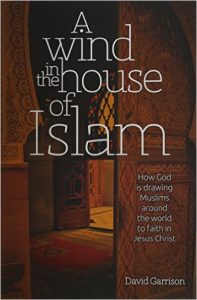
    A Wind in the House of Islam
    David Garrison explores how God is stirring movements toward Christ within the Muslim world, often through supernatural encounters and revelations among those who had never heard the Gospel.​

    A Wind in the House of Islam


    These accounts underscore the belief that God’s revelation is not confined to traditional means but can manifest uniquely across different cultures and contexts.

    A Note:

    Many conservative preachers are adamant that Prevenient Grace is not biblical because they simplistically hold to an exclusive view of verses such as:

    John 14:6 Jesus said to him, “I am the way, and the truth, and the life. No one comes to the Father except through me.

    Yet this is too dogmatic and exact words and a shallow interpretation.

    If God has and does save people that have never heard the gospel, through special revelation, who are we to say that He does not, and the Bible forbids it.

    There is also a command in Scripture, not to judge those that you do not know, this would include those that have never heard, and say that they WILL go to hell.

    How do they know what God has said to them, and how they have responded.

    Rom 14:4 Who are you to pass judgment on the servant of another? It is before his own mastera that he stands or falls. And he will be upheld, for the Lord is able to make him stand.


  • Gospel Message

    God Calls Everyone To Apologise


    God is completely holy and pure, without even the slightest shade of wrong/evil/sin in Himself.

    God is the Originator of purity, love, patience, honesty, etc… And that is how He made this world.


    It is not something that God just decided to do, to make things hard for us, it is who He is. He can never be or do anything else. All His laws are there to protect His character and us.

    These things were built into the whole universe, and built into humans when He created them.

    He cannot do anything that contradicts Himself. You could call it the ‘Unchangeable Laws of the Universe.’

    So, the God of the Bible is the Great Creator God of the whole universe, as well as the creator of the smallest part of an atom, which is invisible to us.


    Who Is God? What does the Bible, His Word say?


    The LORD is high above all nations; His glory is above the heavensIsaiah 42:8 

    “For the LORD your God is a consuming firejealous God.” Deuteronomy 4:24

    My name is the LORD! I won’t let idols or humans share my glory and praise. Psalm 113:4

    “Yours, O LORD, is the greatness and the power and the glory and the victory and the majesty, indeed everything that is in the heavens and the earth; Yours is the dominion, O LORD, and You exalt Yourself as head over all1 Chronicles 29:11 And all the angels were standing around the throne …  And they fell before the throne with their faces to the ground and worshiped GodRevelation 7:11

    The Lord said to Job “Where were you when I laid the foundations of the earth? Tell me, if you know so much…But of course, you know all this! For you were born before it was all created, and you are so very experienced!… “Can you direct the movement of the stars— binding the cluster of the Pleiades or loosening the cords of Orion?… Then the LORD said to Job, “Do you still want to argue with the Almighty? You are God’s critic, but do you have the answers?” Then Job replied to the LORD, “I am nothing—how could I ever find the answers? I will cover my mouth with my hand. I have said too much already. I have nothing more to say.”…the Lord said “Will you discredit my justice and condemn me just to prove you are right? Are you as strong as God?… Then Job replied to the LORD: “I know that you can do anything, and no one can stop you. You asked, ‘Who is this that questions my wisdom with such ignorance?’ It is I—and I was talking about things I knew nothing about, things far too wonderful for me… I had only heard about you before, but now I have seen you with my own eyes. I take back everything I said, and I sit in dust and ashes to show my repentance.” Job 38:4,21,31, 40:1-5,8,9, 42:1-6  God blesses those people who depend only on him. They belong to the kingdom of heaven! Matthew 5:3


    Just like Job, most people today, have only heard about God, they have never truly met Him.

    Why do we arrogantly demand answers from the Great God, to our feeble questions? Of course, the big questions we have of universal justice are valid, but not to the point where we can demand that the Almighty Creator God give us an account of His seemingly unjust handling of life.


    God not only owns the universe, but He also owns us too, and all He wants is what belongs to Him. His command is to love and serve Him in return. It can be hard to swallow, but this world is His toy, and He can make it however He likes. If you or I made it, we could set the rules. God says:

    Deut. 6:5 And you must love the LORD your God with all your heart, all your soul, and all your strength. 6 And you must commit yourselves wholeheartedly to these commands that I am giving you today.                    NLT

    God could have taken all the danger out of this life, by making us all obedient robots. But He wanted beings that had ‘choice’ and would choose to love Him. A being something like Himself.


    The things we do wrong/evil/sin, they utterly violate God’s nature and holiness, and again, you could say a violation of the ‘Unchangeable Laws of the Universe’ – the ordered universe He created. These things have separated us from God.

    Even the things we consider ‘little’, like: thinking hateful things about someone; not forgiving someone that hurt us; pride; resentment; white lies; being ungrateful to God, not serving God, ignoring God our Creator. etc… All these things are a violation of the perfect purity, holiness, ownership, and leadership of God. Each time we do them, it is ‘giving the Holy God a slap in the face.


    In the Bible, God says in His Law, that it is wrong to steal, have you ever stolen anything in your life? He also says not to covert things that belong to others. Have you ever had a strong desire to have a friend’s life or stuff? He also says not to use His Name in vain or flippantly. Have you ever blasphemed? God also commands that we honour our mother and father. Did you ever talkback to your mother and father?

    You see how God’s holiness is so much more serious than we have understood it to be. We really need to understand how bad we really are and how far we have fallen from God’s Holiness.

    The Bible tells us how bad:

    Jeremiah 17:9 “The human heart is the most deceitful of all things, and desperately wicked.

    Who really knows how bad it is? 10 But I, the LORD, search all hearts and examine secret motives. I give all people their due rewards, according to what their actions deserve.”

    God knows about everything, and ALL wrong/evil/sin MUST be put right – a time will come when ALL evil MUST be judged or you could say, reconciled to be in harmony with the ‘Unchangeable Laws of the Universe’. This is also when followers of Jesus Christ are rewarded with heaven.

    People wrongly blame God for the things that go wrong, but it is not God’s fault. He made everything perfect, Adam screwed up and we continue to screw up. God CANNOT just come in and make everything nice for us. The order or process of things that God set in motion, must be completed, even though they have been corrupted by Adam and Eve.

    However, God provided a way for all our wrong/sin/evil to be paid for, before the audience of all creation/the universe – before God, mankind, angels, Satan & the demons.

    Of course, that was the crucifixion, death, burial and the resurrection of His Son, Jesus.

    Jesus was the Pure Sacrifice for all evil. No other method could paid for our evil. The Bible says:

    Romans 3:23 Everyone has done and thought wrong things and is far away from God’s saving presence.

    So, ‘being a good person’ and doing good things cannot save us from the penalty of our own wrong behaviour and thoughts, only Jesus can. If all we do in life is be a ‘good’ person and go to church, we are not saved and will not get into to heaven. Which means, we will go to hell:

    Romans 6:23 For the penalty of doing and thinking wrong things is death (hell)

    This is why attending a funeral of a non-Christian troubles me deeply. This is also why my main priority in life is telling people about who God really is. To tell those who never go to church, and to those who do go to church but never properly understood, what it was about. The  misunderstanding of God is common, and is either because the preaching they heard was unclear or it was compromised by traditions of men, and trying to make the Eternal, Unchanging God appear as though He is just a nice, cuddly, teddy bear type god, who could not possibly send anyone to hell.

    Constantly I hear people argue “How can God be like that?” But, one cannot understand the Eternal God by using our standards of expectation and behaviour. He truly is ‘out of this world’ and He tells us who He is and how He rules with the Bible. Expecting Him to abide by our rules, only gives us a wrong view of God. Jesus answered these types of question with “Your mistake is that you don’t know the Scriptures, and you don’t know the power of God.” Mark 12:24.

    The ONLY way to ‘get a ticket to heaven’ is to realise how bad/sinful we really are before a Holy God, and to tell God that we are so sorry for all our wrong/sin/evil, and then to give up our own life, live for Him, and follow Him for the rest of our lives:

    Luke 9:23 Then Jesus said to all the people: If any of you want to be my followers, you must forget about yourself. You must take up your cross every day and follow me. CEV

    Jesus never said ‘Be a good person, do good works, and you will be with me in heaven.’

    No, this is what Jesus said about being forgiven:

    Luke 18:9 Then Jesus told this story to some who had great confidence in their own righteousness and scorned everyone else: 10 “Two men went to the Temple to pray. One was a Pharisee, and the other was a despised tax collector. 11 The Pharisee stood by himself and prayed this prayer: ‘I thank you, God, that I am not a sinner like everyone else. For I don’t cheat, I don’t sin, and I don’t commit adultery. I’m certainly not like that tax collector! 12 I fast twice a week, and I give you a tenth of my income.’

    13 “But the tax collector stood at a distance and dared not even lift his eyes to heaven as he prayed. Instead, he beat his chest in sorrow, saying, ‘O God, be merciful to me, for I am a sinner.’ 14 I tell you, this sinner, not the Pharisee, returned home justified before God. For those who exalt themselves will be humbled, and those who humble themselves will be exalted.”    NLB

    The Pharisee in this story does not do the so-called ‘bad sins’ yet he was not forgiven by God.

    The tax collector did do ‘bad sins’ but was forgiven by God, because he truly apologised.

    It is a humbling thing to admit we have been wrong/sinful/evil and to surrender our lives totally to God. But we must if we want God to forgive us of that wrong and save us from hell – the consequences of our wrong living. We must come to God humble and helpless. Jesus said:

    Matthew 18:2Jesus called a little child to him and put the child among them. 3 Then he said, “I tell you the truth, unless you turn from your sins and become like little children, you will never get into the Kingdom of Heaven.                           NLB

    Just doing good things for God will not save us:

    Ephesians 2:8God saved you as a gift when you believed. And you can’t take credit for this; it is a gift from God. 9 Salvation is not a reward for the good things we have done, so none of us can boast about it.

    So, we are forgiven when we confess our sins, repent and believe. Not by the ‘good works’ we do for others. We cannot be saved by doing ‘good works’ for God either. We must confess (admit our own personal evil), repent (change our ways) and believe (in the Bible, this word means ‘to believe who God is and to live for God’. It means doing what you believed) in God.

    1Peter 3:15  Honour Christ and let him be the Lord of your life.

    In other words; Jesus Christ becomes the boss of your life. We are then to live the way the Bible instructs – live for God, reading the Bible, praying daily and calling others to apologise to God as well.


    ~~~~~~~~~~~~~~~~~~~~~~~~~~~~~~~~~~~~~~~~~~~~~~~~~~~~~~

    You can read a Bible here, start with the book of Mark: https://bib1e0264.live-website.com/bit.ly/3j1cmbe or https://www.sermoncentral.com/bible/new-living-translation-nlt/mark-1?passage=Mark+1

    Neil Baulch: 2inview@gmail.com

  • Where Did This Life Come From And Why?

    Overview of the Gospel   16th March 2025

    Where Did This Life Come From And Why?

    Divine Inspiration & Authority of the Bible

    • 2 Timothy 3:16 Every scripture is inspired by God and useful for teaching, for reproof, for correction, and for training in righteousness, 17 that the person dedicated to God may be capable and equipped for every good work.
    • 2 Peter 1:19 Moreover, we possess the prophetic word as an altogether reliable thing. You do well if you pay attention to this as you would to a light shining in a murky place, until the day dawns and the morning star rises in your hearts. 20 Above all, you do well if you recognize this: No prophecy of scripture ever comes about by the prophet’s own imagination, 21 for no prophecy was ever borne of human impulse; rather, men carried along by the Holy Spirit spoke from God.

    Some Proof: God, who dwells outside of time, inspired and dictated to men to write it:

    • The Fall of Babylon (Isaiah 13:19-22, Jeremiah 51:37)
    • Ancient Literature Attestations: Herodotus (Histories 1.191). Josephus (Antiquities 10.11). The Cyrus Cylinder.
    • The Destruction of Tyre (Ezekiel 26)
    • Ancient Literature Attestations: Josephus (Antiquities 11.4.6). Arrian (Anabasis of Alexander 2.19). Plutarch (Life of Alexander 25.3).
    • The Destruction of Nineveh (Nahum 1:8-10, Zephaniah 2:13-15)
    • Ancient Literature Attestations:  Herodotus (Histories 1.106).  Diodorus Siculus (Bibliotheca historica 2.25). Josephus (Antiquities 10.2).
    • The Fall of Jerusalem (Jeremiah 25:9-12, 2 Kings 25:1-21)
    • Ancient Literature Attestations:  Babylonian Chronicle. Josephus (Antiquities 10.9.7).
    • The Return from Exile and the Rebuilding of the Temple (Isaiah 44:28, 45:1; Ezra 1:1-4) Ancient Literature Attestations:  Cyrus Cylinder. Herodotus (Histories 1.214).
    • The Coming of the Messiah and the Destruction of Jerusalem (Daniel 9:24-27, Matthew 24:2)
    • Ancient Literature Attestations:  Josephus (Wars of the Jews 6.4). Tacitus (Histories 5.13)

    There are many more.


    Who Is God?

    The Supreme Holiness and Unquestionable Sovereignty of God

    God, the First Cause and Creator of all that exists, is a being of infinite power and majesty. His creative act was utterly perfect—He fashioned the cosmos without error or flaw. As the source of life, wisdom, and all beauty, He stands far above all created things. Our finite minds can barely grasp His glory, and our very existence is a testament to His sovereign design.

    In this light, the notion of complaining, showing partiality or presuming to correct God is not only misplaced—it is a direct affront to His holiness and authority.

    Because God is infinitely above us—our Creator, Sustainer, and the very source of life itself—the only rational response is total surrender.

    He had every right to create exactly as He pleased, establishing a universe that is the embodiment of order, beauty, and perfection.

    God Wants More Family So Free Will Is Essential

    God wanted a bigger family. He did not want pets, and certainly not robots, but beings that have free choice to love Him. Maybe you could say that God did, make His ‘imaginary friends’. We were created in His Image, to be like Christ. Hence, people like God and family for God

    So, in His divine wisdom, He chose to bestow upon humanity the precious gift of free will. This was a great risk, for His creation may reject Him, however, if His creation was to genuinely ‘love’ Him, they MUST have free will.

    Our freedom of choice, brings great responsibility. Because God is not only loving, He is totally holy and just. All sin (wrong actions, attitudes and thoughts) demands justice, that will rightfully, put us in hell, a place of God’s judgment.

    We did sin (wrong actions, attitudes or thoughts) and the Consequence of Sin: Isaiah 59:2 But your sinful acts have alienated you from your God…

    God Provides A Way And A Sacrifice To Redeem Humans

    Jesus, His Son, a member of the Trinity, God Himself.


    The Plan of Redemption: Covenants with Abraham

    God creates a way to send His Saviour.

    • The Abrahamic Covenant
      • Genesis 12: 1 Now the Lord said to Abram, “Go out from your country, your relatives, and your father’s household to the land that I will show you. 2 Then I will make you into a great nation, and I will bless you, and I will make your name great, so that you will exemplify divine blessing. 3 I will bless those who bless you, but the one who treats you lightly I must curse, and all the families of the earth will bless one another by your name.     (With an animal sacrifice pointing the Jesus, and covenant.)
      • Genesis 15:6 Abram believed the LORD, and the LORD credited it as righteousness to him.
    • A World Plan of Redemption
      • Galatians 3: 8 And the scripture, foreseeing that God would justify the Gentiles by faith, proclaimed the gospel to Abraham ahead of time, saying, “All the nations will be blessed in you.” 9 So then those who believe are blessed along with Abraham the believer.

    God Covenants With Israel – The Mosaic law

    Romans 7:12 So then, the law is holy, and the commandment is holy, righteous, and good.

    God greatly reveals Himself is a new way with the Law given to Moses.

    Animal sacrifices are a type of Christ who was to be the Sacrificial Lamb of God for sin. To pay for sin, and to satisfy the wrath of God against all sin and violations against Him and His Nature.

    Understood Through ‘Types or Shadows’

    The Law given to Israel had three main categories: Moral Law (absolute commands like the Ten Commandments, reflecting God’s holiness), Civil Law (governing Israel as a nation), and Ceremonial Law (sacrificial and ritual laws pointing to Christ). The Tabernacle was God’s dwelling place among His people and was filled with types and symbols of Christ: the Brazen Altar (His atoning sacrifice), the Laver (spiritual cleansing), the Lampstand (Christ as the Light), the Table of Showbread (Christ as the Bread of Life), and the Ark of the Covenant (God’s presence and Christ’s fulfillment of the Law). The veil symbolized separation from God, which Christ tore down at His death (Matthew 27:51). Altogether, the Law and Tabernacle foreshadowed Christ’s work, revealing the way to holiness, atonement, and restored fellowship with God.

    Sacrifices foreshadowed Christ's Sacrifice


    Messiah/Savior – Jesus Christ

    Both fully God and fully human. Two natures. 

    • God in Person
    • Colossians 2:9 For in him the whole fullness of deity dwells bodily.
    • Man in power
    • Philippians 2:6-8 – “Who, being in the form of God, thought it not  robbery to be equal with God: But made himself of no reputation, and took upon him the form of a servant, and was made in the likeness of men.”

    The perfect, sinless Sacrifice. 

    • Hebrews 4:15For we have not an high priest which cannot be touched with the feeling of our infirmities; but was in all points tempted like as we are, yet without sin.
    • John 1:29 Behold the Lamb of God, which taketh away the sin of the world.

    How To Be Saved

    • Romans 2:38And Peter said to them, “Repent and be baptized every one of you in the name of Jesus Christ for the forgiveness of your sins, and you will receive the gift of the Holy Spirit.
    • Acts 16:31And they said, “Believe in the Lord Jesus, and you will be saved, you and your household.”    (believe = believe and live it for life.)
    • Ephesians 2:8For by grace you have been saved through faith. And this is not your own doing; it is the gift of God.

    We Are Now Servants Of God To Not Only Be Like Christ But To Do The Work Of Christ

    •        Ephesians 2:10 For we are his workmanship, created in Christ Jesus for good works, which God prepared beforehand, that we should walk in them.
    •       Romans 12:11 Do not be slothful in zeal, be fervent in spirit, serve the Lord.

    Assured of Salvation – Trust God Without Doubting

    Romans 8:1There is therefore now no condemnation for those who are in Christ Jesus.


    God Provides the Help We Need to Live for Him – The Holy Spirit

    Indwelling & Empowering Believers

    • John 14:16 Then I will ask the Father, and He will give you another Advocate to be with you forever  17 the Spirit of truth, whom the world cannot accept, because it does not see him or know him. But you know him, because he resides with you and will be in you.
    • Acts 2:38 Peter said to them, “Repent, and each one of you be baptized in the name of Jesus Christ for the forgiveness of your sins, and you will receive the gift of the Holy Spirit.

    For Personal Transformation and Sanctification

    Romans 8:You, however, are not in the flesh but in the Spirit, if indeed the Spirit of God lives in you. Now if anyone does not have the Spirit of Christ, this person does not belong to him. 10 But if Christ is in you, your body is dead because of sin, but the Spirit is your life because of righteousness. 11 Moreover if the Spirit of the one who raised Jesus from the dead lives in you, the one who raised Christ from the dead will also make your mortal bodies alive through his Spirit who lives in you

    The Mission: The Great Commission

    Matthew 28:18 Then Jesus came to them and said, “All authority in heaven and on earth has been given to Me. 19 Therefore go and make disciples of all nations, baptizing them in the name of the Father and of the Son and of the Holy Spirit, 20 and teaching them to obey all that I have commanded you. And surely I am with you always, even to the end of the age.”

    Why Bring In Others? Back To God’s Original Plan

    God wanted a bigger family. He did not want pets, and certainly not robots. The masses are created beings that had free choice, to love Him. They were created in His Image, to be like Christ, and reconciled to Him forever.

    We must always maintain a Kingdom perspective. Jesus is everything.


    When Is Jesus Coming Back To Take Us To The Father?

    We Are To Do The Work Of The Kingdom Of God Until Jesus Comes Again

    • Luke 19:13And he summoned ten of his slaves, gave them ten minas, and said to them, ‘Do business with these until I come back.’
    • Matthew 25:14For it will be like a man going on a journey, who called his servants and entrusted to them his property. 15 To one he gave five talents, to another two, to another one, to each according to his ability. Then he went away.   (Everything we have, and are, belong to God.)
    • Luke 18:8I tell you, he will give justice to them speedily. Nevertheless, when the Son of Man comes, will he find faith on earth?”

    End Times Are Here – What Was Predicted?

    Before Christ returns, a great deception will lead many astray, resulting in a falling away from the faith (2 Thess. 2:3), while the world plunges into the Great Tribulation (Matt. 24:21). But at the appointed time, Jesus will rapture, will gather true believers to Himself (1 Thess. 4:16-17), and He will return in power to judge the wicked, save Israel, and establish His kingdom reign (Rev. 19:11-16) for 1,000 years of peace (Mat 24:30) and finally oversee the Great Judgment (Rev 20:11-15) where those who rejected Him  are condemned to hell, but the righteous enter eternity in heaven with Him.

    Matthew 24:30Then will appear in heaven the sign of the Son of Man, and then all the tribes of the earth will mourn, and they will see the Son of Man coming on the clouds of heaven with power and great glory. Followed by a 1000 years of peace with Jesus Christ as King and Ruler.

    Our Great Hope – Being Like Christ, Living As Family With The Father

    Revelation 21:1Then I saw a new heaven and a new earth, for the first heaven and earth had passed away, and the sea was no more. 2 I saw the holy city, the new Jerusalem, coming down out of heaven from God, prepared as a bride adorned for her husband. 3 And I heard a loud voice from the throne saying: “Behold, the dwelling place of God is with man, and He will dwell with them. They will be His people, and God Himself will be with them as their God. 4 ‘He will wipe away every tear from their eyes,’ and there will be no more death or mourning or crying or pain, for the former things have passed away.”


  • Holiness of God

    Communion 2nd March 2025

    Holiness of God

    Why Holiness? Why is holiness so important?

    Sometimes we imagine that ‘holiness’ was thought up by God, just to have some hard rules, like He made up all these important sounding rules for the sake of having a more formal religion.

    But no, God created the universe and mankind, out of Himself, out of His very nature and being. The eternal laws that govern heaven, also govern the creation of everything.

    God is love. God is holiness. And this Being who is Holiness, created all things, including mankind, the pinnacle of all of His creation.

    All the governing laws and principles were automatically built into all of creation.

    Holiness is a key of life, not just our spiritual life. All people will come to realise that at judgment, if they have not before then.

    Now, in taking communion, we receive an impartation or a transference, of the life of Christ, when we take it in devotion and faith. It’s not just a memorial practice. It’s a dynamic act.

    But, if we are knowingly sinning, if there is an area of sin in our life that we will not change, then the opposite is true:

    1 Corinthians 11:29 ‘For anyone who eats and drinks without discerning the body, eats and drinks judgment on himself.

    So, for humans, for us, if we choose not to be holy (to rid ourselves of known sin) it is actually, an act of rebellion against God. And in fact, it is to rebel against all creation.

    Even worse, it is to agree and align oneself with the Enemy. The first & greatest rebel, and arch enemy of God.

    The writer of Hebrews is very serious about sin and holiness too:

    Hebrews 12:4 In your struggle against sin you have not yet resisted to the point of shedding your blood.

    The writer means taking sin very seriously, and removing it out of your life.

    Yet, Jesus DID give His Blood, in His fight against our sin.

    Hence, not only in the OT, but also in the NT we are commanded to ‘be holy even as the Lord is holy.’

    1 Peter 1:15 but as he who called you is holy, you also be holy in all your conduct, 16 since it is written, “You shall be holy, for I am holy.”

    And part of being holy unto the Lord, is to hate sin with a passion as God does:

    Jude 1:23 save others by snatching them out of the fire; to others show mercy with fear, hating even the garment stained by the flesh. ESV

    NLT: hating the sins that contaminate their lives.

    CEV: But hate even the clothes of those who have been made dirty by their filthy deeds.

    It is a choice on our part. A choice to passionately hate sin, and, an earnest desire and commitment to be truly be holy.

    We must count the cost of following Christ; it means giving up all sin, all things the Bible says are wrong.

    But having highlighted God’s hatred of sin, and His command for us to be holy, God also provided the power for us to be holy, to defeat persistent sin in our lives:

    John 16:8 And when he (the Holy Spirit) comes, he will convict the world concerning sin and righteousness and judgment:

    Rom 8:10 But if Christ is in you, although the body is dead because of sin, the Spirit is life because of righteousness. 11 If the Spirit of him who raised Jesus from the dead dwells in you, he who raised Christ Jesus from the dead will also give life to your mortal bodies through his Spirit who dwells in you.

    At the Lord’s Table, we receive an impartation or a transference, of the life and power of Christ in taking communion, when we take it in devotion and faith. It sharpens our conscience of sin, and empowers us to live holy.

    1Cor 11:23 …the Lord Jesus on the night when he was betrayed took bread, 24 and when he had given thanks, he broke it, and said, “This is my body, which is for you. Do this in remembrance of me.” 25 In the same way also he took the cup, after supper, saying, “This cup is the new covenant in my blood. Do this, as often as you drink it, in remembrance of me.” 26 For as often as you eat this bread and drink the cup, you proclaim the Lord’s death until he comes.


  • Do We Realize Just How Much God Hates Sin?

    Communion January 26th 2025

    Do We Realize Just How Much God Hates Sin, The Wrong We Do, Think and Say?

    Think about the utter purity of God, nothing that even hints of any wrong in Him.

    I sometimes talk about the ‘beauty of His Holiness’. When you really think about it, what we consider ‘beautiful’ – a very beautiful woman, or a lovely act of caring for someone very needy, the beauty of His Holiness far, far surpasses any of that. Oh the Holiness of God.

    It is a true Kingdom perspective of God, ‘not of this world.’

    – How does this Holiness of God demand He feel about sin? Utter, utter revulsion and hatred.

    – What does this Holiness of God demand He do about sin? Either judge all who had sinned with great wrath for evilness, He MUST, or send a Perfect Sacrifice to pay and SUFFER for it.

    Those who see God as only a ‘loving’ God, and that Jesus just went around loving people, without clearly seeing the other side of His great hate for what is evil, does not truly know the God of the Bible.

    His wrath, hatred and fury on the sinner, will be clearly seen at the end on Judgment Day, but until then, He patiently holds back His fury.

    ONE SACRIFICIAL LAMB COULD NOT EVEN DEMONSTRATE WHAT GOD WOULD DO, TO THE PERFECT SACRIFICE HE WOULD SEND TO EARTH:

    Day of Atonement – Lev 16

    2 goats/lambs to picture what would happen to the Lamb of God – one killed, blood sacrifice; second, the ‘scapegoat’ the ‘living sacrifice’ was pushed out into the wilderness to suffer the fury of wild animals.

    NOTICE THE WRATH OF GOD ON JESUS THE SACRIFICE FOR OUR SIN:

    Isa 53:4 Surely he has borne our griefs and carried our sorrows;
    yet we esteemed him stricken, smitten by God, and afflicted.
    5 But he was pierced for our transgressions;
    he was crushed for our iniquities;
    upon him was the chastisement that brought us peace,
    and with his wounds we are healed…
    Yet it was the will of the Lord to crush him; he has put him to grief
    when his soul makes an offering for guilt…

    Rom 5:9 Since, therefore, we have now been justified by his blood, much more shall we be saved by him from the wrath of God.

    John 3:36 says whoever believes in the son has eternal life but whoever rejects the sun will not see life for God’s wrath remains on him.

    Grandpa’s story – missionaries overseas in the 1920’s. 100 years ago.

    Think on that, as we take the Bread & Cup – Jesus was not only was the Spotless Lamb sacrifice (the expiation for us); He was also the Scapegoat (the propitiation for us- to appease God’s wrath. Turning away God’s wrath by providing a substitute punishment) on which the Father had to vent His full fury and wrath, that we might be spared.

    1Cor 11: 23 …the Lord Jesus on the night when he was betrayed took bread, 24 and when he had given thanks, he broke it, and said, “This is my body, which is for you. Do this in remembrance of me.” 25 In the same way also he took the cup, after supper, saying, “This cup is the new covenant in my blood. Do this, as often as you drink it, in remembrance of me.” 26 For as often as you eat this bread and drink the cup, you proclaim the Lord’s death until he comes.