Jesus Was Not “Nice”—and That Was the Father’s Wisdom
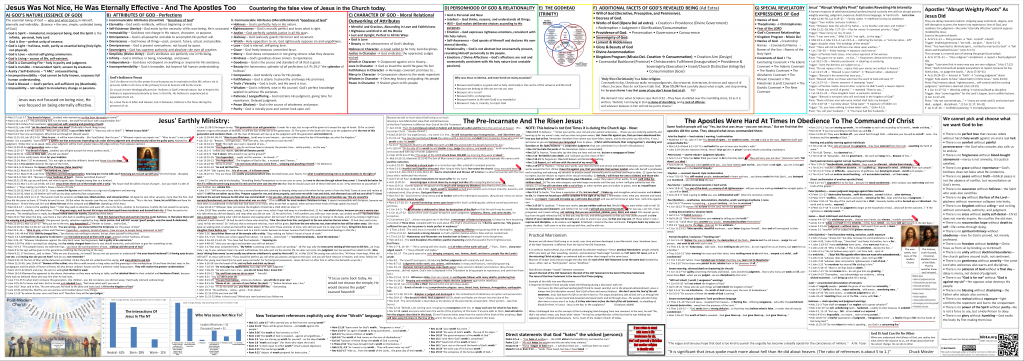
Modern Western culture treats “goodness” as niceness: affirmation without friction, gentleness without authority, compassion without confrontation, inclusion without boundaries, and comfort without cost. It is not surprising that this instinct bleeds into the Church. But the New Testament presents something more bracing: the incarnate Son is not soft, sentimental, or endlessly accommodating. He is holy-love in action—truth-speaking, sin-exposing, warning-giving, boundary-drawing, and mission-driven. Your chart is built to make this collision visible: the “nice-only Jesus” is a cultural reconstruction, while the biblical Jesus is simultaneously tender and severe, because He is obedient to the Father and committed to saving people from real guilt, real judgment, and real hell.
Here also for reference, is a table of all Bible accounts of God taking lives of people in His judgment:

Use Policy: Free for personal and church use. Not for sale or commercial distribution.
How To Use This Chart:
1) Start with the thesis sentence (top title)
Read the title as a two-standard comparison:
-
Modern “nice” standard: conflict-avoidant, non-judgmental, affirming, never sharp.
-
Biblical/kingdom standard: covenantal love that tells the truth, confronts evil, warns of wrath, disciplines sheep, and executes judgment when necessary.
The chart is not trying to make Jesus “mean.” It is trying to show that “niceness” is not the controlling category in Scripture—holiness and saving purpose are. That’s the core interpretive lens your chart wants the reader to adopt.
2) Recognize the chart’s “map”: A–H facets are the controlling framework
This chart is essentially a theology map: it forces the reader to interpret Jesus through your A–H “Greatness of God” facets, rather than through a modern personality-preference grid.
A practical way to say it: the chart is a diagnostic tool—it reveals which facets we welcome and which facets we resist.
And the key rule (embedded in the study logic): Jesus’ severity is not a deviation from divine love; it is often divine love operating as holiness and covenant loyalty.
3) Read it in the intended order (do not “random-walk” the boxes)
Use this reading sequence every time:
-
A–B (Being/Attributes): Who God is (non-negotiable reality)
-
C–D (Character/Relationality): How God morally engages humans
-
E (Trinity): Why Jesus’ hard words are not “against love” but triune love-in-action
-
F–G (Works/Revelation): How God acts in history and speaks covenantally
-
H (Greatness/Doxology): the correct end-state: worship, fear-of-the-LORD realism, and obedience
That flow matters because it prevents this common mistake: treating Jesus’ strong sayings as “personality quirks,” rather than as the outworking of God’s nature, holiness, and redemptive mission.
4) For each facet, do one simple discipline: “Nice + Hard” pairing
The chart is built on a repeated move:
-
Identify a “nice” (pleasant-to-modern-ears) facet-expression (comfort, mercy, welcome, tenderness, patience).
-
Pair it with a “hard” facet-expression that is equally divine (wrath, warning, discipline, exclusion, judgment, “woe,” “cut off,” etc.).
You, the reader must stop treating the hard texts as “embarrassing exceptions.” The study instructions are explicit: force covenantal pairs (love/holiness, mercy/judgment, patience/wrath, peace/division) under each heading.
5) Use the E (Trinity) section as the “logic bridge”
This is where the chart becomes more than a collection of useful prooftexts.
The chart’s Trinitarian point (as your study states it) is:
-
The Father: whose will defines holiness and judgment
-
The Son: who enacts redemption by incarnation, obedience, cross, and lordship
-
The Spirit: who convicts, applies, and empowers covenant life
Therefore, when Jesus confronts sin, warns, disciplines, and judges, those are not contradictions of love—they are the triune God’s covenantal character operating to reconcile people to God.
This prevents a very common reader-response: “That doesn’t sound like love.”
The answer becomes: “It is precisely love, when love is defined by God’s holiness and truth, not by modern therapeutic norms.”
6) Read the “abrupt pivot” lists as method, not trivia
The chart includes lists where Jesus (and then the apostles) make sudden, weighty pivots—tenderness to warning; invitation to threat; affirmation to rebuke.
Don’t treat those as random anecdotes. They function as pattern evidence:
-
Jesus does not merely “comfort.” He diagnoses and exposes.
-
Jesus does not merely “include.” He separates true from false.
-
Jesus does not merely “heal.” He warns about ultimate peril and judgment.
These pivots are a practical demonstration of your pairing-rule: mercy and severity appear in the same Teacher, because they are in the same God.
7) Use the apostles section as the “objection-killer”
This chart anticipates the common dismissal (because it is the normal objection these days):
“Yes, but that was Jesus—you are not Jesus.”
So it shows that the apostolic ministry (under Christ’s command) also includes:
-
sharp rebuke,
-
boundary-making,
-
public warning,
-
discipline/exclusion,
-
and judgment language.
In other words: the “not-nice” dimension is not a one-off “Jesus moment.” It’s part of new-covenant church life under the reign of Christ (by the Spirit).
8) Treat the “not nice actions” material as covenant realism, not shock value
The chart includes episodes of divine discipline/judgment in the NT, use them for one point:
-
God’s covenant is not sentimental.
-
God’s holiness is not rhetorical.
-
God’s church is not a playground.
This reinforces the same conclusion: we don’t get to redefine God by our emotional comfort threshold.
9) Land where the chart lands: the “We cannot pick and choose” box
This is the chart’s intended “so what.”
When you finish reading the facets + pivots + apostolic continuity, the correct conclusion is:
-
You cannot have the “nice” blessings of God while rejecting the “hard” truths of God.
-
You cannot have salvation without holiness, comfort without perseverance, mercy without judgment categories, etc.
The chart is aiming to produce whole-Bible worship and whole-Bible obedience (not a toned-down God who fits modern sensibilities).
10) A practical “how to use it” workflow (personal study or teaching)
Use this repeatable pattern:
-
Pick one facet (A through H).
-
Read the “nice” texts first (so people feel the goodness).
-
Read the “hard” texts second (so people feel the weight).
-
Ask: What does this reveal about God that modern “nice-only” filters would suppress?
-
Ask: How does this severity serve redemption (repentance, purity, truth, protection, reality)?
-
End with one obedience application (repent, endure, forgive, warn, separate, worship, fear God rightly).
===================================================
What “Not Nice” Means (and Does Not Mean)
To say Jesus was “not nice” is not to accuse Him of sinful harshness, irritability, or cruelty. Scripture never presents Christ as morally uncontrolled. Rather, it shows that perfect love does not equal perpetual softness. Jesus’ words and actions routinely refuse the modern demand that love must feel soothing to the recipient. Instead, His love is morally serious: it tells the truth, confronts self-deception, threatens false peace, disciplines sin, and warns of the coming reckoning.
Jesus’ apparent “hardness” is not a personality quirk. It is the necessary shape of obedience to the Father’s redemptive purpose.
The Chart’s Core Thesis: You Cannot Have the “Nice Facets” Without the “Hard Facets”
A central strength of this chart is that it refuses to treat “severity” as an embarrassing anomaly. Instead, it organizes the data under A–H facets of God, showing that what many modern Christians call “not nice” is actually woven into God’s revealed being and saving action:
-
A) God’s Nature (Essence): If God is truly holy and sovereign, He is not a mascot for human preferences. Holiness includes opposition to evil, and sovereignty includes judgment.
-
B) Attributes (Perfections): Love is real—but so are justice, wrath, and truth.
-
C) Character (Moral-relational outworking): Covenant mercy does not abolish covenant discipline.
-
D) Personhood & Relationality: God relates personally—meaning He comforts, but also rebukes, grieves, warns, and corrects.
-
E) The Godhead (Trinity): Father, Son, and Spirit are not divided into “nice” and “hard” roles; the one God acts in unified holiness.
-
F) Ad Extra facets (God’s actions outward): Providence, government, and covenant administration include both rescue and judgment.
-
G) Special revelatory expressions: Signs, miracles, and prophetic confrontations often intensify accountability rather than reduce it.
-
H) Greatness of God: God’s “bigness” is not only comforting; it is also terrifying to the unrepentant and humbling to the proud.
This is the theological engine of the conclusion panel: we cannot pick and choose what we want God to be. The chart explicitly pairs “pleasant” outcomes (peace, assurance, freedom, intimacy) with the “hard” realities that make them true (truth, holiness, lordship, discipline, reverent fear, final judgment).
The “Modern Jesus vs Biblical Jesus” Contrast
This chart includes an intentionally provocative comparison box: “Biblical Jesus” warns of judgment and hell, gives salvation, joy and hope, demands self-denial, and preaches the holiness of God; “Modern Jesus” avoids negativity, offers positive reinforcement, encourages self-love, and preaches only love. That contrast is not merely rhetorical—it diagnoses a real catechesis problem: many churchgoers are being trained to interpret any strong biblical note as “un-Christlike,” even when the strong note is the voice of Christ Himself.
Related to that, the chart includes a small “interactions” graphic that portrays a meaningful portion of Jesus’ engagements as “stern,” reinforcing the point that firmness is not rare in His ministry. (Even if one debates the precise percentages, and you may do what I did-read slowly through the gospel accounts and make careful not of every interaction of Jesus and what it was like, the direction is undeniable: the Gospels are not a long therapeutic affirmation session.)
Why Jesus’ Severity Is Actually Saving Love
If you remove judgment from the gospel, the cross becomes confusing. But if judgment is real, then Jesus’ warnings become mercy. Strong speech is often preventive medicine: it aims to wake the sleeping, humble the proud, and rescue the self-deceived before it is too late.
That is why the New Testament can hold together what modern taste tries to separate: Jesus can be gentle with bruised reeds and simultaneously thunder “woe” at hypocritical leadership; He can welcome sinners and also command, “go and sin no more”; He can promise rest and also demand total allegiance. The same Christ who invites the weary also tells the complacent that the gate is narrow and the road is hard.
This chart’s deeper theological instinct here is: “nice” love that refuses to warn is not love. It is sentimental negligence.
The Apostles Continued the Pattern—Because They Obeyed Christ
An important point on this chart is that it blocks the common evasion: “Well, Jesus could say hard things because He is Jesus; we must only be gentle.” I have specifically added a table of apostolic examples showing that the early Church—under the authority of Christ and the power of the Spirit—also employed severe warnings, public rebukes, and formal discipline when required.
A catalog examples ranging from John the Baptist’s confrontational preaching, to Peter’s severe exposure of deceit, to Paul’s anathemas and exclusions, to Hebrews’ sobering apostasy warnings. The point is not that apostles were temperamentally abrasive; it is that the risen Christ governs His Church through truth, correction, and discipline as well as comfort.
“Eternally Effective”: Why This Matters for the Plan of Salvation
In the Father’s plan, salvation is not merely emotional relief; it is deliverance from sin’s guilt and power, reconciliation to God, and preparation for a holy kingdom. That requires a Savior who does more than soothe. It requires a Savior who:
-
names sin as sin,
-
exposes false religion,
-
confronts self-deception,
-
warns of consequences,
-
calls for repentance and faith,
-
and shepherds His people into holiness.
In other words, Jesus’ “hard edges” are not an unfortunate overlay on His love; they are one mode of His love when the stakes are eternal. If hell is real, then warnings are kind. If holiness is required, then discipline is merciful. If truth matters, then doctrinal boundaries are loving. The chart’s repeated pairings (peace/truth, assurance/holiness, freedom/lordship, unity/doctrinal boundaries, gentleness/severity) are not rhetorical tricks—they are theological realities.
Summary: The Whole Christ for the Whole Church
This chart, taken as a whole, argues that the modern Church often builds a “fence” around the acceptable attributes of God—welcoming comfort, affirmation, and sentimental love, while treating warning, wrath, discipline, and fear of the Lord as spiritually inappropriate. But Scripture will not allow that partition. The biblical Jesus is not “nice” by modern standards because modern standards are often calibrated to protect human pride, not to magnify divine holiness.
The invitation at the end of this chart is straightforward and urgent: recover the full Christ—the Christ whose mercy is real because His judgments are real; whose comfort is true because His call to repentance is true; whose grace is glorious because His holiness is unyielding. That Christ is not always “nice,” but He is always good—and He is eternally effective in accomplishing everything the Father sent Him to do.