Jesus and the Greatness of God (A–H)
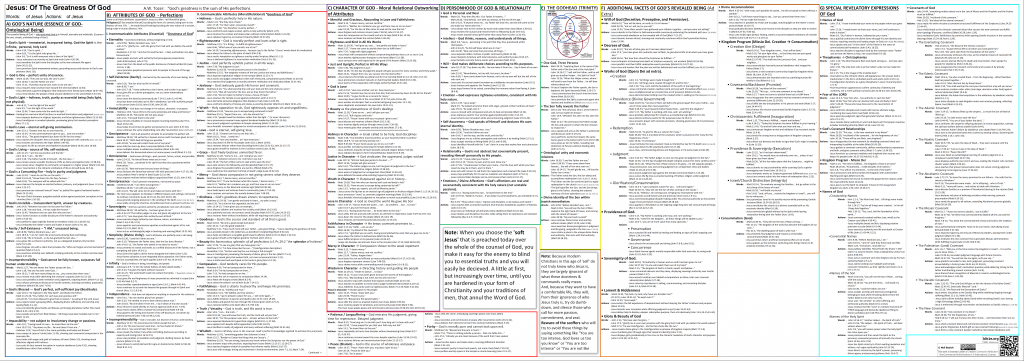
This chart study is framed as a necessary follow-up to the Greatness-of-God work: if we have learned to embrace God’s fullness (including holiness, wrath, judgment, discipline, and fear-of-the-LORD), then we must ask how Jesus—God’s climactic self-revelation—actually lived and spoke in history. The study states the concern plainly: the modern Christian imagination often reduces Jesus to “all love and warmth,” and therefore misreads (or filters out) the parts of the New Testament that present His severity as holy, purposeful, and redemptive.
Use Policy: Free for personal and church use. Not for sale or commercial distribution.
1) The controlling premise: Jesus doesn’t merely “resemble” God—He makes God known
The most important methodological move in this study is this: I am not building an argument from temperament (“Jesus is like God”) but from revelation (“Jesus interprets God to us”). The document anchors this logic in the New Testament’s explicit claim that the Son is the decisive disclosure of the Father, with John 1:18 functioning as a programmatic control text: the Son “has made him known” (ἐξηγήσατο / exēgēsato)—not merely reporting information, but rendering God intelligible in covenant encounter.
That means the Greatness-of-God facets (A–H) are not an abstract theology “behind” Jesus. They are the very reality that stands in front of us in Jesus’s words, actions, priorities, warnings, mercies, and judgments. In the A-section framing, the goal is to establish that Jesus is “the definitive self-revelation of God… the God-man in whom the fullness of deity dwells,” and therefore the historical disclosure of what God is in Himself.
2) A–H as a Christ-centered map: the Son reveals God “from the inside out”
The categories are especially useful because they prevent a common modern mistake: treating God’s “nice” traits as His true identity and His “hard” traits as exceptions. The A–H scaffolding forces a whole-God reading, and then the study asks: where does Jesus sit in each facet?
Below is a synthesis of the study’s thrust—what the chart is doing conceptually—rather than a reprint of every cell.
A) God’s Nature (Essence / Ontological Being): Jesus makes the invisible God knowable
Facet A is the foundation. If Jesus is not truly God, the rest of the mapping becomes moralism. But if He is God’s self-revelation, then His tenderness and severity are not competing moods; they are the manifestation of divine reality in human history.
This study treats John 1:18 as decisive: “No one has ever seen God… he has made him known,” with “made known” carrying interpretive force (exēgēsato).
In other words: the Jesus we meet in the Gospels and preached in the apostolic witness is the public disclosure of God’s being.
Implication: we cannot appeal to an imagined “God behind Jesus” who is kinder than Jesus’s actual speech and actions. Jesus is the interpretive disclosure of God.
B) Attributes (Perfections): divine greatness shows up as authority, knowledge, holiness, and rule
The chart’s logic here is straightforward: if divine attributes are real, they will appear as divine prerogatives and divine capacities in Christ’s words and works.
A key example the study highlights is Jesus’s divine-name speech (“I AM”): “before Abraham was, I am,” and the arrest narrative where His “I am” causes the party to draw back and fall—functioning as revelatory self-disclosure, not casual self-identification.
The point is not merely preexistence; it is the intersection of divine identity with history as a speaking subject.
Implication: attributes like eternity, sovereignty, and holiness do not produce a soft deity. They produce worship, fear-of-the-LORD sobriety, and accountability.
C) Character (Moral-relational outworking): disciplining love and covenant faithfulness are still love
The study repeatedly treats “hardness” not as cruelty but as covenantal moral seriousness. Divine love is not sentimental permissiveness; it is holy love that protects truth, corrects self-deception, and calls people into reality.
That is why—within the charting logic—Christ’s sharp warnings, boundary-making, and exposure of hypocrisy belong here: they are not detours from love, but expressions of love ordered by holiness.
D) Personhood & Relationality: the personal God is not a force, and Jesus’s ministry is not mood-management
This section is one of the most pastorally pointed. The study argues that if God is treated as an impersonal force, worship becomes emotional technique and prayer becomes self-talk; likewise, if the Spirit is treated as a force, holiness becomes technique and “power” becomes the point.
Against this, the study emphasizes that Jesus reveals personal divine life:
-
God as personal Father, approached and known
-
Jesus as personal Son, who obeys, loves, confronts, weeps, rejoices, and intercedes
-
The Spirit as personal Helper, who teaches, guides, speaks, and testifies
Implication: Jesus’s “hard sayings” are not a failure of empathy; they are personal, covenantal speech addressed to real moral agents.
E) The Godhead (Trinity): Jesus reveals God as triune communion, not a solitary deity
The study anchors Trinity not in abstract speculation but in liturgy and narrative.
-
Matthew 28:19: one singular “name” with three personal referents (“of the Father and of the Son and of the Holy Spirit”), signaling unity of divine identity with real personal distinction.
-
Jesus’s baptism (Matt 3:16–17): Son in the water, Spirit descending, Father speaking—simultaneous presence that rules out modalism in a face-value reading.
Implication: the “niceness-only” collapse often treats God as a single approving voice. Trinitarian revelation restores holy authority, saving purpose, and personal communion.
F) Ad Extra works (Kingdom, judgment, mission): “hard” moments often function as eternal effectiveness
One of the clearest “chart-summary” insights appears in my mapping notes: hardness clusters around works/kingdom/judgment themes—authority, mission-priority, and eschatological accountability.
This is critical: Jesus’s severity frequently does something constructive—awakens repentance, exposes hypocrisy, forces decision, guards the covenant community, preserves the mission.
Implication: a Jesus who never confronts, never warns, never disciplines is not “more loving”—He is less salvific, because He will not do what holiness and truth require to rescue.
G) Special revelatory expressions: the “Name” and the fear-of-the-LORD dynamic are restored in Christ
The study develops “Name theology” as covenant disclosure: Jesus does not merely pronounce God’s name; He makes it known—the revelatory content of who God is encountered in covenant reality.
Then it shows how divine-name disclosures concentrate in Jesus, especially in the “I AM” identifications and the “I am” predicate sayings (light, shepherd, resurrection, way/truth/life, vine).
Implication: if Christ restores God’s Name, He also restores the appropriate response to God’s presence—trust, worship, obedience, and (when necessary) fear-of-the-LORD sobriety.
H) Greatness: not a single attribute, but a synthetic term that gathers all perfections into doxology
Facet H is the summit: “greatness” is not one trait among others, but a term that gathers being, attributes, and works into praise-evoking supremacy.
The study stresses the key NT move: Jesus is presented as the locus where God’s greatness becomes visible in history and divine greatness is ascribed to Him directly.
It then highlights explicit “great” titles clustered around Jesus (e.g., Titus 2:13; Heb 4:14; Heb 13:20) as part of this doxological climax.
Implication: if greatness is doxological majesty, then “purifying judgment” and holy authority are not embarrassments to be edited out; they are part of what makes God God.
What the chart is doing, in one sentence
It is mapping Jesus’s words and actions across A–H so that modern believers cannot keep “nice Jesus” while discarding the Jesus who warns, confronts, judges, disciplines, and demands repentance—because those “hard” elements are not contradictions of divine love; they are expressions of divine holiness accomplishing divine salvation.
A brief summary (takeaways)
-
Jesus is the definitive disclosure of God, not a soft alternative to the Father.
-
Trinitarian reality (Father, Son, Spirit) anchors both intimacy and authority; it rejects “God as a single approving vibe.”
-
Divine-name revelation (“I AM”) restores the weight of God’s presence—comforting to the faithful, terrifying to the self-deceived.
-
Severity is often missionally and covenantally functional—clustered around kingdom/judgment accountability and protection of the covenant community.
-
Greatness (H) gathers everything into worship, including holiness and judgment as part of God’s praise-worthy supremacy.
And the closing pastoral note: upsetting people is not automatically proof of wrongdoing; the real test is fidelity to Scripture and the Spirit’s conviction—not “traditions of men” that select only the agreeable parts of God.