A chart studying revealing a greater Kingdom Perspective on all things, after having done an in-depth study of God.
Downloads – PDF
Download – .PNG Image
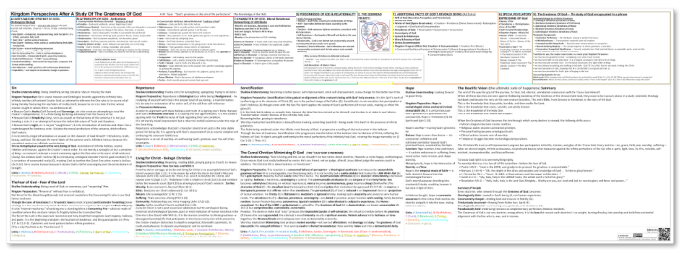
If you find some of the words a bit too technical and hard to understand, I have placed a Glossary at the bottom of this post or you can download this PDF: Technical-Terms
Re-Interpreting Christian Doctrines & Concepts Through the Lens of the Greatness of God
When the knowledge of the true God—the God who is infinite, holy, self-existent, simple, sovereign, and eternally blessed—recaptures the heart, every doctrine is rescued from being a mere religious category and becomes a thunderclap of eternal weight. Suddenly everything is seen as it truly is: a relation to the uncreated I AM, whose very Being is the only absolute standard of all reality.
This is a profound shift in perspective. When theology moves from being anthropocentric (man-centered) to theocentric (God-centered), every doctrine changes texture. It ceases to be about “my benefits” and becomes about “His Glory.”
Each item is a doctrine that, when analysed against the infinite majesty, holiness, simplicity, sovereignty, triune life, and creator–creature distinction of God, becomes far more serious, weighty, and qualitatively different from how most Christians ordinarily think.
This chart contains just 7 doctrines or concepts through the lens of who God truly is – The Greatness Of God but below are over 100 doctrines and biblical concepts re-evaluated by Scripture, by a true Kingdom Perspective.
These deeper truths must become the basis of our theology, by which we discern and judge all things, how we interpret the Bible, and how we walk in the Spirit day by day.
Each reframed through the hermeneutical lens of The Greatness of God—where every theological category is transformed from religious duty into cosmic reality, covenantal privilege, and participation in the life of the Triune God.
Of course, one can go too far with this, constantly demanding a re-evaluation of every word, term, concept, doctrine, verse, passage, idea, attitude, action and event, thereby suffocating the Spirit’s work in our life and church. That is not what I am suggesting at all. Rather, these kingdom perspectives need to be built into our thinking over time, and allow the Spirit of God to transform us – from glory to glory, for His glory.
~~~~~~~~~~
Use Policy: Free for personal and church use. Not for sale or commercial distribution.
Neil Baulch
~~~~~~~~~~
Build A “Kingdom Perspective”
When Christians truly grasp the Greatness of God — his infinite holiness, sovereignty, beauty and triune life — ordinary doctrines stop being religious slogans and begin to reshape everything we think and do. Your chart, which maps everyday subjects (God, Church, ministry, self, living, future, etc.) against the Greatness lens, does exactly that: it converts abstract truth into a practical grid for spiritual formation and ministry practice.
At first glance the shift is simple but seismic. Take sin: the surface-level account treats it as “doing something wrong.” Seen through God’s greatness, sin becomes violation—an assault on the holy order God sustains. The moral problem is not primarily legal or social; it is cosmic: rebellion against God’s reign. Or take repentance: not merely remorse or behavior change, but the decisive re-orientation of a person’s allegiance from self-rule to the rule of the King. These are not trivial re-definitions. They reframe identity, motive, and mission.
That re-framing is exactly what this chart makes visible. By laying doctrines and practices side-by-side with their “surface” and “Kingdom” readings, the chart functions on three levels:
-
Cognitive correction — it corrects false or flattened notions of doctrine, so students stop carrying therapeutic or consumerist misreadings into the pew and pulpit.
-
Affective formation — by repeatedly confronting the glory and weight of God, the chart cultivates reverence, humility, and joy as ordinary spiritual habits.
-
Behavioral transformation — renewed thinking produces new habits: repentance, worship, mission and stewardship begin to look different and therefore to act different.
Practically, the chart becomes a teaching tool with immediate uses. For individual growth: use it as a weekly meditation guide. Take one cell (e.g., “Suffering → Kingdom meaning”), read the Scriptures listed in your Greatness study, journal what allegiance is being tested, and pray for reorientation. For discipleship groups: it’s a conversation map — small groups can trace how a Kingdom re-read of one doctrine should change a family, workplace, or church policy. For preaching and ministry: the chart helps pastors avoid merely moralistic or therapeutic sermons; it supplies theological depth and pastoral application simultaneously.
Ministry itself becomes less about techniques and more about formation. Pastoral care learned from the chart does not ask “How can I fix this person?” but “How can I help this soul stand before the Great King and receive re-ordering?” Evangelism moves from decision-counting to calling people into an allegiance-shifting Kingdom. Church life — liturgy, teaching, stewardship — is assessed by one question: Does this reflect the greatness of God?
Finally, the chart builds resilience. A theology that knows God’s sovereignty and glory sustains a Christian in suffering and motivates faithful action in uncertainty. It answers modern Christianity’s two great temptations: to domesticate God into a therapist or to privatize faith into mere ethics. Instead, the Kingdom perspective restores worship as the organizing center.
In short: the chart is not an academic poster. It is a formation device — a doctrinal compass that re-educates the mind, steadies the heart, and re-tools the hands for faithful Kingdom living and ministry. Use it to teach, to confess, to pray, and to send people out as faithful ambassadors of a Great and Holy King.
But this chart only references a few doctrines and concepts, there are so many more that should be studied.
Here are some of them in brief:
The Greatness of God (A–H framework). Each doctrine moves from surface definition to ontological depth, showing how God’s infinite perfections reconfigure our understanding of reality itself.
I. Foundational Doctrines
- Sin
Shallow Understanding: Doing something wrong, breaking rules or missing the mark.
Kingdom Perspective: Sin is cosmic treason and ontological insanity against the infinitely holy, infinitely worthy, self‑existent Creator God; an attempt to dethrone the One who is the source of all being, thereby fracturing the very fabric of reality itself. To sin is to hate the One whose essence is Light in whom there is no darkness at all.
Because God is Aseity (Self‑Existent) and Sovereign, sin is the creature attempting to steal the Creator’s independence. It is a finite being declaring autonomy from the Source of Life.
Because God is Simplicity (Unity), sin is an assault on the harmony of the universe. It is not just breaking a rule; it is an attempt to fracture the indivisible nature of Truth and Goodness.
Because God is Light, sin is not just “naughtiness”; it is the introduction of darkness and chaos into a realm designed for luminous order. It violates the moral architecture of the universe, which reflects God’s nature.
It is not merely a legal infraction but an assault on the character of God Himself—His holiness, truth, beauty, and love. Sin disrupts the moral fabric of the universe and is infinitely heinous because it is committed against an infinitely worthy being.
Sin is a metaphysical assault on the very being of God. As violation of infinite holiness, cosmic rebellion and treason, against the Creator’s moral order. It is not merely a wrongful act but a privation of being—a creature’s attempt to assert autonomy against the One who is the source of all existence (Aseity). Sin violates God’s holiness (B) by introducing ontological disorder into His good creation (F). It is a rejection of covenantal reality (G), treating God as less than the Great One whose name is Jealous (Ex 34:14). Sin is cosmic treason because it denies God’s rightful sovereignty over the entire domain of being (F).
Links: A (Aseity), B (Holiness/Justice), C (Wrath), D (Will), F (Decree; Permissive), G (Covenant), H (Greatness → Humility)
- Holiness
Shallow Understanding: Being morally pure, righteous, or “set apart” in a general sense.
Kingdom Perspective: Holiness is the ontological otherness and moral purity that constitutes God’s very essence—His absolute transcendence and terrifying purity that cannot coexist with evil. The Hebrew qāḏôš (קָדוֹשׁ) signifies not mere separation but intensity of being—a reality so dense with divine presence that it burns whatever is impure (Lev 10:1–3). The Greek hagios (ἅγιος) carries the same weight: God is wholly other, not a projection of human ideals.
Because God is Spirit (A), holiness is not physical but metaphysical purity—a simplicity of being that cannot be divided or polluted.
Because God is One (A), holiness is not one attribute among many but the radiating center of all His perfections—His love is holy love, His justice holy justice.
The psychological‑spiritual dynamic is terror and fascination: Isaiah’s “Woe is me!” (Isa 6:5) reveals that beholding holiness induces self‑annihilation before it grants commissioning. Holiness crushes pride and births reverent fear, the beginning of wisdom (Prov 9:10).
From the divine perspective, holiness is God’s delight in His own infinite worth. It is not a standard He meets; He is the standard. His holiness necessarily opposes sin with wrath (C) and yet, through the cross, makes mercy possible without compromise.
Practically, holiness calls the church to be a counter‑cultural temple—a people whose worship, ethics, and mission are shaped by the God who is a “consuming fire” (Heb 12:29). We do not “achieve” holiness; we participate in His through the Spirit’s sanctifying presence (2 Cor 3:18).
Links: A (Spirit; One; Light), B (Holiness; Wrath; Beauty), C (Character of holiness manifested), D (Will), E (Trinity – Father’s glory, Son’s radiance, Spirit’s sanctifying), F (Judgment; Providence), G (Fear of the LORD; Covenant call to be holy), H (Greatness → reverent worship)
- Repentance
Shallow Understanding: Feeling sorry for sin, apologizing, or trying harder.
Kingdom Perspective: Repentance is metanoia (μετάνοια)—a fundamental re‑orienting of the entire soul’s allegiance from self‑sovereignty to the Kingship of the Great Self‑Existent God. It is not mere regret but a covenantal return (Heb. šûḇ, שׁוּב) to the One from whom sin has alienated us.
Exegetically, the OT prophetic call to “return to the LORD” assumes that sin is cosmic treason (see Sin above); thus repentance is the creature’s confession that Aseity belongs to God alone. It is the soul’s renunciation of attempted autonomy.
Metaphysically, repentance is the re‑ordering of being: the creature realigns its will, affections, and reason to the ontological source of all goodness. It is the Spirit’s work of regeneration (John 3:5–8; Titus 3:5) that re‑creates the human spirit.
Psychologically‑spiritually, repentance involves godly grief (2 Cor 7:10) that produces hatred of evil, not just fear of punishment. It is the affective response to God’s holiness (B) and wrath (C), but also to His mercy (B) and love. This is why Scripture pairs repentance with faith: the will turns from sin and toward Christ.
From God’s perspective, repentance is the Spirit‑enabled response to the effective call of the gospel (Rom 8:30). God ordains the means (repentance) as surely as He ordains the end (salvation). The Decree (F) includes both the Permissive will (allowing sin) and the Preceptive will (commanding repentance).
Practically, repentance is not a one‑time event but the ongoing posture of the believer—daily turning from idols to serve the living God (1 Thess 1:9). It is the foundation of mission: we proclaim repentance because God’s Kingdom (F) has drawn near in Christ.
Links: A (Aseity; Spirit), B (Holiness; Mercy; Love), C (Wrath provoking return), D (Will; Affections), F (Decree; Kingdom Program), G (Covenant return; Fear of the LORD), H (Greatness → humility and worshipful response)
- Righteousness
Shallow Understanding: Being a good person, following moral rules, or having a clear conscience.
Kingdom Perspective: Righteousness is tsedeq (צֶדֶק)—covenant fidelity and moral alignment with God’s own character. It is not a human achievement but God’s perfect consistency with Himself, revealed in creation, law, and redemption. The Hebrew term includes forensic (legal) and transformative dimensions: a judge who renders mishpat (justice) and a king who acts rightly (1 Kings 10:9). The Greek dikaiosynē (δικαιοσύνη) captures the same: the right order that reflects God’s being.
Because God is Simple and One (A), His righteousness cannot be separated from His love or justice; they are one perfect character (C).
Metaphysically, righteousness is the ontological structure of reality—what ought to be because God is. Sin is a privation of this righteousness; it disorders creation.
Psychologically‑spiritually, human righteousness requires faith that receives Christ’s imputed righteousness (Rom 3:21–22) and the Spirit’s work of sanctification that reshapes the soul’s desires (Rom 8:4). The will is re‑ordered to love what God loves.
From God’s perspective, righteousness is His faithful commitment to uphold His name and covenant (G). The cross satisfies His righteousness (propitiation) while displaying His love.
Practically, righteousness produces ethical congruence: believers walk in holiness (B) because they are united to the Righteous One (1 John 2:29). It fuels justice in society and integrity in the church.
Links: A (One; Simplicity), B (Righteousness; Holiness), C (Character of righteousness in judgment/mercy), D (Will), F (Decree; Works of God), G (Covenant—righteousness as covenant fidelity), H (Greatness → ethical obedience)
- Justice
Shallow Understanding: Fairness, equal treatment, or punishment for wrongdoing.
Kingdom Perspective: Justice is mishpat (מִשְׁפָּט)—the covenantal upholding of God’s righteous order in creation and redemption. It is not an abstract principle but God’s active character (C) ensuring that His holiness (B) and righteousness are honored. The Greek krisis (κρίσις) and dikaiosynē reveal that divine justice is personal, retributive, and restorative.
Because God is Sovereign (F), justice is the execution of His will over all creation. Because He is Holy, justice is necessarily opposed to sin; it cannot overlook evil (Hab 1:13).
Metaphysically, justice is the ontological balance of reality: God’s Decree (F) ensures that all sin is either punished in Christ or in the sinner. Justice is inseparable from His love: at the cross, mercy and justice kiss (Ps 85:10).
Psychologically‑spiritually, apprehending God’s justice produces fear (G) and gratitude—we fear because sin is serious; we rejoice because Christ bore our penalty. The will is subdued by the majesty of the Judge.
From God’s perspective, justice is His glory (H) displayed in judgment and salvation. The economic Trinity (E) shows the Father’s justice satisfied in the Son’s propitiatory death, applied by the Spirit.
Practically, justice calls the church to advocate for the oppressed (Ps 9:7–8) and to trust that God will vindicate His people, freeing us from vengeance (Rom 12:19).
Links: A (One; Sovereignty), B (Justice; Holiness; Righteousness), C (Wrath as holy opposition), D (Will; Affections), E (Trinity—justice in redemption), F (Decree; Judgment), G (Covenant; Fear of the LORD), H (Greatness → trust and mission)
- Wrath
Shallow Understanding: God losing His temper, a vengeful emotional outburst, or divine punishment without purpose.
Kingdom Perspective: Wrath is ‘ap (אַף) and orgē (ὀργή)—settled, holy opposition to sin that flows from God’s immutably perfect character. It is not a passion (contrary to immutability) but the unchanging posture of a holy God against that which violates His Light and Love. Wrath is personal (D), covenantal (G), and eschatological—it is the reactive aspect of His righteousness (C).
Because God is Impassible (rightly understood), wrath is not involuntary; it is the necessary outworking of His holiness (B) against ontological disorder.
Metaphysically, wrath is the negative side of God’s love for His own glory: to love His name is to hate what opposes it. Wrath is the privation of God’s favor—creaturely being recoiling from the Source of being.
Psychologically‑spiritually, the fear of the LORD (G) is awakened by God’s wrath; it breaks pride and drives sinners to repentance. Yet for the believer, wrath is satisfied in Christ, turning fear into reverent love.
From God’s perspective, wrath is not capricious but perfectly proportioned to sin’s infinite offense against His Greatness (H). The cross is where wrath and mercy meet—the Son endures the Father’s wrath so that the Spirit can apply peace.
Practically, understanding wrath frees us from cheap grace (Bonhoeffer) and fuels holiness—we flee sin because it is cosmically serious.
Links: A (Spirit; Light; Consuming Fire), B (Wrath; Holiness; Justice), C (Character of wrath enacted), D (Will; Affections), E (Trinity—wrath poured out on Son), F (Judgment; Decree), G (Fear of the LORD; Covenant), H (Greatness → awe and worship)
- Mercy
Shallow Understanding: God being nice, letting people off the hook, or avoiding punishment.
Kingdom Perspective: Mercy is ḥesed (חֶסֶד) and eleos (ἔλεος)—covenantal loyalty to the undeserving because of God’s holy love. It is not a suspension of justice but its fulfillment through a substitute. Mercy is God’s character (C) in action, flowing from His Goodness (B) and Love, yet never compromising His Holiness.
Because God is Self‑Existent (A), mercy is gratuitous: He owes nothing yet gives everything. Because He is Simple (A), mercy is inseparable from His justice (they are one act in Christ).
Metaphysically, mercy is the positive face of God’s opposition to sin: He overcomes evil with good (Rom 12:21) by absorbing the cost Himself. Mercy is being‑giving—the Creator restores creaturely being that sin had corrupted.
Psychologically‑spiritually, mercy awakens gratitude (Rom 12:1) and humility—we receive what we cannot earn. It heals the soul’s shame and re‑orients the will to obedience out of love, not fear.
From God’s perspective, mercy is His glory (H) displayed in redemption. The economic Trinity (E) shows the Father’s mercy enacted by the Son’s sacrifice, applied by the Spirit’s comfort (Helper/Advocate).
Practically, mercy becomes the church’s mission—we extend forgiveness because we have been forgiven (Matt 18:33) and advocate for the marginalized, reflecting God’s heart (Mic 6:8).
Links: A (Aseity; Goodness), B (Mercy; Grace; Love; Holiness), C (Character of mercy shown), D (Affections; Will), E (Trinity—mercy in redemption), F (Providence; Kingdom Program), G (Covenant—hesed; Fear of the LORD), H (Greatness → gratitude and mission)
- Grace
Shallow Understanding: Unmerited favor, a free gift, or God’s “helpful attitude” toward sinners.
Kingdom Perspective: Grace is ḥēn (חֵן) and charis (χάρις)—God’s self‑giving abundance that creates what it commands. Grace is not merely attitude but powerful action: the Triune God (E) granting creaturely participation in His divine life. It is sovereign (F), effectual, and irresistible in its purpose (though creatures resist it).
Because God is Aseity (A), grace is purely gratuitous: He gives because He is goodness itself, not because creatures deserve it. Because He is Simple (A), grace is inseparable from His holiness—it never compromises justice but fulfills it.
Metaphysically, grace is ontological enrichment: it re‑creates the soul’s being, making it alive (Eph 2:5). It is being‑given—the Creator shares His own life (2 Pet 1:4).
Psychologically‑spiritually, grace liberates from performance anxiety and legalism, producing joy and generosity. It re‑forms the will to freely obey out of love (2 Cor 5:14).
From God’s perspective, grace is His glory (H) displayed in ad extra works—the Decree (F) to save is grace, the cross is grace, the Spirit’s indwelling is grace.
Practically, grace fuels mission (Acts 20:24) and humility—we boast only in the Lord (1 Cor 1:31). It is the ground of all assurance (Rom 8:32).
Links: A (Aseity; Goodness), B (Grace; Mercy; Love), C (Character of grace enacted), D (Will; Affections), E (Trinity—grace from Father, through Son, by Spirit), F (Decree; Kingdom Program), G (Covenant—new covenant in His blood), H (Greatness → humility and doxology)
- Goodness / Benevolence
Shallow Understanding: God being kind, nice, or giving good things; a general sense of divine kindness.
Kingdom Perspective: Goodness is ṭôḇ (טוֹב) and agathos (ἀγαθός)—the ontological perfection that God is, not merely what He does. Goodness is the foundational property of all reality: because God is good, creation is good (Gen 1). Goodness is simple (A)—it cannot be separated from His holiness, truth, or love.
Because God is Self‑Existent (A), His goodness is self‑diffusive: He gives because it is His nature to communicate being and blessing. Because He is Sovereign (F), goodness is not arbitrary but ordered to His Decree.
Metaphysically, goodness is the standard of value—all things are good insofar as they participate in God’s design. Sin is privation of goodness, a corruption of being.
Psychologically‑spiritually, God’s goodness draws the soul to repentance (Rom 2:4) and satisfies the heart’s deepest longing (Ps 34:8). It re‑orders the affections to delight in God above all.
From God’s perspective, goodness is His glory (H)—the beauty of His perfections that compels worship (Ps 27:4). The economic Trinity (E) displays goodness: the Father gives the Son, the Son gives His life, the Spirit gives gifts.
Practically, goodness calls us to gratitude (1 Thess 5:18) and generosity—we become conduits of His goodness to the world (2 Cor 9:8).
Links: A (Aseity; Goodness), B (Goodness; Love; Grace), C (Character of goodness expressed), D (Will; Affections), E (Trinity—goodness in giving), F (Providence; Works of God), G (Covenant—goodness pledged), H (Greatness → gratitude and delight)
- Love
Shallow Understanding: God’s affection for people, unconditional acceptance, or a feeling of divine warmth.
Kingdom Perspective: Love is ’aḥabâ (אַהֲבָה) and agapē (ἀγάπη)—the eternal, self‑giving communion of the Triune God (E) that defines reality itself. God is love (1 John 4:8) because the Father, Son, and Spirit eternally give and receive perfect beatitude. Love is not one attribute among many but the harmonious synthesis of all perfections: holy love, just love, merciful love.
Because God is Simple (A), love is His essence. Because He is Aseity (A), love is gratuitous: He loves because He is good, not because creatures merit it.
Metaphysically, love is ontological donation: the Creator gives being to creatures and restores it in redemption. Sin is hate directed at the Source of being; love is being‑restoration.
Psychologically‑spiritually, love heals shame, re‑forms identity, and re‑orients the will to obedience (John 14:15). It produces joy and peace (Rom 15:13).
From God’s perspective, love is His glory (H) displayed supremely at the cross (Rom 5:8), where justice and mercy meet. The economic Trinity (E) shows love: the Father sends, the Son gives, the Spirit applies.
Practically, love is the mark of the church (John 13:35) and the motivation for mission (2 Cor 5:14). It is holy love, not sentimental indulgence.
Links: A (Aseity; Simplicity; Love), B (Love; Grace; Mercy; Holiness), C (Character of love enacted), D (Will; Affections), E (Trinity—love in eternal communion and mission), F (Kingdom Program; Providence), G (Covenant—love pledged; New Covenant), H (Greatness → worship and mission)
- Truth
Shallow Understanding: Correct facts, propositional accuracy, or consistency with reality.
Kingdom Perspective: Truth is ’emeṯ (אֱמֶת) and alētheia (ἀλήθεια)—God’s self‑consistent being and faithful covenantal speech that grounds all reality. God is truth (John 14:6); His Word is truth (John 17:17). Truth is not a property outside God; it is His character (C) that makes reality intelligible.
Because God is Simple (A), truth is undivided—His knowledge, will, and speech are one. Because He is Immutably (A) true, truth is stable—a rock (Deut 32:4).
Metaphysically, truth is ontological correspondence: creation fits God’s Decree (F) because it participates in His Logos (John 1:1–3). Sin is falsehood—a mis‑representation of reality, a lie about God (Rom 1:25).
Psychologically‑spiritually, truth frees (John 8:32) from deception, pride, and anxiety. It re‑forms the mind (Rom 12:2) and anchors the will in obedience.
From God’s perspective, truth is His glory (H) displayed in revelation (G). The economic Trinity (E) shows truth: the Father speaks, the Son is the Word, the Spirit guides into truth (John 16:13).
Practically, truth calls the church to proclaim the gospel without compromise (2 Cor 4:2) and to live transparently, as children of light (Eph 5:8).
Links: A (One; Spirit; Light), B (Truth; Holiness; Righteousness), C (Character of truthfulness), D (Intellect; Will), E (Trinity—Son as Truth, Spirit as Spirit of truth), F (Decree; Revelation), G (Word of God; Names of God; Covenant), H (Greatness → confidence and proclamation)
- Original Sin
Shallow Understanding: Inherited guilt from Adam; a bad example passed down; a tendency to sin.
Kingdom Perspective: Original Sin is corporate participation in Adam’s covenantal rebellion—the ontological rupture of the human race’s union with the Source of being. The Hebrew concept of corporate solidarity (Rom 5:12–21) means all sinned in Adam (ἥμαρτον, aorist). Sin is not merely personal but trans‑personal: we are born into a state of alienation from God’s Aseity (A).
Because God is Sovereign (F), the Decree allowed Adam’s fall as the Permissive will, yet God overrules it for a greater good (Gen 50:20). Because He is Holy (B), original sin pollutes the imago Dei, making us by nature children of wrath (Eph 2:3).
Metaphysically, original sin is being‑corruption: the creature asserts autonomy from the Creator, fracturing human nature at its root. It is ontological insanity (see Sin).
Psychologically‑spiritually, original sin means total depravity (see below)—the will is enslaved to self‑love, the affections are disordered, and the mind is darkened (Rom 1:21).
From God’s perspective, original sin is real but not ultimate: He predestines redemption in Christ (Eph 1:4–5). The economic Trinity (E) works to restore the imago Dei: the Son becomes the Second Adam, the Spirit re‑creates believers.
Practically, original sin humbles us, destroying pride. It drives us to grace alone (sola gratia) and Christ alone (solus Christus) for salvation.
Links: A (Aseity; Goodness; Holiness), B (Sin; Wrath; Justice), C (Character of rebellion), D (Will corrupted), E (Trinity—Second Adam), F (Decree; Permissive; Providence), G (Covenant—Adamic covenant), H (Greatness → humility and need for grace)
- Total Depravity
Shallow Understanding: People are really bad, totally evil, or incapable of any good.
Kingdom Perspective: Total Depravity is the total corruption of the whole person—mind, will, affections—by original sin, rendering the sinner unable to seek, love, or obey God in a way that pleases Him. The “total” refers not to intensity (people are as evil as possible) but to extent: every faculty is tainted by sin’s privation of goodness. The Hebrew ra‘ (רַע) and Greek ponēros (πονηρός) describe moral corruption that darkens reason (Rom 1:21), enslaves the will (John 8:34), and disorders the affections (Rom 1:24–27).
Because God is Spirit and Light (A), the fallen soul is spiritually dead (Eph 2:1), incapable of spiritual sight. Because He is Holy (B), even our “good” deeds are polluted (Isa 64:6).
Metaphysically, total depravity is ontological alienation: the creature is cut off from the Source of being, living in a shadow existence of self‑destruction.
Psychologically‑spiritually, the will is enfeebled—it chooses sin freely but cannot choose God (John 6:44). The affections love darkness (John 3:19). The mind suppresses truth (Rom 1:18).
From God’s perspective, total depravity magnifies His grace: salvation is monergistic—God alone regenerates (John 3:8; Eph 2:5). The economic Trinity (E) acts: the Father elects, the Son redeems, the Spirit awakens faith.
Practically, total depravity humbles evangelism—we preach the gospel prayerfully, knowing only God can open hearts (Acts 16:14). It liberates from moralism—we rest in Christ’s perfect righteousness, not our own.
Links: A (Spirit; Light; Aseity), B (Sin; Wrath; Justice), C (Character of corruption), D (Will enslaved; Affections disordered), E (Trinity—Regeneration), F (Decree; Permissive), G (Covenant—need for new heart), H (Greatness → humility and grace alone)
II. Soteriology (Salvation)
- Atonement
Shallow Understanding: Jesus died on the cross to pay for our sins so we can go to heaven.
Kingdom Perspective: The Atonement is the economic Trinity’s supreme ad extra work, where the self-existent Son (A-Aseity, E) who is the exact imprint of the Father’s being (Heb 1:3) voluntarily assumes creaturely flesh (F-Accommodation) to bear the consuming fire of God’s holy wrath (B-Wrath, C-Wrath) against sin. This is not a commercial transaction but a metaphysical reality: the One who is life itself enters the realm of death, bearing the ontological weight of divine justice (B-Justice) to satisfy God’s righteous character (C-Righteousness) while manifesting the beauty of holy love (B-Love, H-Beauty). The Atonement reveals that God’s attributes are simple and undivided: His love cannot be separated from His holiness, and His mercy cannot eclipse His justice. It is the covenantal fulfillment (G) of the eternal decree (F-Decree) that the Lamb would be slain before the foundation of the world (Rev 13:8), demonstrating that salvation is entirely from God’s independent, free, and gracious nature (A-Independence). The cross is where God’s character is most fully displayed: He is both just and justifier (Rom 3:26), showing that His greatness is not raw power but power perfected in love.
Links: A (Aseity, Independence), B (Wrath, Justice, Love, Holiness), C (Righteousness, Mercy), D (Will, Affections), E (Economic Trinity, Son as Mediator), F (Decree, Works, Kingdom Program), G (Covenant, Prophecy), H (Beauty, Greatness)
- Substitution
Shallow Understanding: Jesus took our place and died instead of us.
Kingdom Perspective: Substitution is the metaphysical reality that the self-existent Son (A-Aseity, E), who is co-eternal with the Father, enters the ontological privation that sin creates—bearing sin not merely as a legal proxy but as the Living One who becomes sin for us (2 Cor 5:21). This is not a third-party exchange but the Creator entering creaturely curse, substituting Himself for rebels to restore communion. Because God is simple (A-Simplicity), His love cannot be separated from His justice: substitution is how God harmonizes His holiness with mercy. The Son bears the full weight of divine jealousy (B-Jealousy) against covenant treason, absorbing the curse that God’s own righteousness demands. This flows from the Triune will (D-Will) and eternal decree (F-Decree), showing that salvation is monergistic: the self-sufficient God provides the Substitute from His own fullness. Substitution is covenantal (G)—the LORD provides the Lamb (Gen 22:14)—and reveals that God’s greatness is self-giving love, not detached sovereignty.
Links: A (Aseity, Simplicity), B (Justice, Holiness, Jealousy), C (Faithfulness, Mercy), D (Will, Affections), E (Son as Substitute), F (Decree, Kingdom Program), G (Covenant, Sacrifice), H (Greatness)
- Regeneration (New Birth)
Shallow Understanding: When you believe, God makes you a new person inside.
Kingdom Perspective: Regeneration is the Spirit’s monergistic impartation of the self-existent God’s own life (A-Living, A-Aseity) into a soul dead in trespasses, which is a metaphysical resurrection from non-being into true being (Eph 2:5). It is not a response to human decision but the Spirit’s sovereign invasion of a heart that hates Him (D-Affections), creating faith ex nihilo. Because God is Spirit (A-Spirit), this rebirth is a spiritual reality that transcends natural capacity, fulfilling the New Covenant promise (G) that God will write His law on hearts (Jer 31:33). Regeneration is the outworking of the Father’s elective decree (F-Decree), demonstrating that salvation is entirely from God’s independent, free, and gracious character (C-Grace, C-Mercy). It is the psychological-spiritual awakening where the soul recognizes its absolute dependence on the Creator (A-Independence) and is granted the affections to love what God loves. Regeneration is the first taste of eschatological life, revealing that God’s greatness is not only power but life-giving mercy.
Links: A (Spirit, Living, Aseity), B (Power, Mercy), C (Grace, Mercy), D (Affections, Will), E (Spirit as Agent), F (Decree, Kingdom Program), G (New Covenant), H (Greatness)
- Faith
Shallow Understanding: Believing in Jesus to get saved.
Kingdom Perspective: Faith is the Spirit-illuminated (G-Illumination) recognition of the infinite worth and authority of the self-existent God (H-Greatness), granted to the regenerate soul as a pneumatic capacity to apprehend divine reality. It is not a human work but the psychological-spiritual response whereby the creature acknowledges its total dependence on the Creator (A-Independence) and joyfully submits to His sovereign rule (F-Sovereignty). Because God is truth (B-Truth), faith is the epistemological bridge between the infinite and finite, enabling the soul to trust God’s character (C-Faithfulness) and covenant promises (G). Faith is the instrument that unites us to Christ, who is the exact representation of God’s being (E), and is itself a gift of God’s grace (C-Grace), not a meritorious act. It is the soul’s assent to God’s decree (F-Decree) that salvation is in Christ alone, revealing that God’s greatness demands and deserves absolute trust.
Links: A (Aseity, Independence), B (Truth, Power), C (Grace, Faithfulness), D (Will, Affections), E (Christ as Object), F (Sovereignty, Decree), G (Illumination, Covenant), H (Greatness)
- Sanctification
Shallow Understanding: Becoming a better Christian over time by trying hard.
Kingdom Perspective: Sanctification is the Spirit’s application of God’s holiness (B-Holiness) to the believer’s entire being—mind, will, and affections (D)—conforming them to the image of the Son (E). It is not self-improvement but the metaphysical transformation of a creature’s nature by the Creator’s presence, fulfilling the covenantal reality (G) that God is “the LORD who sanctifies” (YHWH-Mekaddeskum). Because God is simple (A-Simplicity), sanctification is holistic: every attribute of God (love, justice, truth) works in concert to purify. This is the outworking of divine love (B-Love) that disciplines (C-Wrath rightly understood) and refines, driving out darkness by the beauty of holiness (H-Beauty). Sanctification is the soul’s gradual alignment with God’s moral order (C-Righteousness), showing that God’s greatness is not only power but transformative grace.
Links: A (Simplicity, Holiness), B (Holiness, Love, Truth), C (Righteousness, Wrath), D (Affections, Will), E (Spirit as Sanctifier), F (Providence, Kingdom Program), G (Covenant), H (Beauty, Greatness)
- Perseverance
Shallow Understanding: If you’re really saved, you’ll keep believing until the end.
Kingdom Perspective: Perseverance is the metaphysical certainty that the self-existent God (A-Aseity) who decreed salvation (F-Decree) will sustain the believer by His immutable character (A-Immutability) and covenant faithfulness (C-Faithfulness). It is not a test of human willpower but the outworking of God’s preserving providence (F-Preservation) and the Spirit’s sealing (G-Seal), guaranteeing that election is inviolable. Because God is simple (A-Simplicity), His promises cannot be divided from His being: to be in Christ is to be secured by God’s own life. Perseverance is the psychological-spiritual fruit of seeing God’s greatness (H) and trusting His Word (G-Inerrancy), knowing that the One who is life itself cannot fail to preserve His own. It is the soul’s rest in God’s sovereignty, not its own striving.
Links: A (Aseity, Immutability), B (Faithfulness, Power), C (Faithfulness, Mercy), D (Affections), E (Spirit as Seal), F (Decree, Preservation), G (Covenant, Seal), H (Greatness)
- Adoption
Shallow Understanding: God makes us His children.
Kingdom Perspective: Adoption is the spiritual-legal act where the self-existent Father (A-Aseity, D-Fatherhood) grants rebels the status of sons by gracious decree (F-Decree), sharing His own Son’s inheritance. It is the ultimate expression of God’s fatherly character (C-Love, C-Mercy), where the adoptive love of the Father is poured into hearts by the Spirit (E), enabling believers to cry “Abba!” This is metaphysical sonship—participating in the Son’s own relation to the Father, which is the greatest possible exaltation of creatures. Because God is one (A-Unity), adoption does not divide the Trinity but allows creatures to share in the Son’s sonship. It reveals that God’s greatness is not distant majesty but covenantal intimacy, showing that the self-sufficient God freely chooses to bind Himself to sinners as their Father.
Links: A (Aseity, Unity), B (Love, Goodness), C (Love, Mercy, Grace), D (Fatherhood, Affections), E (Spirit of Adoption), F (Decree, Kingdom Program), G (Covenant), H (Greatness)
- Forgiveness
Shallow Understanding: God pardons our sins when we ask.
Kingdom Perspective: Forgiveness is the divine decision of the self-existent Judge (A-Aseity) to not impute sin, grounded in the propitiatory work of Christ (E). It is not a mere overlooking but the active removal of guilt and restoration of covenantal communion (G), flowing from God’s mercy (C-Mercy) and truthfulness (C-Faithfulness). Because God is light (A-Light), forgiveness is metaphysical cleansing: the holy God reconciles defiled creatures to Himself. It is the outworking of God’s simplicity (A-Simplicity): His love cannot deny His justice, so the Son bears the cost, satisfying justice (B-Justice) while manifesting love (B-Love). Forgiveness is the psychological-spiritual release from shame, granted by the Spirit’s witness that the Father has accepted the Son’s sacrifice, revealing that God’s greatness is both holy and merciful.
Links: A (Aseity, Light), B (Justice, Holiness, Love), C (Mercy, Faithfulness), D (Affections), E (Propitiation), F (Decree), G (Covenant, New Covenant), H (Greatness)
- Assurance
Shallow Understanding: Feeling sure you’re saved.
Kingdom Perspective: Assurance is the Spirit’s internal testimony that the believer is united to Christ, rooted in the immutability of God’s character (A-Immutability) and the certainty of His covenant promises (G). It is not based on subjective feelings but on the objective reality that the self-existent God (A-Aseity) who decreed salvation (F-Decrees) is faithful to complete it. Because God is simple (A-Simplicity), His promises cannot be divided from His being: to be in Christ is to be secured by God’s own life. Assurance is the psychological-spiritual fruit of seeing God’s greatness (H) and trusting His Word (G-Inerrancy), knowing that the One who is life itself cannot fail to preserve His own. It is the soul’s rest in God’s sovereignty, not its own striving, revealing that God’s greatness evokes confidence, not anxiety.
Links: A (Immutability, Aseity), B (Faithfulness, Truth), C (Faithfulness, Mercy), D (Affections), E (Spirit as Testifier), F (Decree, Preservation), G (Covenant, Inerrancy), H (Greatness)
- Salvation
Shallow Understanding: Being saved from hell and going to heaven.
Kingdom Perspective: Salvation is the comprehensive rescue of fallen humanity from ontological death and moral corruption by the self-existent Triune God. It encompasses election, atonement, regeneration, justification, sanctification, and glorification, all flowing from God’s sovereign will (F-Decrees) and manifesting His character (C-Grace, C-Mercy, C-Love). Because God is Spirit (A-Spirit), salvation is a spiritual reality that restores the imago Dei. It is God’s Kingdom Program (F) unfolding in history, where He restores His rule over creation by redeeming a people for His glory (H). Salvation is the demonstration that God’s greatness is not only power but holy love, making Him both just and justifier (B-Righteousness, B-Love). It is metaphysically the reversal of sin’s ontological privation, bringing creatures back into communion with the Creator.
Links: A (Spirit, Aseity), B (Righteousness, Love, Grace), C (Grace, Mercy, Love), D (Will, Affections), E (Trinity in Salvation), F (Decree, Kingdom Program), G (Covenant), H (Greatness)
- Justification
Shallow Understanding: Being declared righteous by God.
Kingdom Perspective: Justification is the forensic declaration that a sinner is righteous, grounded in the imputed righteousness of Christ (E), who is YHWH our Righteousness (YHWH-Tsidkenu). It is the act of the sovereign Judge (F-Sovereignty) whose justice (B-Justice) is satisfied by the Son’s propitiatory sacrifice, and whose love (B-Love) moves Him to justify the ungodly. Because God is simple (A-Simplicity), justification is a metaphysical reality: the believer is united to the Son and shares His standing before the Father. It is the covenantal fulfillment (G) of the promise that God would provide righteousness apart from the law, showing that God’s character harmonizes justice and mercy. Justification is the doorway to adoption and sanctification, revealing that God’s greatness is not arbitrary but morally perfect.
Links: A (Simplicity, Aseity), B (Justice, Righteousness, Love), C (Righteousness, Mercy), D (Will), E (Christ as Righteousness), F (Decree, Sovereignty), G (Covenant), H (Greatness)
- Propitiation
Shallow Understanding: Jesus took God’s anger for us.
Kingdom Perspective: Propitiation is the appeasement of God’s holy wrath (B-Wrath) against sin through the self-giving of the Son (E), who is the mercy seat (hilasterion). It is the Triune God’s own provision: the Father sets forth Christ, the Son willingly bears the curse, and the Spirit applies the benefits. Because God is light (A-Light) and holy (B-Holiness), propitiation reveals that God’s love is not permissive but holy love—He cannot overlook sin because His nature is pure. This is the metaphysical heart of atonement: the self-existent God (A-Aseity) absorbs His own just judgment to redeem rebels. Propitiation is covenantal (G), fulfilling the Day of Atonement typology, and shows that God’s greatness is both terrifying and tender, consuming sin while saving sinners.
Links: A (Light, Aseity), B (Wrath, Holiness, Justice), C (Love, Mercy), D (Will, Affections), E (Son as Propitiation), F (Decree, Works), G (Covenant, Typology), H (Greatness)
- Redemption
Shallow Understanding: Jesus bought us back from the devil.
Kingdom Perspective: Redemption is the Triune God’s act of purchasing sinners from the bondage of sin and death, paying the price of His own blood (E). It is the economic Trinity’s mission (F-Missions) to liberate captives, fulfilling the covenant promise (G) that God would be their Redeemer (YHWH-Go’el). Because God is living (A-Living), redemption is ontological liberation: the self-existent Life rescues from spiritual death, transferring believers from the kingdom of darkness into the Kingdom of His beloved Son (F-Kingdom Program). It is the outworking of God’s sovereignty and love, displaying His greatness as both mighty and merciful. Redemption is not a commercial exchange but the Creator reclaiming His creation by entering its suffering.
Links: A (Living, Aseity), B (Power, Love), C (Grace, Mercy), D (Will), E (Christ as Redeemer), F (Decree, Kingdom Program, Missions), G (Covenant), H (Greatness)
- Election
Shallow Understanding: God chose certain people to be saved.
Kingdom Perspective: Election is the Father’s eternal, sovereign choice (F-Decrees) of particular individuals in Christ before the foundation of the world, based not on foreseen faith or works but on His own good pleasure and purpose (D-Will). Because God is self-existent (A-Aseity), He is free to have mercy on whom He will have mercy (Rom 9:15). Election is the metaphysical foundation of salvation, showing that God’s aseity means He owes no one salvation. It is Christ-centered (E) and covenantal (G), guaranteeing that God’s Kingdom purposes (F) will be accomplished. Election is not arbitrary but expresses God’s holy love (B-Love) and justice (B-Justice) in choosing to glorify Himself by redeeming a people. It is the ultimate display of God’s freedom, humbling human pride and securing the praise of His glory (H).
Links: A (Aseity, Sovereignty), B (Love, Justice), C (Faithfulness, Grace), D (Will), E (Christ as Elect Head), F (Decree, Kingdom Program), G (Covenant), H (Greatness)
- Predestination
Shallow Understanding: God planned everything that happens, including who gets saved.
Kingdom Perspective: Predestination is the Triune God’s comprehensive plan (F-Decrees) for all things, encompassing election, foreordination, and the outworking of history. It is rooted in God’s omniscience (B-Omniscience) and sovereignty (F-Sovereignty), ensuring that all creation serves His Kingdom Program (F). Because God is self-existent (A-Aseity), His plan is not contingent on creation but is the free expression of His will (D-Will). Predestination is not fatalism but the wise ordering of all things by the One who works all things according to the counsel of His will (Eph 1:11). It includes both the certainty of salvation for the elect and the real accountability of human choices, held together in a covenantal balance that transcends human logic but bows to God’s greatness (H). Predestination reveals that history is teleological, moving toward the consummation of God’s glory.
Links: A (Aseity, Omniscience), B (Wisdom, Omniscience), C (Faithfulness), D (Will), E (Trinity in Counsel), F (Decree, Sovereignty, Kingdom Program), G (Covenant), H (Greatness)
III. Scripture & Revelation
- Inspiration
Shallow Understanding: God told the Bible writers what to write.
Kingdom Perspective: Inspiration is the Spirit’s superintending work (E-Spirit) whereby the self-existent God (A-Aseity) breathed out His Word through human authors, ensuring that Scripture is exactly what He intended. It is the outworking of God’s character (C-Truthfulness) and will (D-Will), guaranteeing that the Bible is the covenantal revelation (G) of God’s mind. Inspiration is metaphysical: the infinite God communicates finitely without loss, accommodating (F-Accommodation) His revelation to human language while preserving divine authority. Because God is truth (B-Truth), Scripture is inerrant, reflecting God’s own being. Inspiration involves concurrence (F-Concurrence): God’s sovereignty and human authorship are inseparably united, showing that God’s greatness is displayed in His ability to use finite means to reveal infinite truth.
Links: A (Aseity), B (Truth, Immutability), C (Truthfulness, Faithfulness), D (Will), E (Spirit as Author), F (Accommodation, Concurrence), G (Revelation), H (Greatness)
- Inerrancy
Shallow Understanding: The Bible has no mistakes.
Kingdom Perspective: Inerrancy is the theological necessity that the self-existent God’s Word (A-Aseity, C-Truthfulness) cannot be false or misleading. Because God is light (A-Light) and truth (B-Truth), His revelation must be perfect—any error would be a defect in God’s character. Inerrancy is metaphysically grounded: a perfect God cannot lie (Num 23:19), so His Word reflects His own being. It is not an empirical claim but a doctrinal deduction from God’s greatness (H). Inerrancy means Scripture is truthful in all it affirms, including history, science, and theology, because it is the covenantal revelation (G) of the God who is faithful. It is the epistemological foundation for knowing God, bridging the infinite-finite divide through Spirit-illuminated faith (G-Illumination). Inerrancy safeguards that God’s self-disclosure is reliable, showing that God’s greatness includes His communicative perfection.
Links: A (Light, Aseity), B (Truth, Immutability), C (Truthfulness, Faithfulness), D (Will), E (Spirit’s Witness), F (Accommodation), G (Revelation, Illumination), H (Greatness)
- Illumination
Shallow Understanding: The Holy Spirit helps us understand the Bible.
Kingdom Perspective: Illumination is the Spirit’s work of opening the eyes of the heart to perceive the glory of God in Christ through Scripture. It is the psychological-spiritual dynamic where the self-existent God (A-Aseity) makes Himself known, overcoming the noetic effects of sin. Because God is Spirit (A-Spirit), illumination is a spiritual reality that transcends natural reason, enabling the soul to grasp covenantal truth (G). It is not adding new revelation but enabling believers to see what is already written, connecting them to God’s redemptive plan. Illumination is the subjective side of inspiration, ensuring that God’s objective Word is received as truth, leading to transformation and worship (H). It reveals that God’s greatness is not only in revealing truth but in enabling creatures to receive it.
Links: A (Spirit), B (Wisdom, Truth), C (Faithfulness, Grace), D (Affections, Will), E (Spirit as Illuminator), F (Accommodation), G (Revelation, Scripture), H (Greatness)
- Prophecy
Shallow Understanding: Predictions about the future.
Kingdom Perspective: Prophecy is the Spirit-inspired declaration of God’s covenantal purposes (G), rooted in His sovereign decree (F-Decrees). It is metaphysical testimony that history is teleological, moving toward the consummation of God’s Kingdom Program (F). Because God is omniscient (B-Omniscience) and omnipotent (B-Omnipotence), prophecy reveals that God’s greatness includes His ability to declare the end from the beginning (Isa 46:10). It is not merely foretelling but forth-telling: the proclamation of God’s character (C-Faithfulness) and will (D-Will) in history. Prophecy is covenantal (G), showing that God’s promises are certain and that His glory will fill the earth (H). It is the psychological-spiritual anchor for hope, assuring believers that God’s Word will not fail.
Links: A (Omniscience), B (Omniscience, Omnipotence), C (Faithfulness, Truth), D (Will), E (Spirit of Prophecy), F (Decree, Kingdom Program), G (Covenant, Revelation), H (Greatness)
- Covenant
Shallow Understanding: Agreements God made with people.
Kingdom Perspective: Covenant is the binding relational structure through which the self-existent God (A-Aseity) commits Himself to His creation. It is the outworking of God’s character (C-Faithfulness, C-Love) and will (D-Will), revealing His Kingdom Program (F). Covenants are not human contracts but divine oaths, secured by God’s own name and character. Because God is one (A-Unity), His covenants are unified, progressively revealing His essence and attributes, culminating in the New Covenant where God writes His law on hearts (G). The covenant is metaphysical: it creates a new ontological reality for its members, placing them in communion with the Creator. It shows that God’s greatness is not only in His power but in His trustworthy commitment to redeem a people for His glory (H).
Links: A (Aseity, Unity), B (Faithfulness, Love, Holiness), C (Faithfulness, Love, Mercy), D (Will, Relationality), E (Trinity in Covenant), F (Kingdom Program, Decree), G (Special Revelation), H (Greatness)
- The Word of God (Scripture)
Shallow Understanding: The Bible is God’s written word.
Kingdom Perspective: The Word of God is the covenantal self-disclosure of the self-existent Triune God, where the Son as the eternal Logos (E) is made known through the Spirit-inspired text (E-Spirit). Because God is truth (B-Truth) and light (A-Light), Scripture is the infallible reflection of God’s being, bearing divine authority as the Creator’s speech to creatures. It is metaphysically unique: the finite form of infinite truth, accommodated (F-Accommodation) to human capacity yet retaining divine power. The Word is not merely information but the active, living voice of God (Heb 4:12), exercising His sovereignty (F-Sovereignty) over minds and hearts. It is the means by which God reveals His greatness (H) and demands worshipful obedience, showing that God’s greatness includes His communicative perfection and covenantal faithfulness (C-Faithfulness).
Links: A (Aseity, Light), B (Truth, Immutability), C (Faithfulness, Truthfulness), D (Will), E (Son as Logos, Spirit as Author), F (Sovereignty, Accommodation), G (Revelation), H (Greatness)
IV. The Church
- Worship
Shallow Understanding: Singing songs, feeling spiritual, attending a church service.
Kingdom Perspective: Worship is the ontological response of the creature to the Creator’s aseity—the whole‑person (mind, will, affections, body) bowing before the infinite worth of the Triune God. The Hebrew šāḥāh (שָׁחָה) and Greek proskyneō (προσκυνέω) denote physical prostration expressing spiritual submission. It is not entertainment but doxological ascription of greatness (H). Because God is Spirit (A), worship is in spirit and truth (John 4:24)—the soul’s encounter with divine reality. Because He is One (A), worship is undivided loyalty (Deut 6:5). Metaphysically, worship re‑orders being: the creature’s will is subsumed under the Creator’s will (D). Psychologically, it re‑structures the affections from self‑love to delight in God’s beauty (B). From God’s perspective, worship is His right as the Great One; He actively seeks true worshippers (John 4:23‑24) and accommodates their weakness (F). Practically, worship permeates all of life (Rom 12:1‑2) and is the foundation of mission: we proclaim what we prize.
Links: A (Spirit, Light, One), B (Holiness, Beauty, Love), C (Character of holiness expressed), D (Will, Relationality), E (Trinity—Father seeks worshippers), F (Accommodation; Kingdom Program), G (Fear of the LORD; Names of God), H (Greatness → doxology)
- Prayer
Shallow Understanding: Asking God for things, a spiritual wish‑list, or a devotional exercise.
Kingdom Perspective: Prayer is covenantal participation in the divine life—the Spirit‑enabled response of a dependent creature to the self‑existent God (A). Hebrew pālal (פָּלַל) means to intervene, intercede; Greek proseuchomai (προσεύχομαι) is to entreat the Great One. Because God is Sovereign (F), prayer is real engagement with His Decree; the effectual, fervent prayer (James 5:16) genuinely shapes outcomes (F) without compromising God’s plan. Because He is Personal (D), prayer is relational dialogue, not mechanical ritual. Metaphysically, prayer aligns the creature’s will (D) with the ontological source of all good (A). Psychologically, prayer forms dependence, humility, and trust. From God’s perspective, prayer is ordained means (F) by which He works His providential ends; He “relents” (anthropopathically) in response to intercession (Exod 32:14). Practically, prayer is spiritual warfare (Eph 6:18), communion, and missional empowerment.
Links: A (Aseity, Spirit), B (Sovereignty, Omniscience, Faithfulness), C (Character of responsiveness), D (Will, Relationality), E (Spirit intercedes, Rom 8:26‑27), F (Decree; Permissive; Providence), G (Covenant—promised access; Names of God), H (Greatness → trust)
- Baptism
Shallow Understanding: A public declaration of faith, a symbolic washing, or a church tradition.
Kingdom Perspective: Baptism is sacramental union with Christ’s death and resurrection—an ontological incorporation into the covenant community (G). Greek baptizō (βαπτίζω) means immerse, dip , signifying complete identification with the Triune God. Because God is Living (A), baptism is the washing of regeneration (Titus 3:5). Because He is One (A), it unites the baptized to the one Body (E). Metaphysically, baptism is a real means of grace (not magic) wherein the creature participates in new creation (F). Psychologically, it re‑forms identity from “old self” to “new self” (Rom 6:4). From God’s perspective, baptism is His ordained sign (F) of the New Covenant (G), sealing invisible grace. Practically, baptism is initiation into Kingdom citizenship (Acts 2:38‑41) and commissioning for mission.
Links: A (Spirit, Living, One), B (Grace, Mercy, Love), C (Character of cleansing), D (Will, Relationality), E (Trinity—baptized in the Name), F (Accommodation; Works of God), G (Covenant—New Covenant sign), H (Greatness → new identity)
- Communion (The Lord’s Supper)
Shallow Understanding: A memorial meal, remembering Jesus, symbolic bread and wine.
Kingdom Perspective: Communion is covenantal participation in the Body and Blood of Christ—a real spiritual communion with the Triune God. Greek koinōnia (κοινωνία) means participation, fellowship. The cup is “the new covenant in my blood” (1 Cor 11:25). Because God is Living (A), the Supper nourishes with Christ’s benefits (Heb 9:15‑22). Because He is One in Trinity (E), communion unites the Church to Christ and to one another. Metaphysically, it is a means of grace wherein believers partake of the heavenly reality (F). Psychologically, it forms memory, gratitude, and community (1 Cor 10:16‑17). From God’s perspective, the Supper is His ordained sign (F) displaying the covenant (G) and nourishing faith. Practically, it proclaims the Lord’s death (1 Cor 11:26), examines hearts, and feeds mission.
Links: A (Spirit, Living, One), B (Grace, Mercy, Love), C (Faithfulness, Goodness), D (Relationality), E (Trinity—communion of saints with God), F (Accommodation; Kingdom Program), G (Covenant—New Covenant meal), H (Greatness → gratitude)
- Church Discipline
Shallow Understanding: Punishing sin, kicking people out, legalistic enforcement.
Kingdom Perspective: Church discipline is covenantal preservation of God’s holiness in His people—the community’s participation in God’s own commitment to purity (B). Hebrew yāsar (יָסַר) means to chasten, instruct; Greek paideia (παιδεία) is training. Because God is Holy (A), discipline protects the Body from leaven (1 Cor 5:6‑7). Because He is Personal (D), discipline is loving correction, not impersonal punishment (Heb 12:6). Metaphysically, discipline re‑orders the soul’s trajectory, restoring ontological alignment with God’s character. Psychologically, it aims at restoration (Gal 6:1) and produces godly sorrow (2 Cor 7:10). From God’s perspective, discipline is His love (C) and wrath against sin mediated through the Church. Practically, it guards the Church’s witness, protects the sinner, and displays God’s glory (H).
Links: A (Holiness), B (Justice, Wrath, Love), C (Character of holy love), D (Will, Authority), E (Spirit works through the Body), F (Governance; Kingdom), G (Covenant—community accountability), H (Greatness → purity)
- Fellowship
Shallow Understanding: Social time, friendship, church community.
Kingdom Perspective: Fellowship is Trinitarian communion extended to creatures—participation in the divine life through covenantal bond. Greek koinōnia (κοινωνία) means deep sharing, partnership. Because God is One (A) in Trinity (E), fellowship manifests that unity among believers (John 17:21‑23). Because He is Personal (D), fellowship is relational, not merely institutional. Metaphysically, fellowship is the horizontal outflow of vertical reality: united to Christ, believers share His life (1 John 1:3). Psychologically, it forms identity, belonging, and mutual edification (Eph 4:16). From God’s perspective, fellowship is His design for displaying His character (C) and advancing His mission (F). Practically, fellowship means bearing burdens (Gal 6:2), using gifts (1 Pet 4:10), and making disciples together.
Links: A (Spirit, One), B (Love, Goodness), C (Character of community), D (Relationality), E (Trinity—unity), F (Kingdom mission), G (Covenant—people of God), H (Greatness → mutual glorification)
- Ministry
Shallow Understanding: Serving in church, doing religious work, or holding leadership.
Kingdom Perspective: Ministry is priestly participation in the missio Dei—the Spirit‑empowered exercise of gifts as the ongoing work of Christ (E). Greek diakonia (διακονία) means service, attending to needs. Because God is Spirit (A), ministry is Spirit‑driven (1 Cor 12:7). Because He is Sovereign (F), ministry accomplishes His Decree. Because He is Personal (D), ministry is relational, not merely task‑oriented. Metaphysically, ministry participates in God’s providential care (F). Psychologically , it forms identity as servant (Mark 10:43‑45). From God’s perspective , ministry is His ordained means to build the Body (E) and extend the Kingdom (F). Practically , ministry is Spirit‑empowered service for edification and evangelism .
Links: A (Spirit), B (Grace, Wisdom), C (Character of service), D (Will, Relationality), E (Body of Christ), F (Works, Providence), G (Covenant—priesthood of believers), H (Greatness → stewardship)
- The Church
Shallow Understanding: Building, institution, organization, denomination.
Kingdom Perspective: The Church is the covenantal people of the Triune God—the Body of Christ, the Temple of the Spirit, where God’s character (C) is displayed and His Kingdom (F) advanced. Greek ekklēsia (ἐκκλησία) means called‑out assembly. Because God is Spirit and One (A), the Church is spiritually united yet diversely gifted. Because He is Trinity (E), the Church images divine communion. Metaphysically, the Church is the new humanity (Eph 2:15) participating in divine nature (2 Pet 1:4). Psychologically, it forms identity as adopted children (D). From God’s perspective, the Church is His chosen vessel to manifest wisdom (Eph 3:10) and fulfill His mission (F). Practically, the Church is missional community making disciples (Matt 28:18‑20) and reflecting God’s holiness to the world.
Links: A (Spirit, One, Living), B (Love, Holiness, Grace), C (Character formed in community), D (Adoption, Relationality), E (Body, Temple, Bride), F (Kingdom Program; *Missio Dei *), G (Covenant—New Covenant people), H (Greatness → glory to God)
V. Anthropology (Human Nature)
- Imago Dei (Image of God)
Shallow Understanding: Humans have souls, are like God in some way, or possess rationality.
Kingdom Perspective: The Imago Dei is the ontological constitution of humans as representatives of the Creator—carrying His character (C) to exercise dominion (F). Hebrew ṣelem (צֶלֶם) means carved image; Greek eikōn (εἰκών) means visible likeness. Because God is Spirit and Personal (A), the image includes relationality, rationality, and moral agency. Because He is One (A), the image is undivided—not a faculty but a whole‑person reality. Metaphysically, Imago Dei means human dignity is conferred, not earned. Psychologically, it grounds identity as vice‑regents (Gen 1:26‑28). From God’s perspective, the image is fractured by sin (see Original Sin) but restored in Christ, the perfect image (Col 1:15; 2 Cor 3:18). Practically, Imago Dei mandates human rights, creation care, and mission—treating all people as image‑bearers.
Links: A (Spirit, One, Personal), B (Wisdom, Righteousness), C (Character reflected), D (Will, Relationality), E (Christ as perfect image), F (Creation mandate; Dominion), G (Covenant—stewardship), H (Greatness → human purpose)
- Human Will / Free Agency
Shallow Understanding: Ability to choose, autonomous decision‑making, libertarian freedom.
Kingdom Perspective: Human will is creaturely volition reflecting divine will (D) but enslaved by sin (Total Depravity). Hebrew rāṣōn (רָצוֹן) means delight, preference; Greek thelēma (θέλημα) means will. Because God is Sovereign (F), human choices are real (D) but within His ontological governance. The will freely chooses according to its nature: fallen nature chooses sin; regenerate nature chooses God (John 8:36). Metaphysically, the will is a faculty of the soul designed for alignment with God’s will. Psychologically, the fallen will is enfeebled—it cannot choose what pleases God (Rom 8:7‑8) until regenerated by the Spirit (E). From God’s perspective, human agency magnifies His sovereignty (F) without making Him the author of sin. Practically, understanding bound will drives us to prayerful dependence and Spirit‑enabled obedience.
Links: A (Aseity, Sovereignty), B (Justice, Wisdom), C (Character of God’s will), D (Personhood, Will), E (Spirit enables freedom), F (Decree, Providence, Concurrence), G (Covenant—response required), H (Greatness → humility)
- Human Guilt
Shallow Understanding: Feeling bad about wrongdoing, legal culpability, shame.
Kingdom Perspective: Human guilt is ontological liability before the Great Judge—the objective state of owing infinite debt to the self‑existent God (A). Hebrew ’āšam (אָשַׁם) means debt, trespass‑offering ; Greek enochos (ἔνοχος) means liable, guilty . Because God is Holy (B), guilt is infinite—a violation of His ontological majesty. Because He is Just (B), guilt demands satisfaction of His wrath (C). Metaphysically, guilt is the soul’s recognition of violation against infinite purity. Psychologically, guilt produces fear (G) and drives either to despair or repentance. From God’s perspective, guilt is real (C) and requires propitiation (see Atonement). Practically, true guilt makes grace amazing and fuels evangelistic urgency.
Links: A (Holiness), B (Justice, Wrath, Mercy), C (Character of judgment), D (Will, Conscience), E (Christ’s atonement), F (Decree, Judgment), G (Fear of the LORD, Covenant), H (Greatness → need for mercy)
- Human Purpose
Shallow Understanding: Finding happiness, fulfilling potential, making a difference.
Kingdom Perspective: Human purpose is ontological teleology—imaging God (Imago Dei) by exercising dominion (F) for His glory (H). Hebrew yeqar (יְקָר) means value, honor; Greek telos (τέλος) means end, goal. Because God is Spirit and Personal (A), purpose involves relational stewardship of creation. Because He is One (A), purpose is unified: all of life is worship. Metaphysically, purpose is derived from participation in God’s being and will. Psychologically, purpose forms identity as vice‑regents (Gen 1:26‑28). From God’s perspective, purpose is to display His character (C) and extend His Kingdom (F). Practically, purpose drives stewardship, vocation, and mission—all of life as worship.
Links: A (Imago Dei, Spirit), B (Wisdom, Goodness), C (Character reflected), D (Will, Relationality), E (Union with Christ), F (Creation mandate, Kingdom Program), G (Covenant—stewardship), H (Greatness → stewardship for glory)
- Human Mortality
Shallow Understanding: Physical death, end of life, biological cessation.
Kingdom Perspective: Human mortality is the ontological consequence of sin’s assault on being—the creature’s return toward non‑being as judgment. Hebrew māweṯ (מָוֶת) means separation ; Greek thanatos (θάνατος) means separation from life. Because God is Living (A), death is separation from the Source (Isa 59:2). Because He is Just (B), mortality is penal (Rom 6:23). Metaphysically, death is privation of being. Psychologically, mortality drives fear and searches for meaning. From God’s perspective, mortality is both judgment (C) and mercy (B)—limiting sin’s spread. Christ defeats death (1 Cor 15:55‑57). Practically, mortality produces wisdom (Ps 90:12), urgency for mission, and hope in resurrection.
Links: A (Living, Spirit), B (Justice, Mercy), C (Character of judgment), D (Will, Affections), E (Christ’s resurrection), F (Providence, Decree), G (Covenant—promise of life), H (Greatness → hope)
- Human Dignity
Shallow Understanding: Inherent worth, equal rights, self‑esteem.
Kingdom Perspective: Human dignity is the ontological weight of bearing the Creator’s image—conferred value rooted in God’s character (A), not human performance. Hebrew kāḇōḏ (כָּבוֹד) means weight, glory . Because God is Good (B), dignity is good; because He is Holy (B), it is inviolable (Gen 9:6). Metaphysically, dignity reflects the Greatness (H) of God invested in creatures. Psychologically, dignity grounds identity beyond circumstance or ability. From God’s perspective, dignity is real but fractured by sin; restored in Christ (Gal 3:28). Practically , dignity demands justice, protection of the vulnerable, and proclamation of worth in Christ.
Links: A (Imago Dei, Spirit), B (Goodness, Love), C (Character of care), D (Personhood), E (Union with Christ restores), F (Providence, Dominion), G (Covenant—image bearers), H (Greatness → justice)
- Humility
Shallow Understanding: Low self‑esteem, meekness, avoiding attention.
Kingdom Perspective: Humility is ontological realism —the creature’s accurate perception of its dependence on the Self‑Existent God and smallness before His greatness. Hebrew ‘ănāḇāh (עֲנָוָה) means gentleness; Greek tapeinophrosynē (ταπεινοφροσύνη) means lowly mind. Because God is Aseity (A), humility is truth; because He is Great (H), humility is only fitting. Metaphysically, humility aligns the soul with reality. Psychologically, it frees from self‑assertion and opens to grace. From God’s perspective, humility is the prerequisite for receiving grace (James 4:6; 1 Pet 5:5). Christ exemplified humility (Phil 2:6‑8). Practically, humility manifests in service, teachability, and worship.
Links: A (Aseity, Greatness), B (Grace, Love), C (Character toward the humble), D (Will, Affections), E (Christ’s humility), F (Providence, Kingdom), G (Fear of the LORD), H (Greatness → only proper response)
VI. Creation & Providence
- Creation ex nihilo
Shallow Understanding: God made everything from nothing, an alternative to the big bang.
Kingdom Perspective: Creation ex nihilo is the ontological act of the Self‑Existent God (A) calling all reality into being by His Word (E)—the ultimate display of sovereignty (F) and freedom . Hebrew bārāʾ (בָּרָא) is used only of God , meaning create from nothing. Because God is Spirit (A), creation is immaterial cause; because He is One (A), it is unified. Metaphysically, creation is the transition from non‑being to being by divine fiat, showing being is contingent on God alone. Psychologically, it grounds wonder and human significance. From God’s perspective, creation overflows His beatitude (H), displaying His glory (Ps 19:1). Practically, creation mandates stewardship, evokes worship, and refutes idolatry.
Links: A (Aseity, Spirit, Living), B (Omnipotence, Wisdom, Goodness), C (Character of creativity), D (Intellect, Will), E (Trinity—Father speaks, Son is Word, Spirit broods), F (Decree, Works), G (General revelation), H (Greatness → doxology)
- Creation
Shallow Understanding: God made the world, nature, the environment.
Kingdom Perspective: Creation is the covenantal theater of God’s glory—the ordered reality through which He displays His character (C) and purposes (F). Because God is Spirit (A), creation is spiritually meaningful; because He is Living (A), it teems with life. Metaphysically, creation is contingent being sustained by God’s continuous will (F). Psychologically, it provides meaning, beauty, and revelation (Rom 1:20). From God’s perspective, creation is the stage for the Kingdom Program (F), from Eden to New Creation. Practically , creation demands stewardship (Gen 2:15), environmental care , and rejection of materialism .
Links: A (Spirit, One, Living), B (Wisdom, Power, Goodness), C (Character displayed in creation), D (Intellect, Will), E (Trinity—all Persons active), F (Decree, Providence, Dominion mandate), G (General revelation), H (Greatness → stewardship)
- Providence
Shallow Understanding: God taking care of things, coincidences, luck.
Kingdom Perspective: Providence is the continuous governance of all reality by the Sovereign God (F) to accomplish His Decree . Hebrew hashgaḥāh (הַשְׁגָּחָה) means oversight ; Greek pronoia (πρόνοια) means forethought. Because God is Immutable (A), providence is reliable; because He is Omnipotent (B), it is effectual. Metaphysically, providence is preservation, concurrence, and governance. Psychologically, it produces trust, peace, and purpose amidst suffering. From God’s perspective, providence is His faithfulness (C) to Covenant (G). Practically, providence calls to prayerful dependence, wise action, and trust in darkness.
Links: A (Immutability, Faithfulness), B (Sovereignty, Omnipotence, Omniscience), C (Character of faithful provision), D (Will, Relationality), E (Trinity—inseparable operations), F (Decree, Works), G (Covenant promises), H (Greatness → trust)
- Sovereignty
Shallow Understanding: God is in control, everything happens for a reason, determinism.
Kingdom Perspective: Sovereignty is God’s absolute authority over the entire domain of being (A)—the unilateral exercise of His will (F) that establishes and orders all reality. Hebrew mamlāḵāh (מַמְלָכָה) means kingdom ; Greek kyriotēs (κυριότης) means lordship. Because God is Aseity (A), sovereignty is un‑derived; because He is One (A), it is unified. Metaphysically, sovereignty means God’s Decree (F) is the final cause of all. Psychologically, it produces humility, trust, and worship. From God’s perspective, sovereignty is His royal prerogative (H) displaying His glory. Practically, sovereignty fuels mission confidence (Matt 28:18‑20) and comfort in suffering (Rom 8:28).
Links: A (Aseity, One, Spirit), B (Omnipotence, Wisdom, Justice), C (Character of kingly rule), D (Will, Authority), E (Trinity—one will), F (Decree, Providence, Governance), G (Covenant—Lord of all), H (Greatness → submission)
- Natural Law
Shallow Understanding: Moral rules everyone knows, conscience, universal ethics.
Kingdom Perspective: Natural Law is the moral architecture embedded in creation (F) reflecting God’s character (C)—the ontological ordering that guides creaturely conduct. No direct Hebrew term, but ḥōq (חֹק) hints at permanent decree; Greek nomos (νόμος) means law. Because God is Light (A), natural law is rational; because He is Truth (A), it is objective. Metaphysically, natural law is creation’s participation in divine reason (Logos). Psychologically, it provides moral intuition but is darkened by sin (Rom 1:21). From God’s perspective, natural law holds all accountable (Rom 2:14‑15) but cannot save . Practically , natural law informs civic ethics , apologetics , and the need for special revelation .
Links: A (One, Light, Truth), B (Righteousness, Justice, Wisdom), C (Character manifested in creation), D (Intellect, Conscience), E (Trinity—Logos), F (Creation, Providence), G (General revelation), H (Greatness → accountability)
- Miracles
Shallow Understanding: Supernatural events, breaking natural laws, proof of God.
Kingdom Perspective: Miracles are the sovereign intrusion of the Creator (A) into creation (F) to display His character (C) and advance His Kingdom Program. Hebrew ʾōṯ (אוֹת) means sign; Greek sēmeion (σημεῖον) means sign, dynamis (δύναμις) power. Because God is Living (A), miracles are life‑giving; because He is Omnipotent (B), they are effective. Metaphysically, miracles are not violations but personal actions of God within His world. Psychologically, they produce faith, awe, and confirm revelation. From God’s perspective, miracles are signs pointing to His identity (G) and mission (F). Practically, miracles validate the gospel (Heb 2:3‑4), demonstrate Kingdom presence (Matt 12:28), and call for faith .
Links: A (Omnipotence, Living), B (Power, Wisdom), C (Character displayed), D (Will, Relationality), E (Trinity—Father’s power, Son’s authority, Spirit’s gift), F (Decree, Kingdom Program), G (Special revelation; Signs), H (Greatness → faith)
VII. Christology
- Incarnation
Shallow Understanding: God becoming man, Jesus as God‑man, the Christmas story.
Kingdom Perspective: Incarnation is the ontological union of the eternal Son (A) with human nature —the Creator entering creation (F) without ceasing to be God. John 1:14: “The Word became flesh ” (σὰρξ ἐγένετο) is metaphysical shock : infinite being accommodating finite form. Because God is Spirit (A), incarnation is accommodation (F) par excellence. Because He is Trinitarian (E), incarnation is the Father’s sending of the Son by the Spirit . Metaphysically, incarnation is the basis for redemption: only God can save; only man should die. Psychologically, incarnation provides sympathy (Heb 4:15) and identification. From God’s perspective, incarnation is the first movement of the economic Trinity (E) to restore creation. Practically, incarnation validates material creation, grounds salvation, and calls for worship.
Links: A (Aseity, Spirit), B (Omnipotence, Grace, Love), C (Character of condescension), D (Personhood—full humanity and divinity), E (Ontological Trinity; Economic Trinity), F (Accommodation, Kingdom Program), G (Theophany → Christophany), H (Greatness → wonder)
- Hypostatic Union
Shallow Understanding: Jesus being both God and man, two natures in one person.
Kingdom Perspective: Hypostatic Union is the metaphysical reality that the eternal Son assumed complete human nature (A) without confusion, change, division, or separation—one Person (hypostasis) with two distinct natures (Chalcedon, 451 AD). Because God is Simple (A), the union is real yet non‑confusing. Because He is Trinity (E), the Person of the Son is unchanged in His divine nature. Metaphysically, the union is the basis for all salvation: only God can save; only man should die (Rom 5:12‑21). Psychologically, Christ’s full humanity means true sympathy (Heb 4:15). From God’s perspective, the union displays Trinitarian love (E). Practically, it grounds our union with Christ (Eph 1:3‑14) and worship of Jesus as Lord.
Links: A (Spirit, One, Living), B (Omnipotence, Wisdom, Grace), C (Character of unity), D (Personhood—full divinity and humanity), E (Trinity—Son assumes humanity), F (Accommodation, Redemption), G (Revelation), H (Greatness → mystery)
- Obedience of Christ (Active & Passive)
Shallow Understanding: Jesus obeying God, dying on the cross, following God’s will.
Kingdom Perspective: Christ’s obedience is perfect covenantal faithfulness (G)—active (perfect law‑keeping) and passive (suffering death)—providing the righteousness (B) sinners lack. Hebrew šāmaʿ (שָׁמַע) means hear and obey ; Greek hupakouō (ὑπακούω) hear under authority . Because God is Spirit and Truth (A), Christ’s obedience fulfills the moral order. Because He is Trinity (E), the Son’s obedience is voluntary yet essential. Metaphysically, Christ’s obedience is the ontological basis for justification: His doing and dying satisfy God’s justice. Psychologically, Christ’s obedience provides pattern and motivation for Christian obedience (Phil 2:5‑8). From God’s perspective, obedience satisfies His justice (B) and demonstrates His love (B). Practically, believers are called to follow Christ’s example in suffering obedience (1 Pet 2:21).
Links: A (One, Light, Truth), B (Righteousness, Justice, Love), C (Character of faithfulness), D (Will, Affections—Christ’s human will), E (Trinity—Son’s submission), F (Decree, Redemption), G (Covenant—law and promise fulfilled), H (Greatness → imitation)
- Mediation
Shallow Understanding: Jesus as go‑between, connecting God and man, intercessor.
Kingdom Perspective: Mediation is the ontological necessity for creatures alienated from the Creator (A)—requiring a Mediator who is both God and man to restore communion. Hebrew mēlîṣ (מֵלִיץ) means intermediary ; Greek mesitēs (μεσίτης) means one who stands between. Because God is Aseity (A), the gap is infinite; because He is Personal (D), the bridge must be personal. Metaphysically, mediation bridges the Creator‑creature divide: only God can reach God; only man can represent man. Psychologically, mediation provides access (Heb 4:16) and confidence (Rom 5:2). From God’s perspective , mediation displays His wisdom (B) and grace (B). Practically, we pray through Christ (John 14:13‑14), worship in His name, and serve as mediators of reconciliation (2 Cor 5:20).
Links: A (Spirit, One), B (Grace, Wisdom, Mercy), C (Character of reconciliation), D (Relationality, Will), E (Trinity—Father, Son, Spirit in mediation), F (Redemption, Providence), G (Covenant—new covenant mediator), H (Greatness → access)
- The Cross
Shallow Understanding: Jesus’ death, sacrifice, payment for sin.
Kingdom Perspective: The Cross is the ontological collision of divine attributes : holiness, justice, wrath (B) meeting love, mercy, grace in the Person of Christ. Because God is Light (A), the cross is judgment (C); because He is Love (A), it is self‑gift (C). Hebrew ʿēṣ (עֵץ) tree/cursed (Deut 21:23); Greek stauros (σταυρός) stake/shame. Metaphysically , the cross is the supreme accommodation (F): infinite God experiencing finite death. Psychologically, it produces repentance, faith, and love. From God’s perspective, the cross is His eternal plan (F) to glorify His name (H) through self‑giving love (E). Practically, the cross grounds justification, sanctification, and mission (1 Cor 1:18‑25).
Links: A (Aseity, Holiness, Love), B (Wrath, Justice, Mercy, Grace), C (Character of holy love), D (Will, Affections), E (Trinity—Father’s plan, Son’s obedience, Spirit’s application), F (Decree, Accommodation, Providence), G (Covenant—blood of new covenant), H (Greatness → worship)
- Resurrection
Shallow Understanding: Jesus rising from the dead, Easter, proof of divinity.
Kingdom Perspective: Resurrection is the ontological reversal of death’s power—the Creator’s vindication of Christ (A) and inauguration of new creation (F). Hebrew tĕḥiyyāh (תְּחִיָּה) revival ; Greek anastasis (ἀνάστασις) standing up. Because God is Living (A), resurrection is life‑giving; because He is Omnipotent (B), it is certain. Metaphysically, resurrection is the firstfruits (1 Cor 15:20) of cosmic renewal, overturning sin’s ontological consequences. Psychologically, it provides hope, assurance, and power for new life (Rom 6:4‑5). From God’s perspective, resurrection is His declarative act (C) that Christ’s work is accepted (Rom 4:25). Practically, resurrection grounds future hope (1 Cor 15), present power (Eph 1:19‑20), and missional boldness (Acts 4:33).
Links: A (Living, Omnipotence), B (Power, Life, Victory), C (Character of vindication), D (Authority, Will), E (Trinity—Father raises Son, Spirit raises us), F (Decree, New Creation), G (Firstfruits guarantee), H (Greatness → hope)
- Ascension
Shallow Understanding: Jesus going to heaven, leaving earth, return someday.
Kingdom Perspective: Ascension is the ontological enthronement of the God‑Man as cosmic Lord (A)—His return to divine glory with humanity included. Hebrew ʿālāh (עָלָה) to go up; Greek analempsis (ἀνάλημψις) taking up. Because God is Sovereign (A), ascension is exaltation (C); because He is Trinity (E), it is mission accomplished. Metaphysically, ascension marks Christ’s heavenly session—interceding (Heb 7:25) and reigning (Eph 1:20‑23). Psychologically, it provides confidence that Christ rules and prays for His people. From God’s perspective, ascension is the culmination of the economic Trinity’s mission, sending the Spirit (John 16:7). Practically, ascension grounds the Great Commission (Matt 28:18‑20) and the Church’s authority.
Links: A (Sovereignty, Majesty), B (Power, Glory, Victory), C (Character of exaltation), D (Authority, Session), E (Trinity—Son at Father’s right hand, Spirit sent), F (Kingdom Program, Decree), G (Session,
VIII. Pneumatology (The Holy Spirit)
- Indwelling of the Spirit
Shallow Understanding: The Spirit lives inside believers, a comforting presence, a spiritual boost.
Kingdom Perspective: The Indwelling of the Spirit is ontological incorporation into the Trinitarian life—the Third Person of the Godhead taking up residence (G) in the human soul, making it His temple (1 Cor 3:16). Because God is Spirit (A), this indwelling is immanent yet transcendent—the Creator dwelling in the creature without diminution of either. Because He is Holy (B), the indwelling sanctifies the entire person (mind, will, affections). Metaphysically, indwelling is being‑sharing—the Spirit (God’s own Life) unites the believer to Christ and Father (E). Psychologically, it produces sealing (security), grief over sin (Eph 4:30), and communion (Rom 8:16). From God’s perspective, indwelling is His covenant promise (G) fulfilled (Ezek 36:27; Jer 31:33). Practically, indwelling empowers holiness, sustains perseverance, and marks the believer as belonging to God.
Links: A (Spirit; Aseity), B (Holiness; Power; Life), C (Faithfulness, Sanctifying presence), D (Relationality, Affections), E (Trinity—Spirit sent by Father & Son), F (Providence, Kingdom), G (Covenant—new covenant seal), H (Greatness → assurance)
- The Trinity
Shallow Understanding: God is three in one, a mysterious concept, a theological puzzle.
Kingdom Perspective: The Trinity is the meta‑ontological reality that God’s one, simple, undivided essence (A) subsists in three co‑eternal, co‑equal Persons (E)—the ontological ground of all creation, redemption, and consummation. Because God is One (A), diversity is not division; because He is Relational (D), personhood is essential. The Hebrew ʾeḥāḏ (אֶחָד) and Greek mia ousia, treis hypostaseis (“one essence, three persons”) articulate this compound unity. Metaphysically, the Trinity is the archetype of all relationships—the Creator/creature distinction preserved, communion realized. Psychologically, Trinity forms love (1 John 4:8), joy, and trust—we image divine perichoresis. From God’s perspective, the Trinity is His inner life (ad intra) revealed ad extra in economy: the Father sends, the Son accomplishes, the Spirit applies (E). Practically, Trinity drives worship, prayer, and mission—we participate in divine fellowship.
Links: A (One, Simple, Spirit), B (All attributes unified), C (Love, Holiness, Justice), D (Personal, Relational), E (Godhead itself), F (Decree, Works, Missions), G (Names—Father, Son, Spirit), H (Greatness → worship)
IX. Eschatology (Last Things)
- Judgment
Shallow Understanding: God judging people, weighing good and bad, final verdict.
Kingdom Perspective: Judgment is God’s unwavering commitment to uphold the moral order (B) and vindicate His name (H)—the ontological necessity that holiness (B) cannot coexist with sin. Hebrew mishpaṭ (מִשְׁפָּט) and Greek krima (κρίμα) mean decree of justice. Because God is Light (A), judgment exposes all darkness (Heb 4:13); because He is Sovereign (F), judgment is universal, personal, and inevitable. Metaphysically, judgment is reality‑alignment: the creature’s being is measured against God’s being and found wanting (Rom 3:23). Psychologically, judgment produces fear (G) (for enemies) and relief (for the redeemed). From God’s perspective, judgment is His righteousness (C) manifested, yet mercy is shown through Christ. Practically, judgment motivates holiness, evangelistic urgency, and trust in divine justice.
Links: A (Light, Spirit, Consuming Fire), B (Justice, Righteousness, Wrath), C (Character of judge), D (Will, Authority), E (Son as judge), F (Decree, Providence), G (Fear of the LORD, Covenant), H (Greatness → reverence)
- Judgment Day
Shallow Understanding: The final day when everyone stands before God, the end‑time court.
Kingdom Perspective: Judgment Day is the eschatological consummation of God’s Decree (F)—the collision of time and eternity where all being is finally aligned with divine righteousness (B). The Hebrew yōm YHWH (יוֹם יְהוָה) and Greek hēmera tēs kriseōs (ἡμέρα τῆς κρίσεως) denote the day of the LORD’s appearing. Because God is Immutable (A), this day is fixed; because He is Sovereign (F), it cannot be thwarted. Metaphysically, Judgment Day is the unveiling of reality‑as‑it‑truly‑is: light exposes all darkness, and God’s character (C) is vindicated. Psychologically, it produces sobriety, holy fear, and hope for believers. From God’s perspective, Judgment Day is the display of His glory (H) and the fulfillment of covenant (G). Practically, it shapes Christian living (2 Peter 3:11‑12), evangelism, and stewardship.
Links: A (Eternity, Immutability), B (Justice, Righteousness, Wrath), C (Character of final justice), D (Authority, Will), E (Trinity—Father, Son, Spirit), F (Decree, Consummation), G (Covenant promises fulfilled), H (Greatness → urgency)
- Resurrection (of believers)
Shallow Understanding: Coming back to life after death, bodily resurrection, future hope.
Kingdom Perspective: Resurrection of believers is eschatological new‑creation—the Spirit‑empowered re‑constitution of the human person (body‑soul) in glorified form. Hebrew tĕḥiyyāh (תְּחִיָּה) and Greek anastasis (ἀνάστασις) mean standing up . Because God is Living (A), resurrection is life‑from‑life ; because He is Omnipotent (B), it is sovereignly certain (1 Cor 15:20‑23). Metaphysically , resurrection is participation in Christ’s resurrection (Rom 6:5)—the Spirit (E) applying the Father’s Decree (F). Psychologically, it provides hope, courage, and comfort in persecution (2 Cor 5:1‑5). From God’s perspective, resurrection is vindication of His covenant (G) and display of His glory (H). Practically, resurrection motivates holiness (2 Peter 3:11‑12), eternal perspective, and stewardship of the body.
Links: A (Living, Omnipotence), B (Power, Victory), C (Faithfulness, Life‑giving), D (Personal, Will), E (Spirit raises, Rom 8:11), F (Decree, New Creation), G (Covenant—firstfruits), H (Greatness → hope)
- Hell
Shallow Understanding: Place of fire, eternal punishment, separation from God.
Kingdom Perspective: Hell is the ontological consequence of ultimate rejection of the self‑existent God (A)—the final, irreversible alienation from all that grounded being. Hebrew šēʾōl (שְׁאוֹל) and Greek gehenna (γέεννα) describe place of torment, Hades. Because God is Holy (A), hell is the absence of holiness; because He is Love (A), it is the absence of love. Metaphysically, hell is non‑being’s attraction: the soul’s will finally fixed on self (D) severs from being’s Source. Psychologically, hell is remorse, rage, and despair—the affections trapped in self‑deception. From God’s perspective, hell vindicates justice (B) and preserves creaturely freedom (D). Practically, hell motivates evangelism (Matt 10:28), sober living, and gratitude for grace.
Links: A (Holiness, Consuming Fire), B (Justice, Wrath), C (Character of judgment), D (Will, Affections), E (Trinity—Son’s judgment), F (Decree, Final judgment), G (Fear of the LORD, Covenant), H (Greatness → fear)
- Heaven / New Creation
Shallow Understanding: Place of reward, eternal bliss, spiritual afterlife.
Kingdom Perspective: Heaven/New Creation is the ontological renewal of all reality—the Creator’s final accommodation of creaturely being into perfect communion with Triune life. Hebrew šāmayim (שָׁמַיִם) and Greek ouranos (οὐρανός) sky; kainē ktisis (καινὴ κτίσις) new creation. Because God is Spirit (A), heaven is spiritual yet material (new heavens and earth). Because He is One (A), it is universal shalom. Metaphysically, new creation is being‑restored: the curse reversed, humanity glorified, creation liberated (Rom 8:19‑22). Psychologically, it produces hope, joy, and holy longing (2 Peter 3:13). From God’s perspective, it is the consummation of the Kingdom Program (F) and display of glory (H). Practically, it shapes mission (Matt 6:10), stewardship (2 Peter 3:11‑12), and perseverance.
Links: A (Spirit, Living, One), B (Goodness, Love, Holiness), C (Character of perfection), D (Relationality, Will), E (Trinity—God dwelling with man), F (Decree, Consummation), G (Covenant—promised land), H (Greatness → hope)
- Eternal Life
Shallow Understanding: Living forever, endless existence, afterlife.
Kingdom Perspective: Eternal Life is participation in the eternal life of the Trinity (E)—the ontological state of knowing and enjoying the self‑existent God (A). Hebrew ḥayyêʿôlām (חַיֵּי עוֹלָם) life of the age; Greek zōē aiōnios (ζωὴ αἰώνιος) life of the age. Because God is Living (A), eternal life is not duration but quality—life from the Source. Because He is One (A), it is union with Him. Metaphysically, eternal life is being‑sharing: the Spirit (E) unites the believer to Christ and Father. Psychologically, it produces joy, security, purpose. From God’s perspective, eternal life is His gift (B) secured by Christ and applied by the Spirit. Practically, eternal life begins now (John 17:3) and motivates holiness, mission, and hope.
Links: A (Living, Aseity), B (Grace, Love), C (Character of life‑giving), D (Relationality, Will), E (Trinity—life in the Godhead), F (Decree, Kingdom Program), G (Covenant—promise of life), H (Greatness → joy)
- The Second Coming
Shallow Understanding: Jesus returning to earth, end‑time event, rapture.
Kingdom Perspective: Second Coming is the eschatological unveiling of Christ’s ongoing Lordship—the visible, bodily return of the Ascended Son to consummate the Kingdom Program (F). Greek parousia (παρουσία) presence, arrival; Hebrew bōʾ (בּוֹא) coming. Because God is Immutable (A), His promise is certain; because He is Sovereign (F), His coming cannot be delayed. Metaphysically, the Second Coming is the collision of the present age with the age to come—heaven descending to earth (Rev 21:2). Psychologically, it produces hope, watchfulness, and moral diligence (Matt 24:42‑44). From God’s perspective, it is the final act of the economic Trinity (E) judging, gathering, and glorifying. Practically, it motivates mission (Acts 1:11), holiness (2 Peter 3:11‑12), and comfort (1 Thess 4:16‑18).
Links: A (Eternity, Immutability), B (Justice, Glory, Power), C (Character of faithfulness), D (Authority, Will), E (Trinity—Son returns), F (Decree, Consummation, Kingdom), G (Covenant promises), H (Greatness → hope)
- Glorification
Shallow Understanding: Becoming glorious, getting a new body, shining like Jesus.
Kingdom Perspective: Glorification is the final eschatological transformation of the soul and body into perfect likeness to Christ—the ontological completion of salvation (Rom 8:30). Greek doxazō (δοξάζω) to make glorious; Hebrew pāʾar (פָּאַר) to beautify, adorn. Because God is Glorious (A), glorification is participation in His nature (2 Pet 1:4). Because He is Trinity (E), glorification is union with the Triune life. Metaphysically, it is the removal of all corruption (1 Cor 15:42‑44) and full restoration of imago Dei. Psychologically, it produces hope, endurance, and joy (Rom 8:18). From God’s perspective, glorification is His Decree (F) accomplished and His name praised (H). Practically, it motivates perseverance and holy living (1 John 3:2‑3).
Links: A (Glory, Eternity, Living), B (Power, Life, Grace), C (Character of perfection), D (Personhood, Will), E (Trinity—glory shared), F (Decree, Consummation), G (Firstfruits harvest), H (Greatness → final worship)
- Eschatology
Shallow Understanding: End times, prophecy, charts of Revelation.
Kingdom Perspective: Eschatology is the study of the ultimate telos of being—the consummation of God’s Decree (F) when all reality is aligned with His character (C). Because God is Eternal (A), eschatology is not speculative but certain anticipation; because He is Sovereign (F), it is unfolding now (inaugurated). Metaphysically, eschatology is ontology‑in‑motion: already/not‑yet (Rom 8:20‑25). Psychologically, it shapes worldview, hope, mission. From God’s perspective, eschatology is the outworking of the Kingdom Program (F) from creation to new creation (Gen 1 → Rev 22). Practically, eschatology motivates holiness, evangelism, stewardship, and perseverance.
Links: A (Eternity, Immutability), B (Faithfulness, Glory), C (Character of faithfulness), D (Will, Authority), E (Trinity—missions), F (Decree, Kingdom Program, Consummation), G (Covenant promises), H (Greatness → hope)
- Final Judgment
Shallow Understanding: Last trial, everyone judged, books opened, final sentencing.
Kingdom Perspective: Final Judgment is the culminating act of God’s righteousness (B) and sovereignty (F)—the absolute alignment of all being with divine holiness (A). Because God is Immutable (A), the judgment is fixed; because He is Personal (D), each person (not just deeds) is judged. Metaphysically, it is the eschatological boundary between being and non‑being (Lake of Fire). Psychologically, it produces ultimate fear (damned) or relief (saved). From God’s perspective, Final Judgment displays His glory (H) as Judge and Savior (E). Practically, it grounds moral seriousness, evangelistic urgency, and confidence in divine justice.
Links: A (Eternity, Holiness, Consuming Fire), B (Justice, Righteousness, Wrath), C (Character of final justice), D (Authority, Will), E (Trinity—Son as Judge), F (Decree, Consummation), G (Covenant—sheep & goats), H (Greatness → fear and hope)
X. Ethics & Sanctification
- Obedience
Shallow Understanding: Following commands, doing what God says, moral compliance.
Kingdom Perspective: Obedience is the creature’s ontological alignment of will (D) with the Creator’s decree (F)—the soul’s movement from autonomous rebellion to dependent submission. Hebrew šāmaʿ (שָׁמַע) hear and do; Greek hupakouō (ὑπακούω) hear under authority. Because God is Sovereign (A), obedience is not optional but the very structure of reality. Because He is Personal (D), obedience is relational, not mechanical. Metaphysically, obedience reorders being—the soul participates in divine life. Psychologically, obedience forms character, trust, and joy. From God’s perspective, obedience is His love language (John 14:15) and glory‑display. Practically, obedience is the evidence of faith (James 2:17), the path of blessing, and the missional witness.
Links: A (Sovereignty, Holiness), B (Wisdom, Righteousness), C (Character of faithfulness), D (Will, Relationality), E (Christ’s obedience as model), F (Decree, Preceptive will), G (Covenant—obedience required), H (Greatness → worshipful response)
- Love for God
Shallow Understanding: Having warm feelings for God, devotion, praising Him.
Kingdom Perspective: Love for God is the creature’s supreme affectional response to God’s infinite worth (H)—the will’s and affections’ ontological surrender to the Greatest Being. Hebrew ʾaḥăbā (אַהֲבָה) and Greek agapaō (ἀγαπάω) denote self‑giving devotion. Because God is Love (A), our love is participation; because He is Aseity (A), our love is gratitude for grace. Metaphysically, love for God re‑orders the soul’s hierarchy—God becomes chief good. Psychologically, it produces joy, trust, and obedience (John 14:15). From God’s perspective, love for Him is the great commandment (Deut 6:5) and the purpose of creation. Practically, it fuels worship, mission, and holiness.
Links: A (Aseity, Love, Goodness), B (Love, Mercy, Grace), C (Character of love), D (Will, Affections), E (Trinity—love from Father), F (Preceptive will, Kingdom), G (Covenant—first command), H (Greatness → delight)
- Love for Neighbor
Shallow Understanding: Being kind, helpful, treating others well.
Kingdom Perspective: Love for neighbor is the horizontal overflow of vertical love for God—the ontological implication that creaturely dignity (Imago Dei) demands honor. Hebrew ʾaḥăbā and Greek agapaō extend to neighbor (Lev 19:18). Because God is Personal (D), love for neighbor is relational. Because He is Just (B), it includes advocacy for the oppressed. Metaphysically, neighbor‑love participates in divine love (1 John 4:21). Psychologically, it cultivates empathy, generosity, and community. From God’s perspective, neighbor‑love fulfills the law (Rom 13:10) and displays His character (C). Practically, it shapes ethics, justice, and mission.
Links: A (Imago Dei, Love), B (Justice, Mercy, Love), C (Character expressed), D (Relationality), E (Trinity—perichoretic love), F (Kingdom—love as mark), G (Covenant—love command), H (Greatness → stewardship)
- Fear of the Lord
Shallow Understanding: Being scared of God, afraid, trembling.
Kingdom Perspective: Fear of the LORD is ontological reverence—the creature’s soul bowing before God’s infinite majesty (H). Hebrew yirʾā (יִרְאָה) combines terror and awe; Greek phobos (φόβος) is reverent dread. Because God is Aseity (A), fear is the only rational response to uncreated being. Because He is Holiness (B), fear motivates separation from sin. Metaphysically, fear is the soul’s perception of divine‑creaturely distance. Psychologically, it produces wisdom (Prov 9:10), humility, and trust. From God’s perspective, fear is the beginning of knowledge and covenant loyalty (G). Practically, fear shapes worship, obedience, and holiness.
Links: A (Aseity, Holiness, Majesty), B (Justice, Wrath, Love), C (Character revealed), D (Affections, Will), E (Trinity—Father’s awe), F (Providence, Precepts), G (Covenant demand), H (Greatness → wisdom)
- Contentment
Shallow Understanding: Being satisfied, not complaining, having enough.
Kingdom Understanding: Contentment is the soul’s alignment with God’s providence (F) and character (C)—the ontological rest that God’s sufficiency is enough. Hebrew samaḥ (שָׂמַח) rejoice ; Greek autarkeia (αὐτάρκεια) self‑sufficiency (Phil 4:11). Because God is Aseity (A), He is the Source of sufficiency. Because He is Sovereign (F), contentment trusts His Decree. Metaphysically, contentment is recognition that being is not threatened by circumstance. Psychologically, it produces peace, joy, and freedom from anxiety. From God’s perspective, contentment honors His provision (Matt 6:31‑33). Practically, it shapes financial stewardship, suffering endurance, and mission focus.
Links: A (Aseity, Eternity), B (Goodness, Love, Providence), C (Character of care), D (Will, Affections), E (Trinity—Father’s provision), F (Decree, Providence, Permissive), G (Covenant—care), H (Greatness → trust)
- Moral Law
Shallow Understanding: Rules of right and wrong, ten commandments, ethical code.
Kingdom Perspective: Moral Law is the ontological structure of reality—God’s character (C) embodied in creation (F) and revealed in covenant (G). Hebrew tôrāh (תּוֹרָה) instruction ; Greek nomos (νόμος) law . Because God is One (A), the law is unified; because He is Light (A), it illuminates right order. Metaphysically, the law is being’s blueprint—summed in love for God and neighbor. Psychologically, the law exposes sin (Rom 3:20) and guides sanctification. From God’s perspective, the law is holy (B) and good (B), yet cannot save (Deut 30:11‑14). Practically, the law informs ethics, civil order, and drives us to Christ.
Links: A (One, Light, Truth), B (Holiness, Righteousness), C (Character expressed), D (Will, Conscience), E (Trinity—law reflects divine order), F (Creation, Providence), G (Covenant—law given), H (Greatness → accountability)
- Virtue
Shallow Understanding: Good character traits, moral habits, positive qualities.
Kingdom Perspective: Virtue is the soul’s habitual orientation toward God’s character (C) enabled by the Spirit (E)—the ontological re‑patterning of mind, will, affections in conformity to Christ. Because God is Aseity (A), virtue is not self‑generated but received (2 Peter 1:3‑4). Because He is Simple (A), virtue is unified (love, humility, patience). Metaphysically, virtue is participation in divine nature (2 Peter 1:4). Psychologically, it forms character, resilience, joy. From God’s perspective, virtue is fruit of the Spirit (Gal 5:22‑23) and display of His image. Practically, virtue shapes discipleship, community, and witness.
Links: A (Spirit, Holiness), B (Goodness, Love, Grace), C (Character formed in believers), D (Will, Affections), E (Spirit produces fruit), F (Sanctification), G (Covenant—fruit of new heart), H (Greatness → reflection)
- Conscience
Shallow Understanding: Inner voice, moral compass, guilt feelings.
Kingdom Perspective: Conscience is the soul’s internal witness to God’s moral law (B) written on the heart (Rom 2:15)—the psychological faculty that accuses or excuses. Hebrew lēḇ (לֵב) heart ; Greek syneidēsis (συνείδησις) co‑knowledge. Because God is Light (A), conscience illuminates right and wrong. Because He is Personal (D), conscience is relational—it responds to God’s presence. Metaphysically, conscience is the image’s moral residue, yet darkened by sin (1 Tim 4:2). Psychologically, it produces guilt, shame, and drive for forgiveness. From God’s perspective, conscience is insufficient for salvation but useful for conviction. Practically, conscience guides ethical decisions, requires formation by Scripture, and must be purified (Heb 9:14).
Links: A (Light, Spirit), B (Righteousness, Truth), C (Character internal witness), D (Relationality, Will), E (Spirit convicts), F (General revelation), G (Law written on heart), H (Greatness → need for cleansing)
- Holiness (human)
Shallow Understanding: Being good, moral, religious, set apart.
Kingdom Perspective: Human holiness is ontological transformation—the Spirit’s (E) re‑creation of the believer in Christ’s image, participating in God’s holiness (B). Hebrew qāḏôš (קָדוֹשׁ) and Greek hagios (ἅγιος) set apart, holy. Because God is Holy (A), we are called to be holy (Lev 19:2). Because He is Simple (A), holiness is not external but internal—entire being. Metaphysically, holiness is being‑reordered from chaos to God’s order. Psychologically, it produces distinction, purity, joy. From God’s perspective, holiness is His will (F) and display of His glory (H). Practically, holiness shapes discipleship, ethical choices, witness.
Links: A (Holiness, Spirit), B (Holiness, Righteousness), C (Character mirrored), D (Will, Affections), E (Spirit sanctifies), F (Preceptive will, Kingdom), G (Covenant—be holy for I am holy), H (Greatness → reflection)
XI. Theological Virtues
- Hope
Shallow Understanding: Positive expectation, wishful thinking, future optimism.
Kingdom Perspective: Hope is the soul’s ontological anchor in God’s Decree (F)—the virtue that trusts the self‑existent God (A) to fulfill His promises. Hebrew tiqwāh (תִּקְוָה) cord, expectation ; Greek elpis (ἐλπίς) confident expectation. Because God is Faithful (B), hope is assured; because He is Eternal (A), it is unfading. Metaphysically, hope is the present reality of future grace—the Spirit’s (E) sealing guarantee (Eph 1:13‑14). Psychologically, it produces perseverance, joy, and courage (Rom 5:3‑5). From God’s perspective, hope glorifies His name (H). Practically, hope sustains suffering, motivates mission, and shapes eschatological living.
Links: A (Eternity, Faithfulness), B (Faithfulness, Love, Grace), C (Character of promise), D (Will, Affections), E (Spirit seals), F (Decree, Providence), G (Covenant promises), H (Greatness → endurance)
- Joy
Shallow Understanding: Happiness, feeling good, celebration.
Kingdom Perspective: Joy is the soul’s ontological response to God’s greatness (H)—the affective fruit of union with the Triune God (E). Hebrew śimḥāh (שִׂמְחָה) and Greek chara (χαρά) delight. Because God is Good (A), joy is substantial; because He is Spirit (A), it is inward. Metaphysically, joy is being‑aligned—the soul’s resonance with divine reality. Psychologically, it counteracts suffering, sustains obedience, and motivates worship. From God’s perspective, joy is His pleasure in His own perfection shared with creatures. Practically, joy is a witness, strength, and missional magnet.
Links: A (Goodness, Love), B (Grace, Mercy), C (Character of delight), D (Affections, Will), E (Trinity—joy from communion), F (Providence, Blessing), G (Covenant‑gift), H (Greatness → delight)
- Peace
Shallow Understanding: Calm, no conflict, inner tranquility.
Kingdom Perspective: Peace is ontological shalom—the soul’s harmony with God’s character (C) and order (F), flowing from reconciliation in Christ. Hebrew šālôm (שָׁלוֹם) wholeness; Greek eirēnē (εἰρήνη) harmony, rest. Because God is One (A), peace is unified; because He is Sovereign (F), it is secure. Metaphysically, peace is the cessation of hostility between creature and Creator (Rom 5:1). Psychologically, it guards hearts (Phil 4:7) and produces rest. From God’s perspective, peace displays His reconciling love (B). Practically, peace shapes relationships, witness, and ethics.
Links: A (One, Spirit), B (Love, Grace, Justice), C (Character of reconciliation), D (Will, Affections), E (Trinity—Son makes peace), F (Decree, Providence), G (Covenant—shalom), H (Greatness → rest)
- Meekness
Shallow Understanding: Weakness, timidity, passivity.
Kingdom Perspective: Meekness is ontological strength under submission—the soul’s will (D) yielded to God’s sovereignty (F), not self‑abdication. Hebrew ʿanāwâ (עֲנָוָה) humility; Greek praotēs (πραΰτης) gentleness, strength. Because God is Aseity (A), meekness trusts His power; because He is Great (H), it is confidence. Metaphysically, meekness is creaturely being submitted to Creator’s plan. Psychologically, it produces patience, teachability, courage under trial. From God’s perspective, meekness displays Christ’s character (C) (Matt 11:29). Practically, meekness shapes leadership, witness, and conflict resolution.
Links: A (Aseity, Sovereignty), B (Strength, Love), C (Character of Christ), D (Will, Affections), E (Trinity—Christ’s meekness), F (Providence, Submission), G (Covenant‑trust), H (Greatness → confidence)
- Zeal
Shallow Understanding: Enthusiasm, passion, excitement for God.
Kingdom Perspective: Zeal is the soul’s ontological alignment of affections (D) with God’s glory (H)—the virtue of holy jealousy (B) for His name and Kingdom. Hebrew qinpāʾ (קִנְאָה) jealousy, zeal ; Greek zēlos (ζῆλος) fervent desire. Because God is Jealous (B), zeal mirrors His character. Because He is One (A), zeal is undivided. Metaphysically, zeal is the soul’s fire for divine truth and covenant fidelity. Psychologically, it motivates action, perseverance, martyrdom. From God’s perspective, zeal displays His own zeal (Ex 34:14). Practically, zeal fuels mission, repentance, cultural engagement.
Links: A (One, Spirit), B (Jealousy, Love), C (Character of holy passion), D (Affections, Will), E (Trinity—Spirit’s fire), F (Kingdom Program), G (Covenant—defend truth), H (Greatness → passion)
- Gratitude
Shallow Understanding: Thankfulness, saying thanks, appreciation.
Kingdom Perspective: Gratitude is the soul’s ontological acknowledgment that all being (F) and blessing are gifts from the self‑existent God (A). Hebrew tôḏāh (תּוֹדָה) thanksgiving ; Greek eucharistia (εὐχαριστία) thank‑offering. Because God is Aseity (A), gratitude is the only rational response to un‑owed goodness. Because He is Faithful (B), gratitude is eternally appropriate. Metaphysically, gratitude is recognition of creaturely contingency. Psychologically, it produces joy, contentment, humility. From God’s perspective, gratitude glorifies His name (H). Practically, gratitude shapes worship, stewardship, and community.
Links: A (Aseity, Goodness), B (Grace, Mercy, Love), C (Character of gift), D (Affections, Will), E (Trinity—gift from Father & Son), F (Providence, Works), G (Covenant—blessings), H (Greatness → worship)
XII. Suffering & Evil
- Suffering
Shallow Understanding: Pain, hardship, trials, God allowing bad things.
Kingdom Perspective: Suffering is ontological dissonance—the creature’s experience of alienation from God’s original design (F) due to sin and the Decree’s good purposes. Hebrew ʿinnuy (עִנּוּי) affliction ; Greek pathema (πάθημα) suffering. Because God is Holy (A), suffering reveals sin’s ugliness; because He is Sovereign (F), it serves His plan (Rom 8:28). Metaphysically, suffering is temporary being‑distortion awaiting new creation. Psychologically, it produces perseverance, character, hope (Rom 5:3‑4). From God’s perspective, suffering is His love language—discipline (Heb 12:6) and conduit for glory (2 Cor 12:9). Practically, suffering shapes ministry, compassion, trust.
Links: A (Holiness, Love), B (Justice, Mercy, Goodness), C (Character of discipline), D (Will, Affections), E (Trinity—Spirit comforts), F (Decree, Providence, Permissive), G (Covenant—suffering as witness), H (Greatness → hope)
- The Problem of Evil
Shallow Understanding: Why does God allow evil, theodicy question, silence.
Kingdom Perspective: The Problem of Evil is the apparent contradiction between God’s perfect being (A‑H) and creaturely evil’s existence. Because God is Aseity (A), He does not create evil (Isa 45:7 is about calamity, not moral evil). Because He is Sovereign (F), He permits (Permissive) evil for greater good (Rom 8:28). Metaphysically, evil is privation of good—non‑being’s parasitic claim on God’s creation. Psychologically, this problem drives existential angst, search for meaning, need for faith. From God’s perspective, evil magnifies His holiness, mercy, justice, glory (H)—the cross is the answer. Practically, the problem calls for trust, lament (F), and mission to resist evil.
Links: A (Aseity, Goodness), B (Justice, Mercy, Wrath), C (Character of sovereignty), D (Will, Affections), E (Trinity—co‑suffering), F (Decree, Permissive Providence), G (Covenant—groaning), H (Greatness → trust)
XIII. Practical Theology
- Evangelism
Shallow Understanding: Telling people about Jesus, witnessing, soul‑winning.
Kingdom Perspective: Evangelism is the creature’s participation in God’s missio Dei (F)—the ontological mandate to declare the Greatness (H) of the self‑existent God (A) to all peoples. Greek euangelizō (εὐαγγελίζω) announce good news. Because God is Sovereign (A), evangelism succeeds as His forceful advance (Matt 11:12); because He is Personal (D), it is relational. Metaphysically, evangelism shares being‑transforming truth—the gospel re‑creates hearers. Psychologically, it produces joy, courage, vulnerability. From God’s perspective, evangelism is His ordained means to gather His elect (F). Practically, evangelism shapes church culture, stewardship, discipleship.
Links: A (Sovereignty, Spirit), B (Love, Grace, Mercy), C (Character of generosity), D (Relationality, Will), E (Trinity—sent by Son), F (Kingdom Program, Mission), G (Covenant—chosen people), H (Greatness → mission)
- Missions (Missio Dei)
Shallow Understanding: Sending missionaries overseas, church planting, global outreach.
Kingdom Perspective: Missions is the eschatological unfolding of the economic Trinity’s (E) purpose: Father sends Son to redeem; Father and Son send Spirit; Spirit sends Church to fill earth with God’s glory (H). Because God is Aseity (A), His mission is source‑sending; because He is Sovereign (F), it cannot fail. Metaphysically, missions extends divine being’s presence to all creation. Psychologically, it produces purpose, sacrifice, global solidarity. From God’s perspective, missions is the Church’s calling to participate in His glory. Practically, missions structures budgets, leadership, prayer.
Links: A (Sovereignty, Eternity), B (Love, Grace, Justice), C (Character of sending), D (Will, Relationality), E (Trinity—Father-Son-Spirit missions), F (Kingdom Program, Decree), G (Covenant—blessing nations), H (Greatness → global worship)
- Stewardship
Shallow Understanding: Managing money, resources, environmental care.
Kingdom Perspective: Stewardship is the ontological responsibility of creaturely representation—the human will (D) exercising dominion (F) over God’s creation (A) for His glory (H). Hebrew ʿāḇaḏ (עָבַד) serve, work ; Greek oikonomia (οἰκονομία) household management. Because God is Sovereign (A), stewards are accountable ; because He is Good (B), resources are gifts. Metaphysically, stewardship is creaturely participation in God’s providence. Psychologically, it cultivates generosity, responsibility, contentment. From God’s perspective, stewardship is worship and trust. Practically, it shapes finances, environmental care, time use.
Links: A (Imago Dei, Sovereignty), B (Goodness, Wisdom), C (Character of care), D (Will, authority), E (Trinity—God’s sharing), F (Creation mandate, Providence), G (Covenant—blessing), H (Greatness → responsibility)
- Vocation (Calling)
Shallow Understanding: Career, job, ministry, purpose.
Kingdom Perspective: Vocation is the ontological assignment of creaturely gifts (F) to serve the Creator’s Kingdom Program . Hebrew qārāʾ (קָרָא) call ; Greek klēsis (κλῆσις) calling. Because God is Personal (D), calling is relational; because He is Sovereign (A), it is authoritative. Metaphysically, vocation re‑orders work as kingdom service. Psychologically, it provides identity, direction, meaning. From God’s perspective, all legitimate work is sacred (1 Cor 10:31). Practically, vocation shapes career, ministry, discipleship.
Links: A (Imago Dei), B (Wisdom, Grace), C (Character of purpose), D (Will, Relationality), E (Trinity—God’s call), F (Creation mandate, Kingdom Program), G (Covenant—priesthood), H (Greatness → stewardship)
- Discipleship
Shallow Understanding: Following Jesus, learning, program, curriculum.
Kingdom Perspective: Discipleship is the ontological re‑formation of the believer into Christ’s image (E)—the process of being conformed to the character (C) of the self‑existent God (A). Hebrew talmîḏ (תַּלְמִיד) learner ; Greek mathētēs (μαθητής) follower . Because God is Personal (D), discipleship is relational ; because He is One (A), it is holistic . Metaphysically , discipleship is participation in divine nature (2 Peter 1:4). Psychologically , it forms identity, character, commitment. From God’s perspective, discipleship is the Great Commission (Matt 28:18‑20). Practically, it shapes community, accountability, mission.
Links: A (Imago Dei, Spirit), B (Love, Grace, Truth), C (Character formed), D (Will, Affections), E (Union with Christ), F (Kingdom Program), G (Covenant—new heart), H (Greatness → transformation)
- Holistic Discipleship
Shallow Understanding: Discipleship covering all life areas, not just spiritual.
Kingdom Perspective: Holistic Discipleship is the ontological integration of every aspect of creaturely existence—mind, will, affections, body, vocation, relationships—into covenantal allegiance to the self‑existent God (A). Because God is One (A), discipleship is undivided; because He is Personal (D), it is relational. Metaphysically, holistic discipleship re‑orders all being under Christ’s Lordship. Psychologically, it prevents fragmentation, produces integrity, joy. From God’s perspective, all life is worship (Rom 12:1‑2). Practically, holistic discipleship shapes education, work, family, community.
Links: A (One, Spirit), B (Wisdom, Love, Grace), C (Character comprehensive), D (Will, Affections), E (Union with Christ), F (Kingdom Program), G (Covenant—wholehearted), H (Greatness → wholeness)
XIV. Additional Concepts
- Idolatry
Shallow Understanding: Worshipping statues, false gods, religious sin.
Kingdom Perspective: Idolatry is ontological treason—the creature’s willful substitution of finite reality for the self‑existent God (A), fracturing the soul’s alignment with being’s Source. Hebrew ʿăwōn (עָוֹן) sin; Greek eidōlolatria (εἰδωλολατρία) idol‑service. Because God is Aseity (A), idolatry is irrational—exchanging truth for lie (Rom 1:25). Because He is Jealous (B), it provokes His wrath (C). Metaphysically, idolatry creates ontological disorder—the soul exchanges being for non‑being. Psychologically, it enslaves (John 8:34) and produces emptiness. From God’s perspective, idolatry is cosmic treason against His Greatness (H). Practically, idolatry must be renounced through repentance and replaced with true worship.
Links: A (Aseity, Holiness), B (Jealousy, Justice, Wrath), C (Character opposed), D (Will, Affections), E (Trinity—God alone is God), F (Decree, Providence, Permissive), G (Covenant—one God), H (Greatness → exclusive worship)
- Angels & Demons
Shallow Understanding: Spiritual beings, good angels, bad demons, spiritual warfare.
Kingdom Perspective: Angels & Demons are ontologically real spirit beings—created (F) by the self‑existent God (A) to serve His sovereign purposes (F). Because God is Spirit (A), angels are spiritual ministers (Heb 1:14); because He is Sovereign , demons are limited rebels (Job 1:12). Metaphysically, angels mediate divine presence (G), demons oppose it. Psychologically, awareness of spiritual beings produces reverence, alertness, courage. From God’s perspective, angels execute His Decree; demons serve His permissive will (F). Practically, this shapes prayer, spiritual warfare (Eph 6:12), praise for God’s protection.
Links: A (Spirit, Omnipotence), B (Justice, Power), C (Character of sovereignty over spirits), D (Will, Relationality), E (Trinity—Spirit’s authority), F (Decree, Providence, Governance), G (Theophanies, Spiritual realm), H (Greatness → authority)
- Prosperity & Poverty
Shallow Understanding: God blesses with wealth, poverty is curse, material blessing.
Kingdom Perspective: Prosperity & Poverty are creaturely conditions subject to God’s sovereign providence (F) for His Kingdom purposes. Because God is Good (B), both can serve good ends (Phil 4:12‑13). Because He is Aseity (A), prosperity is not ultimate. Metaphysically, wealth is a test of stewardship; poverty is a trial of trust. Psychologically, prosperity can breed idolatry; poverty can breed despair—both require contentment (B). From God’s perspective, prosperity displays His blessing; poverty displays His care (Matt 6:25‑34). Practically, this shapes generosity, justice, contentment, trust.
Links: A (Aseity, Sovereignty), B (Goodness, Grace, Providence), C (Character of care), D (Will, Affections), E (Trinity—Father provides), F (Decree, Providence, Permissive), G (Covenant—blessing & trial), H (Greatness → trust in either)
- Time & History
Shallow Understanding: Linear progression, calendar, events, chronology.
Kingdom Perspective: Time & History are creaturely dimensions ordered by God’s eternal decree (F) to display His character (C) and achieve His Kingdom Program. Hebrew ʿēt (עֵת) appointed season; Greek chronos (χρόνος) measurable time, kairos (καιρός) appointed time. Because God is Eternal (A), time is contingent; because He is Sovereign (F), history is teleological (goal‑oriented). Metaphysically, time is the stage for redemption; history is the story of God’s glory. Psychologically, time awareness produces urgency, patience, hope. From God’s perspective, all times are His (Ps 31:15). Practically, this shapes eschatological living, stewardship of time, historical study.
Links: A (Eternity, Immanence), B (Wisdom, Faithfulness), C (Character of providence), D (Will, Relationality), E (Trinity—one act in time), F (Decree, Providence, Kairos), G (Covenant—history of redemption), H (Greatness → purpose)
- Science & Natural Law
Shallow Understanding: Discovery of how world works, empirical method, explanation apart from God.
Kingdom Perspective: Science & Natural Law are creaturely inquiry into God’s created order (F)—the study of contingent being (A) reflecting His character (C). Because God is One (A), the universe is orderly; because He is Truth (A), the laws are discoverable. Because He is Sovereign (F), natural law is not autonomous but His governance. Metaphysically, science studies secondary causes; God is primary cause. Psychologically, science can produce wonder, idolatry, or rejection. From God’s perspective, science reveals His glory (H) (Ps 19:1) and serves humanity (Gen 1:28). Practically, science informs stewardship, apologetics, caution against scientism.
Links: A (One, Order, Truth), B (Wisdom, Power), C (Character displayed in cosmos), D (Intellect, Will), E (Trinity—Logos), F (Creation, Providence), G (General revelation), H (Greatness → wonder)
- Money & Possessions
Shallow Understanding: Wealth, provision, resources, material goods.
Kingdom Perspective: Money & Possessions are creaturely tools subject to God’s sovereign providence (F) for His Kingdom purposes. Because God is Aseity (A), He owns all; because He is Good (B), He provides. Metaphysically, wealth is a test; possessions are stewardship. Psychologically, money can enslave or enable generosity. From God’s perspective, money is a means to glorify Him (Matt 6:33). Practically, this shapes giving, contentment, justice.
Links: A (Aseity, Providence), B (Goodness, Grace), C (Character of provision), D (Will, Affections), E (Trinity—sharing), F (Providence, Governance), G (Covenant—blessing), H (Greatness → stewardship)
- Leadership & Authority
Shallow Understanding: Being in charge, influence, hierarchy, management.
Kingdom Perspective: Leadership & Authority are creaturely roles delegated by God’s sovereign decree (F) to image His character (C) in service. Because God is Sovereign (A), all authority is His; because He is Personal (D), human authority is relational. Metaphysically, leadership is creaturely participation in divine governance. Psychologically, authority produces respect, accountability, submission. From God’s perspective, leadership is servanthood (Mark 10:42‑45). Practically, it shapes church governance, family, workplace, ethics.
Links: A (Sovereignty, Majesty), B (Justice, Wisdom, Love), C (Character of service), D (Will, Relationality), E (Trinity—authority of Son), F (Decree, Governance), G (Covenant—accountability), H (Greatness → servanthood)
- Marriage & Sexuality
Shallow Understanding: Social institution, romance, procreation, companionship.
Kingdom Perspective: Marriage & Sexuality are covenantal icons of Christ and the Church (E)— ontological unions imaging Trinitarian love (A). Hebrew ʾiššāh (אִשָּׁה) man and woman; Greek gamos (γάμος) marriage . Because God is One (A), marriage is one flesh ; because He is Love (A), sexuality is self‑giving. Because He is Sovereign (F), marriage is ordered for procreation and mission. Metaphysically , marriage participates in divine perichoresis ; sexuality images covenant faithfulness . Psychologically , it forms identity, intimacy, family. From God’s perspective, marriage is His design (Gen 2:24) and Christ’s love (Eph 5:31‑32). Practically, it shapes ethics, family, church, society.
Links: A (One, Spiritual union), B (Love, Faithfulness, Grace), C (Character of covenant), D (Relationality, Will), E (Trinity—image of Christ & Church), F (Decree, Dominion), G (Covenant—marriage), H (Greatness → unity)
- Death
Shallow Understanding: End of life, biological death, loss, grief.
Kingdom Perspective: Death is ontological severance—the creature’s separation from the Source of being (A) due to sin (B). Hebrew māweṯ (מָוֶת) separation ; Greek thanatos (θάνατος). Because God is Living (A), death is unnatural; because He is Just (B), it is penal (Rom 6:23). Metaphysically, death is privation; yet Christ conquered it (1 Cor 15:55‑57). Psychologically, death produces fear, grief, hope. From God’s perspective, death is both judgment and mercy (limiting sin). Practically, death shapes evangelistic urgency, comfort, resurrection hope.
Links: A (Living, Holiness), B (Justice, Mercy), C (Character of judgment), D (Affections, Will), E (Christ’s death & resurrection), F (Decree, Providence), G (Covenant—resurrection promise), H (Greatness → hope)
- Confession of Sin
Shallow Understanding: Admitting wrongdoing, saying sorry, asking forgiveness.
Kingdom Perspective: Confession of Sin is ontological realignment—the creature’s will (D) re‑orienting from self‑deception to truth, acknowledging violation of the self‑existent God’s holiness (B). Hebrew yāḏā (יָדָה) admit ; Greek homologeō (ὁμολογέω) same‑word, agree . Because God is Light (A), confession exposes darkness ; because He is Merciful (B), it restores communion . Metaphysically , confession removes ontological barrier (Isa 59:2). Psychologically , it produces relief, humility, restoration. From God’s perspective, confession is His ordained means (1 John 1:9) to apply Christ’s atonement. Practically, it shapes repentance, community accountability, spiritual growth.
Links: A (Holiness, Light), B (Mercy, Grace, Justice), C (Faithfulness to forgive), D (Will, Affections), E (Trinity—Father forgives through Son), F (Decree, Preceptive), G (Covenant—confession required), H (Greatness → humility)
- Free Will / Freedom
Shallow Understanding: Ability to choose, autonomy, independence.
Kingdom Perspective: Freedom is the soul’s ontological capacity according to its nature—the ability to choose in harmony with God’s will (F). True freedom is not autonomy from the Creator (A) but dependence on Him. Because God is Sovereign (A), creaturely freedom operates within His Decree (F). Because He is Personal (D), freedom is relational, not arbitrary. Metaphysically, freedom is the will’s alignment with being’s Source. Psychologically, freedom in Christ produces joy, peace, obedience (John 8:36). From God’s perspective, freedom serves His purposes and displays His power. Practically, freedom shapes moral responsibility, worship, service.
Links: A (Sovereignty, Aseity), B (Justice, Wisdom), C (Character of truthful will), D (Will, Relationality), E (Trinity—freedom in Son), F (Decree, Providence), G (Covenant—response), H (Greatness → responsible)
- The Kingdom of God
Shallow Understanding: God’s rule, heaven, spiritual realm, future reality.
Kingdom Perspective: The Kingdom of God is the ontological reality of God’s sovereign reign (F) over all being —the sphere where His will is done (A). Hebrew malkûṯ (מַלְכוּת) rule; Greek basileia (βασιλεία) kingly power. Because God is One (A), the Kingdom is unified; because He is Spirit (A), it transcends geography. Metaphysically, the Kingdom is both present (inaugurated) and future (consummated) (already/not‑yet). Psychologically, the Kingdom produces allegiance, hope, mission. From God’s perspective, the Kingdom is the Decree’s goal (F), displayed in Christ (E). Practically, the Kingdom shapes ethics, evangelism, political engagement, stewardship.
Links: A (Sovereignty, One, Spirit), B (Justice, Love, Power), C (Character of rule), D (Will, Authority), E (Trinity—King’s reign), F (Decree, Kingdom Program), G (Covenant—King promised), H (Greatness → allegiance)
- The Beatific Vision
Shallow Understanding: Seeing God, eternal bliss, heaven, reward.
Kingdom Perspective: The Beatific Vision is the ontological culmination of creaturely communion—the direct, unmediated perception of God’s essence (A) made possible by grace (B). Because God is Spirit (A), the vision is spiritual; because He is Love (A), it is blissful union. Because He is Holiness (B), it requires purification (Heb 12:14). Metaphysically, the Beatific Vision is participation in divine life (1 John 3:2). Psychologically, it produces longing, joy, hope. From God’s perspective, it is the ultimate display of His glory (H) shared with creatures. Practically, it motivates holiness, perseverance, worship.
Links: A (Spirit, Holiness, Love), B (Grace, Mercy), C (Character of perfection), D (Relationality, Will), E (Trinity—participation in life), F (Consummation), G (Covenant—promise of seeing God), H (Greatness → final satisfaction)
- Fasting
Shallow Understanding: Going without food, spiritual discipline, religious practice.
Kingdom Perspective: Fasting is the ontological practice of re‑ordering creaturely desire (D) away from temporal sustenance toward spiritual dependence on the self‑existent God (A). Hebrew ṣōm (צוֹם) and Greek nēsteia (νηστεία) denote abstinence. Because God is Spirit (A), fasting shifts focus from material to spiritual. Because He is Sovereign (F), it declares dependence. Metaphysically, fasting weakens flesh to strengthen spirit. Psychologically, it produces self‑control, clarity, hunger for God. From God’s perspective, fasting is acceptable worship when accompanied by justice (Isa 58:6‑7). Practically, fasting shapes prayer, repentance, mission, dependence.
Links: A (Spirit, Aseity), B (Holiness, Love), C (Character of devotion), D (Will, Affections), E (Trinity—dependence on Father), F (Providence, Preceptive will), G (Covenant—fasting as worship), H (Greatness → hunger for God)
LIVING FOR CHRIST
Surface understanding: Moral improvement—trying to act like Jesus, obeying commands, doing good works, maintaining religious devotion.
Deepened view: Living for Christ is the telic reorientation of the human hypostasis from self-existence to participation in Christ’s aseity (A). It is not ethical mimicry but ontological relocation—the believer’s life is now located (ἐν Χριστῷ, en Christō) within the One whose immutability (A) and covenant faithfulness (C) guarantee that this life cannot finally fail. The communicable attributes (B)—holiness and love—are not copied but infused by the Spirit as the character of Christ actualized in the believer. The personhood of God (D)—intellect, will, affections—becomes the template for the believer’s renewed mind (Rom 12:2), captured will (Phil 2:13), and reordered affections (Ps 37:4). The Trinity (E) structures this life: the Father ordains it (decretive will, F), the Son exemplifies it (incarnation and cross), the Spirit empowers it (indwelling). The ad extra works (F)—providence and sovereignty—execute the decree that the believer be conformed to Christ’s image (Rom 8:29). Special revelation (G)—the Name (Christianos, Acts 11:26)—becomes the believer’s identity marker, and the fear of the LORD becomes filial awe. The Greatness of God (H) is the mirror in which this life is reflected: the believer images divine beauty (Ps 27:4) and beatitude (1 Tim 1:11) to the cosmos.
Paradox: Living for Christ is simultaneously dying to self (Gal 2:20) and coming alive (Eph 2:5); freedom (Gal 5:1) through slavery (Rom 6:22); strength perfected in weakness (2 Cor 12:9). The Hebraic mind holds these as covenantal pairs; the Western mind seeks resolution, but Scripture calls for worshipful acceptance.
Worship implication: Every moment becomes λογικὴ λατρεία (Rom 12:1)—logical, living worship. Suffering is not interruption but participation in Christ’s sufferings (Phil 3:10), a doxological offering that displays God’s greatness in human weakness.
Scaffold links: A (Aseity, Immutability), B (Holiness, Love), C (Covenant Faithfulness, Mercy), D (Intellect/Will/Affections Reordered), E (Trinitarian Participation), F (Decrees, Providence), G (Name, Fear of LORD), H (Greatness → Beauty, Beatitude).
WHAT IS A CHRISTIAN
Surface understanding: A person who believes in Jesus, attends church, tries to be moral, and holds certain religious views.
Deepened view: A Christian is a recreated hypostasis whose ontological identity is reconstituted by union with Christ’s essence (A). The Spirit (A) regenerates (John 3:5–8), making the believer a new creation (2 Cor 5:17) who participates in the divine nature (2 Pet 1:4) without ontological fusion. The incommunicable attributes (B)—immutability and eternality—secure the believer’s unbreakable inheritance (Eph 1:11). The communicable attributes (B)—holiness (1 Pet 1:16), righteousness (2 Cor 5:21), love (1 John 4:7)—are infused as the character (C) of covenant faithfulness and grace. The Christian’s personhood (D)—intellect, will, affections—is reconstituted in the image of the divine person (Col 3:10). The Trinity (E) defines this identity: in Christ (Son), by the Spirit (paraclete), to the Father (adoption, Rom 8:15). The ad extra works (F)—decrees (Eph 1:4–5), providence (Rom 8:28)—ensure the believer’s conformity to Christ’s image. Special revelation (G) gives the Name (Christianos, Acts 11:26) as a covenantal badge and the fear of the LORD as filial awe (Rom 8:15). The Greatness of God (H) is the anchor: the Christian is a mirror of divine glory (2 Cor 3:18), destined to share in Christ’s inheritance (Rom 8:17).
Paradox: A Christian is already saved (Eph 2:5) yet being saved (1 Cor 1:18); free (Gal 5:1) yet a bondservant (Rom 1:1); in the world (John 17:15) yet not of it (John 17:16). These are covenantal pairs, not contradictions.
Worship implication: Christian identity is doxological witness. The believer’s being proclaims God’s greatness (1 Pet 2:9). Worship is not an act but the essence of who the Christian is—a living sacrifice (Rom 12:1) that images the beauty of the Great God.
Scaffold links: A (Spirit, Invisibility), B (Holiness, Love, Righteousness), C (Adoption, Covenant Faithfulness), D (Relational Personhood), E (Trinitarian Union), F (New Creation, Decree), G (Name, Fear of LORD), H (Greatness → Glory, Inheritance).
The Carnal Christian
THE MINIMIZING OF GOD (THE “EASY GOD” SYNDROME)
Surface understanding: “God is loving and kind, so we shouldn’t be too intense about doctrine. He wants us to be happy, not theological. Grace means God is not really bothered by our sin; He’s our friend, not our judge. The Christian life is about balance, not fanaticism.”
Deepened view: This reaction is a covenantal failure of perception—a theological aesthesia that reduces the unsearchable greatness of God (H) to a manageable, non-threatening deity. It is not humility but a subtle idolatry that trades the I AM WHO I AM (A) for a god-figment shaped by human aseity rather than divine. The incommunicable attributes (B) are silenced: immutability is dismissed as rigidity, holiness as harshness, sovereignty as control. The communicable attributes (B) are stripped of their holy frame: love becomes unholy love (blessing sin without repentance), mercy becomes permissiveness, grace becomes cheap (Bonhoeffer). The character of God (C)—His steadfast love that disciplines (Heb 12:6) and justice that vindicates the oppressed (Ps 9:7–8)—is recast as a therapeutic presence that affirms rather than transforms. The personhood (D) of God is reduced to an impersonal force or a projection of human emotion. The Trinity (E) is flattened into modalism or ignored entirely, making God a singularity who exists to serve human needs. The ad extra works (F)—decrees, providence, sovereignty—are denied in practice: prayer becomes wish-casting, history becomes random, human freedom becomes autonomous. Special revelation (G) is subordinated to subjective experience; the Name is casualized; the fear of the LORD is pathologized as unhealthy. The Greatness of God (H) is domesticated—no longer unsearchable (Ps 145:3) but comprehensible, controllable, comfortable.
Paradox: The desire to make God “easy” produces the impossible burden of self-salvation; the refusal to tremble before His greatness (H) leaves the soul ungrounded; the attempt to avoid intensity results in spiritual anemia. Hebraic balance holds holiness and love together; the Western/Greek mind collapses them into sentimentality or severity.
Worship implication: Minimizing God produces muted worship—not awe but affectation, not doxology but duty. The greatness of God slays pride; the easy god inflates it. True worship exults in divine transcendence; false worship tames God into a domesticated deity.
Scaffold links: A (Spirit, Fire, Invisible → recast as buddy), B (Holiness, Justice, Sovereignty → dismissed; Love, Grace → sentimentalized), C (Faithfulness, Mercy → permissiveness), D (Intellect, Will, Affections → projection), E (Trinity → modalism), F (Decrees, Providence → denial), G (Name, Fear → casualization), H (Greatness → domestication).
- Exegetical Foundation
The biblical text directly confronts this theological acutesia (Greek ἀκηδία, akēdia, “spiritual apathy”).
- Malachi 1:6 (MT): וְאִם־אֲנִי אָב אַיֵּה כְבוֹדִי (“But if I am a father, where is my honor?”). The interrogative אַיֵּה (’ayyêh, “where?”) is not rhetorical but accusatory. The verb כָּבַד (kābad) means “to be heavy, weighty”—semantic domain of glory (H). Minimizing God is robbing Him of His weight. The LXX renders כְבוֹדִי as δόξα μου (doxa mou), denoting divine majesty. The offense is ontological: treating the Great God (H) as light (Prov 21:2).
- Romans 1:21–23 (NA28): διότι γνόντες τὸν θεὸν οὐχ ὡς θεὸν ἐδόξασαν… ἄλλαξαν τὴν δόξαν τοῦ ἀφθάρτου θεοῦ ἐν ὁμοιώματι εἰκόνος φθαρτοῦ ἀνθρώπου. The aorist ἄλλαξαν (allaxan, “they exchanged”) is culpable exchange: the uncorruptible God (ἀφθάρτου θεοῦ, aphthartou theou) is traded for a corruptible image (εἰκόνος φθαρτοῦ, eikonos phthartou). This is not atheism but idolatry—the greatness (H) is shrunk to human scale. The genitive τοῦ ἀφθάρτου θεοῦ is possessive—God’s glory is inalienable; to exchange it is theft and blasphemy.
- 2 Timothy 3:5 (NA28): ἔχοντες μόρφωσιν εὐσεβείας τὴν δὲ δύναμιν αὐτῆς ἠρνημένοι. The noun μόρφωσις (morphōsis, “form, appearance”) is empty semblance; the perfect participle ἠρνημένοι (ērnēmenoi, “having denied”) indicates fixed repudiation. The power (δύναμις, dynamis) of godliness is precisely the Greatness of God (H); denying it is practical atheism. The dative αὐτῆς (autēs, “of it”) shows the denial is personal—a rejection of God’s character (C) as all-sufficient.
- Jude 4 (NA28): παρεισέδυσαν γάρ τινες ἄνθρωποι… τὴν τοῦ θεοῦ ἡμῶν χάριτα μετατιθέντες εἰς ἀσέλγειαν. The verb παρεισέδυσαν (pareisedysan, “crept in”) is infiltration; μετατιθέντες (metatithentes, “turning”) is perversion. Grace (χάρις, charis)—God’s self-giving love (B)—is recast as license. This is the theological heart of the easy god: grace divorced from holiness. The genitive τοῦ θεοῦ (tou theou) indicates the grace is God’s own—to twist it is to defame His character (C).
- Psalm 50:21 (MT): תְּחַשֵּׁבְנִי אֶהְיֶה כָמוֹךָ (“You thought that I was one like yourself”). The cohortative תְּחַשֵּׁבְנִי (tĕḥaššēb̠nî, “you thought”) is intellectual arrogance. The pronoun אֶהְיֶה (’ehyeh) is deliberate echo of Exodus 3:14—the self-existent I-AM is reduced to human parity. This is the exegetical root of minimizing: imago Dei (Gen 1:27) is inverted into deus imago hominis—God made in man’s image.
- Theological Analysis
- Arminian/Dispensationalist Diagnosis
From a conservative non-extreme Free Will perspective, minimizing God is a catastrophic failure of faith, not a theological preference. Jack Cottrell identifies it as “practical atheism”—theoretical belief coexisting with functional denial of God’s active presence (The Faith Once for All, 351). Arnold Fruchtenbaum notes that easy-believism is “Marcionite heresy lite”—separating the “God of love” (NT) from the “God of holiness” (OT) without full Marcionite rejection (Israelology, 743). Robert Picirilli argues that grace divorced from obedience is “unholy love”—a counterfeit that blesses sin (Grace, Faith, Free Will, 43). This is antinomian drift—emphasizing love/grace at the expense of God’s law and holiness.
The Free Will tradition insists: God’s love is holy love (1 Cor 13:6). To soften God is to deny His greatness (H). The warnings (Heb 6:4–6; 10:26–31) are real because God’s character (C) includes justice (Exod 34:7). The Christian life is cooperative—God’s grace enables but does not coerce; the believer must persevere (Heb 3:14).
- Contrast with Reformed Determinism
Reformed theology (e.g., John Murray, Redemption Accomplished and Applied, 165) would attribute minimizing to unregenerate or carnal Christians (1 Cor 3:1–3). The elect cannot finally minimize God. The warnings are hypothetical. The Church is the new Israel. The Free Will tradition objects: this undermines the meaningfulness of the warnings and the reality of human responsibility. A Christian can minimize God and forfeit salvation (Heb 10:26–31). The identity is conditional on abiding (John 15:5–6).
III. Historical Context
- Second Temple Judaism & Early Christian Warning
The Qumran sectaries (1QS 2.25–3.12) condemned those who entered the covenant but did not walk in holiness. The Damascus Document (CD 20.7–8) speaks of “those who turn aside”—covenant members who lose their standing. This Jewish concept of conditional covenant informs the NT warnings. The Didache 16.2 warns of “the sheep turning into wolves”—Christians who revert to worldliness.
- Patristic Critique of “Easy Christianity”
The Didache 1.2 commands, “If you can bear the whole yoke of the Lord, you will be perfect; but if you cannot, do what you can”—grace is not license. Augustine (Confessions 10.36) condemns “the lust of the eyes” that makes God small to serve pleasure. Origen (De Principiis 3.1) warns against “interpreting Scripture by human standards”—minimizing God’s greatness. The Ante-Nicene emphasis on volitional holiness aligns with the Free Will critique: spiritual apathy (akēdia) is deadly.
- Scholarly Insight
- Free Will/Arminian Voices
Robert Picirilli writes, “Unholy love is the devil’s counterfeit of grace” (Grace, Faith, Free Will, 43). Jack Cottrell notes, “To treat God as ‘easy’ is to deny His aseity—He is not a creature to be managed” (The Faith Once for All, 351). Roger Olson argues, “God’s love is not sentimental; it is holy, which means it hates sin and demands righteousness” (Arminian Theology, 268). The minimizing is theological sloth—a refusal to contemplate the greatness (H) that summons worship.
- Dispensationalist Critique
Arnold Fruchtenbaum identifies the “easy god” as Marcionite—a NT-only deity who ignores holiness and justice (Israelology, 743). This denies the unity of Scripture and God’s character (C). The dispensations (Rom, Gal, Eph) reveal a consistent God across covenants—the same holiness that judged Nadab and Abihu (Lev 10:1–3) judges Ananias and Sapphira (Acts 5:1–11). Minimizing God is ignoring the continuity of divine character.
- Biblical Studies
- Howard Marshall observes that “the warnings in Hebrews are real because the author takes God’s holiness seriously”(Hebrews, NIGTC, 182). Gordon Fee writes, “The Spirit’s presence is not a feeling but the power of the Great God”(Paul, the Spirit, and the People of God, 156). To minimize the Spirit is to deny the Greatness (H) that indwells (1 Cor 3:16).
- Metaphysical Reality: What Reality Itself Is Doing
At the ontological level, minimizing God is a rejection of reality. God is (Exod 3:14) self-existent (A); to treat Him as contingent is metaphysical delusion. The cosmos is theocentric (Col 1:16–17); to center it on human comfort is cosmic misalignment. The Greatness of God (H) is not a construct but the grund of all being. Minimizing it is attempting to live in a universe that does not exist—a gnostic fantasy. The psychē that reduces God shrinks itself; the will that resists divine greatness enslaves itself to idols (Rom 1:25); the affections that cling to ease starve on spiritual junk food (Ezek 13:19).
- Psychological-Spiritual Dynamics: Soul, Will, Affections
- Soul (psychē): The soul craves ease because it fears the weight of glory (2 Cor 3:18). Minimizing God is defensive—a refusal to humble the nous (mind) before incomprehensibility (B). It is pride masquerading as humility (“God doesn’t want us to be too serious”).
- Will: The will chooses comfort over holiness because holiness demands. Minimizing God is sloth (ἀκηδία, akēdia)—the deadly sin of spiritual apathy. It is a refusal to cooperate with grace (Picirilli).
- Affections: The affections attach to self rather than God because self is controllable. Unholy love (Jude 4) is self-love projected onto God. The fear of the LORD (G) is pathologized as toxic; awe is replaced by sentiment.
VII. Divine Perspective: How God Sees and Wills This
From the divine vantage, minimizing God is idolatry (Rom 1:23) and blasphemy (Mal 1:6). God wills that His greatness (H) be known (Ps 145:3) and feared (Prov 1:7). The warnings (Heb 6:4–6; 10:26–31) are real because God’s character (C) is true. He sees the Christian who minimizes Him as one who has forgotten the covenant (Jer 2:32). The Great I-AM (A) will not be reduced (Exod 3:14). The Divine Affections (D) grieve (Eph 4:30) but do not waver (Hos 11:8–9). The Trinity (E) continues to work (John 5:17) despite human resistance (Acts 7:51).
VIII. Practical Implications for Conservative Evangelical Life
- Worship: Minimizing God produces muted, casual, entertainment-driven worship. Recovery requires expositional preaching of divine greatness (H) and reverent liturgy that reflects holiness (Lev 10:3).
- Discipleship: Accountability must counter spiritual sloth. The imperatives (Matt 28:18–20; Rom 12:1–2) are not optional. Holiness is commanded (1 Pet 1:15–16).
- Evangelism: Witness must proclaim the greatness (H) of the Great God (Rom 11:33–36), not a therapeutic Jesus.
- Suffering: Comfort must come from God’s sovereign goodness (Rom 8:28), not denial of His activity.
- Community: The Church must guard doctrine (1 Tim 4:16) and excommunicate unrepentant minimizers (1 Cor 5:11–13).
Works Cited
Bonhoeffer, Dietrich. The Cost of Discipleship. Translated by R. H. Fuller. New York: Touchstone, 1995.
Cottrell, Jack. The Faith Once for All: Bible Doctrine for Today. Joplin, MO: College Press, 2002.
Fee, Gordon D. Paul, the Spirit, and the People of God. Grand Rapids: Baker Academic, 1996.
Fruchtenbaum, Arnold G. Israelology: The Missing Link in Systematic Theology. Tustin, CA: Ariel Ministries, 1992.
Marshall, I. Howard. The Epistle to the Hebrews. New International Greek Testament Commentary. Grand Rapids: Eerdmans, 2014.
Murray, John. Redemption Accomplished and Applied. Grand Rapids: Eerdmans, 1955.
Origen. De Principiis. In The Ante-Nicene Fathers, vol. 4, edited by Alexander Roberts and James Donaldson, 239–384. Buffalo, NY: Christian Literature Publishing, 1885.
Picirilli, Robert E. Grace, Faith, Free Will: Contrasting Views of Salvation. Nashville: Randall House, 2002.
Ryrie, Charles C. Dispensationalism Today. Chicago: Moody Press, 1965.
-
Because God is Aseity (A), He does not owe creation exemption from suffering; His self-existence means He is free to will a world where glory is manifested through weakness (2 Cor 12:9) and where the cross—not comfort—is the axis of reality.
-
Because God is One and Simple (A), His attributes work in indivisible harmony: His love is holy, His mercy is just, and His sovereignty is compassionate. Suffering is not a failure of one attribute but the orchestrated outworking of all (B).
-
Because God is Light and Holy (B), suffering exposes sin’s privation and creation’s need for redemption; it is pedagogical, breaking the soul’s self-reliance (Heb 12:5–11).
-
Because God is Living and Active (B), providence (F) is not passive observation but dynamic governance: preservation, concurrence, and governance weave suffering into a tapestry that culminates in eschatological glory (Rom 8:28).
-
Because God is Personal and Relational (D), He enters suffering covenantally: the Spirit groans (Rom 8:26), Christ sympathizes (Heb 4:15), and the Father disciplines (Heb 12:7). Lament is not doubt but divinely sanctioned prayer (G).
-
Because God is Triune (E), suffering is participatory: believers are sumpaschō (συμπάσχω, “suffer with,” Rom 8:17) with Christ, whose cross is the archetype of apparent unfairness vindicated by resurrection.
-
Because God’s Decree is Certain (F), the “unfairness” of the present age is ad extra—not a change in God’s being but a temporary arrangement where evil is permitted (permissive will) yet overruled for ultimate good (Gen 50:20).
-
Because Special Revelation (G) discloses God’s Name as both transcendent (YHWH-‘Elyon) and immanent (YHWH-Shammah), Scripture teaches that hiddenness and nearness coexist: the Fear of the LORD is the beginning of knowledge (Prov 1:7), not its termination.
-
Because God’s Greatness is Unsearchable (H), the question “Why?” is answered not with explanation but with theophany (Job 38–42): the creature is summoned to worship, not to comprehend.
I. Exegesis
-
Hebel (הֶבֶל, Eccl 1:2): “vapor, breath, futility.” The noun appears 38× in Ecclesiastes, framing the preacher’s perception that life “under the sun” is enigmatic and resistant to human control. Theologically, it denotes ontological contingency—life is fleeting because it is sustained by God’s breath (rûaḥ).
-
Rāʿ (רַע, Gen 2:9; 3:5): “evil, calamity, adversity.” In context, it is not ontologically independent but describes what is contrary to God’s ṭôb (good) design. God “creates rāʿ” (Isa 45:7) only in the sense of calamity as a judicial instrument, never moral evil as an autonomous principle.
-
Mîšpāṭ (מִשְׁפָּט, Ps 145:17): “justice, judgment.” God’s mîšpāṭ is perfect; human perception of “unfairness” is a failure to perceive its telos in God’s decree.
-
Adikia (ἀδικία, Rom 1:18): “unrighteousness, injustice.” Paul uses it to describe human suppression of truth, not divine caprice.
-
Mataiotēs (ματαιότης, Rom 8:20): “vanity, futility.” Creation was subjected to mataiotēs not willingly but by God’s sovereign will, indicating that suffering is an ad extra condition, not an ontological flaw.
-
Thlipsis (θλῖψις, John 16:33): “affliction, tribulation.” Jesus promises thlipsis in this world because the world is in revolt against the King.
No significant variants alter the theological weight of these passages. The MT of Job 1–2 preserves the heavenly council scene where Satan acts within divinely set parameters (Job 1:12; 2:6), demonstrating that suffering is permissive yet bounded. The LXX of Psalm 73 (72 LXX) translates hebel as mataiotēs, linking Qohelet’s wisdom to the psalmist’s lament over the wicked’s prosperity.
II. Theological Analysis
Jack Cottrell argues that God’s providence is “responsive, not impromptu” (The Faith Once for All, 351). God’s will (F) accommodates creaturely freedom (D) without coercion. Suffering is therefore permissive—God allows it but does not author evil. Robert Picirilli stresses that God’s decrees are conditional in administration: He decrees salvation if one believes, and decrees judgment if one persists in sin (Grace, Faith, Free Will, 43). Thus, “unfairness” is the result of creaturely abuse of freedom within a divinely governed arena.
Arnold Fruchtenbaum distinguishes Israel’s national sufferings (covenantal curses under the Mosaic Law, Lev 26; Deut 28) from the Church’s sufferings (union with Christ’s rejection, John 15:18–19). The present age is the “dispensation of grace,” where suffering serves the Great Commission (Acts 1:8) and prepares for the Tribulation (Matt 24:9–13). Unfairness is therefore epoch-specific: it is part of Satan’s current lease on the world system (2 Cor 4:4) but will be terminated at the Second Coming.
John Murray insists that God’s decree is unconditional and meticulous, rendering suffering a means to glorify divine sovereignty (Redemption Accomplished, 165). The Reformed tradition sees no ad extra permission that is not also decretive. Human protest against “unfairness” is thus rebellion against God’s secret will. The Free Will tradition counters that this makes God the author of sin and strips lament of its integrity.
III. Historical Context
4 Ezra 3:28–36 reflects the same protest: Israel was delivered from Egypt yet suffers under Rome—where is God’s justice? The author receives no answer but a vision of the coming age. Similar frustration appears in 2 Baruch 14:12–19: the righteous suffer and die like the wicked. The rabbinic solution (e.g., b. Ber. 5a) is to accept suffering as yissurin shel ahavah (sufferings of love) that atone for sin. This aligns with Hebrews 12:6 but risks making suffering meritorious. Scripture’s answer is superior: suffering is ad extra, not punitive but pedagogical and eschatological.
Stoics taught apatheia (impassivity) as the goal; Epicureans avoided suffering by withdrawal. Both are anthropocentric. The biblical view is theocentric: suffering is not to be avoided or stoically endured but offered to God as worship (Rom 12:1).
IV. Scholarly Insight
V. Practical Application
-
Worship: Lament is legitimate worship (Ps 13). The Church must teach believers to lament to God, not about Him.
-
Ethics: Advocacy for the oppressed (Ps 9:7–8) is covenantal obedience, not social activism. Unfairness is real; judgment is coming.
-
Mission: Suffering is the passport to missional authority (2 Cor 1:3–7). The Church that avoids suffering forfeits credibility.
-
Counseling: The grieving soul must be directed from “why?” to “who?”—the Great God who is with us (Hab 3:17–19).
-
Personal Piety: Contentment (Phil 4:11–13) is not resignation but covenantal trust in the God who works all things (F).
One thought on “Finding A True Kingdom Perspective After The Greatness Of God Study”
Comments are closed.