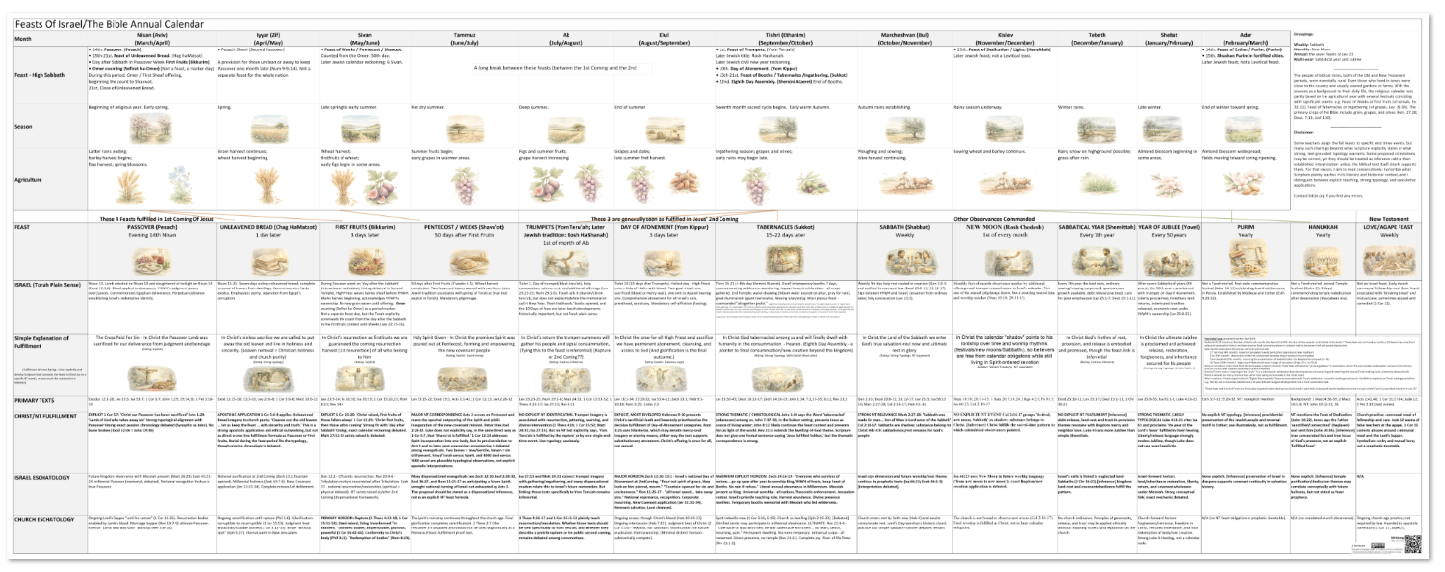
This chart is a study tool that does three jobs at once: (1) it locates Israels sacred times inside an actual calendar year (months, seasons, agriculture), (2) it shows the canonical sequencing of redemptive events (especially the spring feasts clustering around the first coming), and (3) it gives a disciplined “warranted fulfillment” grid that keeps Torah plain sense, NT fulfillment, and eschatological inferences from being collapsed into one undifferentiated prophecy chart.
How the chart is structured
-
Top band: calendar, seasons, and agriculture.
The top section runs month-by-month from Nisan (Aviv) through Adar, placing the feasts into a real annual rhythm: early spring through late winter. This matters because the Torah feasts are not abstract symbols. They are anchored in (a) Israels covenant history (Exodus, wilderness, land life), (b) the agrarian cycle (barley, wheat, grapes, olives), and (c) the worship calendar (pilgrimage gatherings and sacred assemblies). Reading the feasts against the seasonal and agricultural markers prevents over-allegorizing and helps students see why certain images (firstfruits, ingathering, rest, release) are so naturally paired with these appointed times.
-
Middle band: the feast timeline and the redemptive arc
The center line highlights the standard spring sequence (Passover, Unleavened Bread, Firstfruits, then the count to Weeks/Pentecost), then visually leaves a long gap until the seventh-month cluster (Trumpets, Day of Atonement, Tabernacles, and the attached Eighth Day Assembly). This is pedagogically important: it mirrors the canonical flow where the NT gives very explicit first-coming fulfillments for Passover/Firstfruits and explicit event timing for Pentecost, while the fall feasts are more strongly associated with consummation themes (return, cleansing, dwelling) but are not always directly assigned to specific end-times events in the NT. Your chart makes that tension visible: strong fulfillment where Scripture is explicit, cautious inference where Scripture is not.
-
Bottom grid: peshat, fulfillment, and horizons
Each feast/observance has the same set of rows, which forces disciplined comparison:
-
Israel (Torah plain sense): what the text required and what it meant in Israels covenant life.
-
Simple explanation of fulfillment: one-line, student-friendly synthesis.
-
Primary texts and Christ/NT fulfillment: anchors the claim in Scripture rather than tradition.
-
Israel eschatology and church eschatology: separates corporate trajectories without inventing two different gospels.
You also include other commanded rhythms (Sabbath, New Moon, Shemittah, Jubilee) plus later historical observances (Purim, Hanukkah) and the NT agape meal, with the right warning that they do not carry the same Torah status as Leviticus 23 mo’edim.
How to use the chart (a step-by-step study method)
Step 1: Start with Torah plain sense (peshat)
Have students read the Israel row first. Ask three questions: What is commanded? What is commemorated (history)? What is enacted (worship practice)? This establishes that the feasts are covenant time-markers before they are typology. It also prevents the common mistake of beginning with an end-times chart and forcing Torah details to fit it.
Step 2: Identify the warrant level for “fulfillment”
Use your rating logic (explicit vs strong typology vs cautious inference) as an interpretive discipline. The rating is not measuring spiritual importance; it is measuring how directly Scripture itself makes the connection.
-
Passover and Firstfruits are your clearest examples of explicit NT identification.
-
Pentecost is explicit event timing.
-
Trumpets is the case study for cautious inference: the trumpet motif is explicit, but the feast-to-event linkage is not stated.
Students learn to distinguish: (a) what the NT says, (b) what the NT strongly implies, (c) what is plausible but not provable.
Step 3: Trace the Christ-centered logic through the sequence
Walk left-to-right through the spring feasts as a gospel-shaped progression: sacrifice and deliverance (Passover), consecrated life (Unleavened Bread), resurrection guarantee (Firstfruits), and Spirit-formed community (Pentecost). Then explain why the fall cluster is often read as consummation-shaped: summons, cleansing, dwelling. Your chart helps students see that the feasts are not random. They form a coherent theology of redemption moving from deliverance to holiness to life to empowerment to final restoration.
Step 4: Compare Israel-forward and church-forward horizons without collapsing them
This is where the chart is especially useful for your stated position. You are not doing replacement theology (Israel disappears), and you are not doing uncontrolled dual fulfillment (anything can mean anything twice). Instead, you show one Christological substance with differentiated corporate application: Israel receives the calendar; Christ fulfills its substance; the church participates by union with Christ; Israel also has future national turning and kingdom administration themes that remain text-anchored in the prophets. Students learn to keep Romans 11, Zechariah 12-14, Hebrews 9-10, and Revelation 21 in proper relation.
Step 5: Use the “other observances” columns as boundary markers
Sabbath, New Moon, Shemittah, and Jubilee complete the covenant rhythm: weekly, monthly, septennial, and jubilee release. These help students see that biblical time is structured around rest, worship, provision, and liberation. Purim and Hanukkah teach a different lesson: important historical memory and Jewish practice, but not Torah mo’edim and not assigned explicit NT fulfillments. That difference is worth highlighting because it trains students in canonical categories rather than treating all Jewish holidays as equal.
Step 6: End with applications that match the warrant
The chart works best when application follows the same discipline as interpretation. Where the NT is explicit (Passover, Firstfruits, Pentecost), application can be confident. Where typology is strong (Unleavened Bread, Tabernacles, Jubilee themes), application should be robust but still text-bounded. Where the link is inference (Trumpets specifics, some sabbatical/jubilee extensions), application should be humble: encouragement toward watchfulness and hope, not date-setting or dogmatic timelines.
In short: your chart is not merely a calendar. It is a hermeneutics trainer. It teaches students to read the feasts historically, canonically, and Christologically, while keeping clear boundaries between explicit Scripture, strong typology, and speculative end-times mapping.