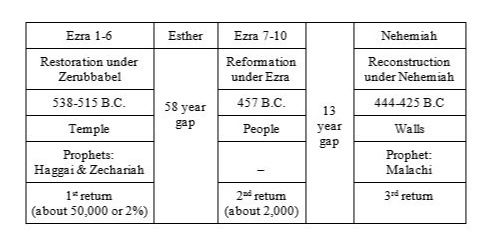
Questions: Give me a detailed timeline of where these books and events took place in this attached pic:
Answer:
Summary of main points
-
The chart is organizing post-exilic restoration history into three major phases of return and rebuilding: (1) Zerubbabel/Temple (Ezra 1–6, 538–515 BC), (2) Esther in the Persian diaspora (between phases), (3) Ezra/Torah reform (Ezra 7–10, ~458/457 BC), (4) Nehemiah/Walls and covenant renewal (Neh, ~445/444–433+ BC), with Malachi’s ministry plausibly overlapping the late Nehemiah period.
-
The “where” moves back and forth between Persian imperial centers (especially Susa and Babylon) and Jerusalem/Yehud (the Persian province of Judah).
-
The theological logic is: God preserves and reconstitutes the covenant people as a “remnant” around (a) temple/worship, (b) Torah/holiness, (c) city boundaries/walls—while also preserving Jews still scattered in the empire (Esther).
1) Detailed timeline of books, events, and locations (matching the chart)
Phase A — Ezra 1–6 (“Restoration under Zerubbabel”) — 538–515 BC
Primary locations: Babylon/Persian imperial administration → Judah (Yehud) → Jerusalem
Core focus in the chart: Temple; Prophets: Haggai & Zechariah; 1st return (~50,000)
-
538 BC — Cyrus’ decree and the return begins
-
Where: Decree issued within the Persian imperial bureaucracy (the narrative assumes the empire’s administrative centers; Cyrus had just taken Babylon in 539). The exiles are in Babylonia when the “return” begins.
-
What happens: YHWH “stirs” Cyrus to authorize rebuilding the house (temple) in Jerusalem (Ezra 1:1–4).
-
Movement: Babylonia → Jerusalem under Sheshbazzar/Zerubbabel (Ezra 1–2).
-
537/536 BC — Altar restored; foundations laid
-
Where: Jerusalem, at the temple site (Ezra 3).
-
What happens: Altar worship resumes, then the foundation of the temple is laid (Ezra 3:2–3, 3:10–13).
-
Opposition and imperial correspondence (multi-site)
-
Where:
-
Local opposition in Yehud/Samaria (Ezra 4).
-
Official letters move from the Levant to the Persian court (Ezra 4:11–16), illustrating how the province is embedded in imperial channels.
-
-
Text note: Ezra preserves imperial documents in Aramaic (Ezra 4:8–6:18), which is itself a “where” clue: we are reading the language of the empire’s administration inside the biblical book.
-
520–518 BC — Prophetic re-ignition under Haggai and Zechariah
-
Where: Jerusalem/Yehud.
-
What happens: The prophetic word confronts discouragement and re-orders priorities: rebuild the house (Hag 1:1–11; Zech 1:1–6). Ezra explicitly links the temple completion to these prophets (Ezra 5:1–2; 6:14).
-
515 BC — Temple completed and dedicated
-
Where: Jerusalem (Ezra 6:15–18).
-
What happens: The “house” is finished; worship and calendrical life (Passover) are re-stabilized (Ezra 6:19–22).
-
The chart’s emphasis (“Temple”) is precisely this: the post-exilic community is re-centered on worship as covenant identity.
Gap + Book of Esther (the chart’s “58 year gap”)
Primary location: Susa (Shushan), the Persian citadel, and “throughout the provinces” of the empire
Core meaning in the chart: Esther is not in Jerusalem; it explains God’s preservation of Jews who did not return.
-
Setting and “where”
-
Where: The narrative repeatedly locates the court in Susa (Esth 1:2; 2:5; 3:15; 8:15).
-
Empire-wide scope: The threat and deliverance concern Jews across the empire’s provinces (Esth 3:12–14; 9:20–28).
-
Chronological placement (why it sits between Ezra 1–6 and Ezra 7–10)
-
Esther is set under Ahasuerus (commonly identified with Xerxes I, 486–465 BC), placing it after the temple is completed (515) but before Ezra’s later arrival under Artaxerxes I (Ezra 7).
-
So the “58-year gap” in your chart is doing double work: it marks time in Yehud and simultaneously highlights that huge Jewish populations remain in Persia, where the covenant people still need preserving.
Phase B — Ezra 7–10 (“Reformation under Ezra”) — ~458/457 BC
Primary locations: Babylon → along the Euphrates route → Jerusalem
Core focus in the chart: People; 2nd return (~2,000)
-
Ezra’s commissioning
-
Where: Ezra departs “from Babylon” (Ezra 7:6, 7:9). The authorization is issued by Artaxerxes (Ezra 7:11–26), meaning Ezra is operating directly under imperial authority.
-
The journey and arrival
-
Where: Route follows the major riverine corridor (the text’s travel notices imply the Euphrates world), then into Jerusalem (Ezra 7:8–9).
-
Reformation centered on Torah and communal holiness
-
Where: Jerusalem/Yehud (Ezra 9–10).
-
What happens: Ezra teaches/implements Torah order (Ezra 7:10). The crisis is intermarriage with surrounding peoples (Ezra 9:1–4). The resolution involves covenant recommitment and a difficult communal purge (Ezra 10).
Why the chart says “People”: after the temple exists, the next vulnerability is not architecture but identity—a rebuilt temple with an assimilated people is covenantally incoherent.
Phase C — Nehemiah (“Reconstruction under Nehemiah”) — ~445/444–433+ BC
Primary locations: Susa → Jerusalem → (back to Susa) → Jerusalem again
Core focus in the chart: Walls; Prophet: Malachi; 3rd return
-
Nehemiah’s call and commissioning
-
Where: Susa, “the citadel” (Neh 1:1).
-
What happens: News arrives about Jerusalem’s distress and broken walls (Neh 1:3). Nehemiah petitions Artaxerxes (Neh 2:1–8).
-
Jerusalem wall reconstruction
-
Where: Jerusalem, around the city perimeter (Neh 2–6).
-
Opponents and regions: resistance from leaders associated with Samaria (Sanballat), Ammon (Tobiah), and Arab groups (Geshem) (Neh 2:10, 2:19; 4:1–8). This triangulates the geopolitical “where” of conflict: Jerusalem is a small province contested by neighboring power networks.
-
Completion: the wall is finished rapidly (Neh 6:15).
-
Covenant renewal and Torah public reading (Ezra + Nehemiah together)
-
Where: public assembly in Jerusalem (Neh 8).
-
What happens: Ezra reads Torah; the people understand; reforms follow (Neh 8–10).
-
Nehemiah’s later reforms (second visit)
-
Where: Nehemiah returns to the king, then comes again to Jerusalem (Neh 13:6–7).
-
What happens: reforms address temple neglect, tithes, Sabbath trade, and intermarriage (Neh 13:10–31).
Malachi (placed under Nehemiah in the chart)
Primary location: Jerusalem/Yehud
Why the chart attaches Malachi to the Nehemiah era: Malachi addresses the same covenant failures Nehemiah confronts—corrupt priesthood, polluted worship, intermarriage, and tithes/offerings (cf. Mal 1–3 with Neh 13).
2) Exegesis (key original-language features that illuminate “what is happening”)
(a) “Return” and “remnant” as covenant categories (Hebrew)
-
שׁוּב (šûḇ, “turn/return”) is the deep grammar of post-exilic history: return is not merely geographic but covenantal—turning back into fidelity. This underlies why physical rebuilding is repeatedly paired with repentance and Torah obedience (Ezra 7:10; Neh 8–10).
-
שְׁאָרִית (šĕʾārît, “remnant”) (conceptually, even when the noun is not foregrounded) frames the community as a preserved subset through judgment, carrying forward Abrahamic/Davidic promises.
(b) Ezra’s bilingual texture: Hebrew + Imperial Aramaic as “location” in language
-
Large sections of Ezra are in Aramaic (Ezra 4:8–6:18; 7:12–26). This is not a curiosity: it is the textual imprint of Persian administrative reality embedded in Scripture—God’s covenant history is unfolding inside an empire whose paperwork has its own tongue.
-
Theologically, that bilinguality “incarnates” providence: the holy story is told partly in the language of the state because the state is one of God’s instruments (Ezra 1:1; 6:14).
(c) Esther’s most striking textual feature: divine hiddenness in the Masoretic narrative
-
In the Hebrew MT of Esther, God’s name is famously absent, yet the story turns on “coincidences” that are too fitted to be random. That literary strategy forces a providential reading without explicit narration—appropriate to the diaspora setting where covenant life persists without temple, land, or Davidic throne.
3) Theological analysis (Free-Will/Provisionist + Dispensational synthesis, with Reformed contrast)
(a) Free-Will / Provisionist emphasis
-
These books repeatedly assume real human agency: leaders choose courage, the people choose obedience or compromise (Ezra 10; Neh 13).
-
Simultaneously, God’s initiative is explicit: “the LORD stirred up the spirit of Cyrus” (Ezra 1:1) and later “the elders… prospered through the prophesying” (Ezra 6:14).
-
The synthesis is non-competitive causation: God genuinely acts, and humans genuinely respond; the narrative does not treat human obedience as illusory.
(b) Dispensational emphasis (Israel remains Israel)
-
The returns do not dissolve Israel into a generic “people of God.” They are a concrete, genealogically continuous covenant community re-constituted in the land under Persian rule (Ezra 2; Neh 7).
-
The restoration is real but partial: the temple is rebuilt, but the Davidic throne is not restored; the prophets and narrative maintain forward pressure toward fuller messianic fulfillment rather than declaring the kingdom promises exhausted.
(c) Contrast with common Reformed accent (without caricature)
-
Reformed readings often foreground God’s meticulous sovereignty in the stirring of kings and the preservation of the covenant line. That emphasis is textually grounded (Ezra 1:1; Neh 2:8).
-
Where a non-extreme Free-Will reading differs is in refusing to collapse the repeated covenant calls (repentance, separation, obedience) into mere outworking of unilateral determinism; the narrative’s moral urgency treats these as genuine covenant conditions within God’s gracious initiative.
4) Historical context (Second Temple Judaism + Persian imperial “where”)
Persian imperial geography: why the story keeps moving between capitals and Jerusalem
-
Susa functions as a major royal center (explicit in Esther; explicit in Neh 1:1). It represents the nerve-center of imperial decision.
-
Babylon/Babylonia remains a massive Jewish population center even after returns begin (Ezra 7:6–9 presupposes this), explaining why “return” happens in waves: the community is distributed.
Yehud as a small province with big covenant meaning
-
Post-exilic Judah is a provincial reality—economically weak, politically exposed, religiously contested—so temple, Torah, and walls are not “projects” but identity-anchors.
5) Scholarly insight (conservative evangelical, SBL style)
-
On the Persian background and diaspora setting that illumines Esther/Nehemiah’s “Susa” world: Edwin M. Yamauchi, Persia and the Bible (Grand Rapids: Baker, 1990), 1–60, 143–210.
-
On the post-exilic restoration as covenant preservation and the re-forming of Israel’s identity: Eugene H. Merrill, Kingdom of Priests: A History of Old Testament Israel (Grand Rapids: Baker, 1987), 479–520.
-
On Israel’s continuing distinct role and the theological significance of post-exilic national preservation within a broader redemptive program (Dispensational frame): Arnold G. Fruchtenbaum, Israelology: The Missing Link in Systematic Theology (Tustin, CA: Ariel Ministries, 1989), 555–620.
-
On providence and “hiddenness” themes that help explain Esther’s narrative strategy while maintaining conservative commitments: Karen H. Jobes, Esther (Grand Rapids: Zondervan, 2011), 15–55.
6) Practical implications (conservative evangelical)
-
Worship first (Ezra 1–6): rebuilding “house/altar” before social prestige is a template for post-judgment renewal: covenant life reboots around worship.
-
Identity second (Ezra 7–10): spiritual collapse often comes less from external pressure than internal assimilation; Torah formation and boundary-keeping are portrayed as communal survival, not legalistic trivia.
-
Public order third (Nehemiah): walls symbolize governed space—a community can’t keep covenant life public if it cannot regulate access, commerce rhythms (Sabbath), and leadership integrity.
-
Diaspora realism (Esther): God’s people may live under alien systems; faithful presence may require political wisdom, courage, and communal solidarity without presuming the system is “the kingdom of God.”
Divine-perspective level (how the narrative wants you to see God “willing” this whole sequence)
Across the chart’s phases, God is portrayed as governing history by preserving a covenant people through (1) imperial policy, (2) prophetic word, and (3) covenant renewal, so that the promised redemptive line and witness in the world are not extinguished—whether the Jews are in Jerusalem (Ezra/Nehemiah) or Susa (Esther).