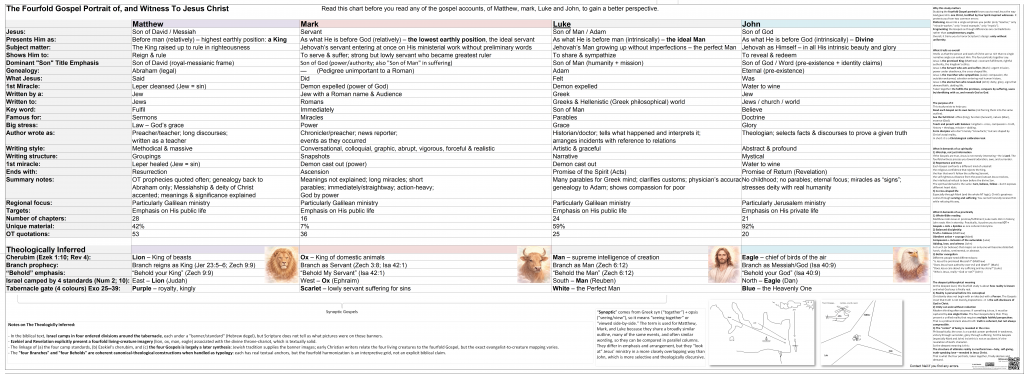
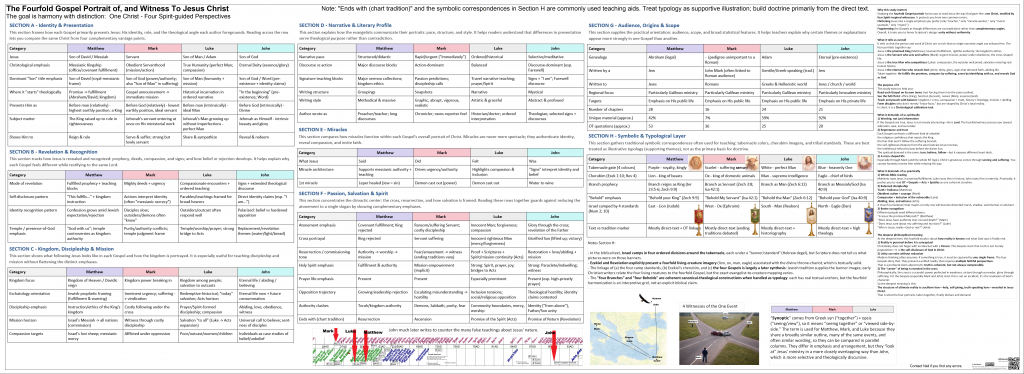
Two charts, one in brief and the other in full.
Fourfold Gospel Portrait of, and Witness To Jesus Christ in BRIEF:
Fourfold Gospel Portrait of, and Witness To Jesus Christ in FULL:
Use Policy: Free for personal and church use. Not for sale or commercial distribution.
Why this study matters
Studying the fourfold Gospel portrait forces you to read Jesus the way God gave Him: one Christ, testified by four Spirit-inspired witnesses. It protects you from two common errors:
-
Flattening Jesus into a single emphasis you prefer (only “teacher,” only “miracle-worker,” only “moral example,” only “mystic”).
-
Fragmenting the Gospels as though differences are contradictions rather than complementary angles.
Overall, it trains you to honor Scripture’s design: unity without uniformity.
What it tells us overall
It tells us that the person and work of Christ are so rich that no single narrative angle can exhaust Him. The four portraits together say:
-
Jesus is the promised King (Matthew): covenant fulfillment, rightful authority, the kingdom’s ethics.
-
Jesus is the Servant who acts and suffers (Mark): urgent mission, power under obedience, the cross-shaped life.
-
Jesus is the true Man who sympathizes (Luke): compassion, the outsider welcomed, salvation entering real human history.
-
Jesus is the eternal Son who reveals God (John): deity, glory, signs that demand faith, abiding life.
Taken together: He fulfills the promises, conquers by suffering, saves by identifying with us, and reveals God as God.
The purpose of it
This study exists to help you:
-
Read each Gospel on its own terms (not forcing them into the same outline).
-
See the full Christ: office (King), function (Servant), nature (Man), essence (God).
-
Teach and preach with balance: kingdom + cross, compassion + truth, history + theology, mission + abiding.
-
Form disciples who don’t merely “know facts,” but are shaped by Christ’s total reality.
In short: it is a Christological calibration tool.
What it demands of us spiritually
1) Worship, not just information
If the Gospels are true, Jesus is not merely interesting—He is Lord. The fourfold witness presses you toward adoration, awe, and surrender.
2) Repentance and trust
Each Gospel confronts a different kind of unbelief:
-
the religious confidence that rejects the King,
-
the fear that won’t follow the suffering Servant,
-
the self-righteous distance from the poor/outcast Jesus receives,
-
the intellectual refusal to bow before the divine Son.
The spiritual demand is the same: turn, believe, follow—but it exposes different heart idols.
3) A cross-shaped life
Especially through Mark (and the whole NT logic), Christ’s greatness comes through serving and suffering. You cannot honestly receive Him while refusing His way.
What it demands of us practically
1) Whole-Bible reading
Matthew roots Jesus in promise/fulfillment; Luke roots Him in history; John roots Him in eternity. Practically, it pushes you to read OT + Gospels + Acts + Epistles as one coherent storyline.
2) Balanced discipleship
-
Truth + holiness (Matthew)
-
Obedient action + courage (Mark)
-
Compassion + inclusion of the vulnerable (Luke)
-
Abiding, love, and witness (John)
A church (or believer) that majors on only one will become distorted: harsh, shallow, sentimental, or abstract.
3) Better evangelism
Different people need different doors:
-
“Is Jesus the promised Messiah?” (Matthew)
-
“Does Jesus have authority over evil and death?” (Mark)
-
“Does Jesus care about my suffering and my story?” (Luke)
-
“Who is Jesus, really—God or not?” (John)
The deepest philosophical meaning
At the deepest level, this fourfold study is about how reality is known and what God says is finally real.
1) Reality is personal before it is conceptual
Christianity does not begin with an idea but with a Person. The Gospels insist that truth is not merely propositions—it is the self-disclosure of God in Christ.
2) Unity can exist without reduction
Modern thinking often assumes: if something is true, it must be captured by one single frame. The four Gospels deny that. They present a unified reality that requires multiple faithful perspectives.
That is a profound claim about truth: truth is coherent, but not always compressible.
3) The “center” of being is revealed in the cross
Philosophically, the cross is a scandal: power perfected in weakness, victory through surrender, glory through suffering. Yet the Gospels (especially Mark and John) insist this is not an accident; it’s the revelation of God’s character.
So the deepest meaning is this:
The structure of ultimate reality is cruciform love—holy, self-giving, truth-speaking love—revealed in Jesus Christ.
That is what the four portraits, taken together, finally declare and demand.
If you want, I can write a one-page “poster summary” version of this (tight bullets, highly quotable) to place on bib1e.org under the chart.
The Fourfold Gospel Portrait of Jesus: What This Chart Shows, Why It Matters, and How to Use It
If you’ve ever read the Gospels back-to-back, you’ve probably noticed something striking: the same Jesus is presented with different emphases. One Gospel feels structured and “fulfilled-prophecy heavy.” Another moves rapidly from event to event. Another lingers with compassion on outsiders and the poor. Another soars into deep theology and direct identity claims.
That isn’t a problem to be solved. It’s a design feature—and a gift.
This study and chart exist to help you see what God has given us in the fourfold Gospel witness: one Christ, revealed through four Spirit-inspired perspectives. When you learn to read each Gospel on its own terms (without flattening them into one uniform outline), you gain a fuller, clearer, and more worship-producing grasp of Jesus Christ.
Below is an explainer of what this chart shows, why it’s important, and how to use it for Bible reading, teaching, discipleship, and evangelism.
1) What is the “Fourfold Gospel Portrait” study?
The chart compares Matthew, Mark, Luke, and John side-by-side across key categories—identity, purpose, writing approach, miracle structure, discipleship emphasis, and theological themes.
The aim is not to force the Gospels into identical wording. The aim is to answer:
-
What angle does each Gospel emphasize?
-
How does each author reveal Jesus?
-
What does each Gospel particularly demand of the reader—faith, repentance, discipleship, worship?
-
How do the four portraits fit together into one coherent Christology?
In other words, the chart functions like four camera angles capturing one scene. Each angle shows the same person, but highlights different features. Together they give you depth perception.
2) Why are there four Gospels?
If God wanted only a biography, one Gospel would have been enough. But Scripture gives us four because Jesus is not merely a historical figure to catalogue—He is the Messiah, Lord, and Savior whose person and work are multi-dimensional.
The fourfold witness provides:
A) Fullness without reduction
One Gospel can emphasize kingship; another servanthood; another humanity; another deity. None of these cancels the others. Together they prevent you from reducing Jesus to one favorite theme.
B) Harmony with distinction
The Gospels are not copies of one another. Their differences are purposeful—like different facets of the same diamond. They harmonize at the level of truth, even when they differ in arrangement and emphasis.
C) A discipleship tool
Each Gospel forms disciples in a different way:
-
through teaching and kingdom ethics,
-
through costly following and action,
-
through compassion, prayer, and Spirit-formed life,
-
through abiding, love, and deep faith.
The church needs all of those.
3) What the chart says in one sentence
Matthew presents Jesus as the promised King; Mark presents Him as the obedient Servant; Luke presents Him as the perfect Man who sympathizes; John presents Him as the eternal Son who reveals God.
That simple summary becomes richer once you compare the details.
4) The four perspectives (high-level overview)
Matthew: Jesus the King—promise fulfilled
Matthew is saturated with Old Testament fulfillment and Jewish expectation. Jesus is shown as the rightful Davidic King and the promised Messiah, bringing the kingdom and teaching the ethics of the kingdom. Matthew frequently communicates through structured teaching blocks and “this was to fulfill…” framing.
What Matthew demands of you:
Submit to the King. Receive the Messiah God promised. Live the righteousness of the kingdom—not as self-salvation, but as the fruit of allegiance to Christ.
Mark: Jesus the Servant—action, authority, suffering
Mark moves quickly. Events come fast. The pace carries urgency: the mission has begun; the kingdom is breaking in; evil is confronted; the Servant is on the move. Mark highlights Jesus’ authority through deeds and then drives toward the cross, where the Servant suffers.
Mark is famous for its “immediately” feel and its action-forward narrative.
What Mark demands of you:
Follow the Servant-King in a cross-shaped life. Don’t mistake power for comfort. Jesus’ path is obedience, sacrifice, and victory through suffering.
Luke: Jesus the Perfect Man—compassion and salvation in history
Luke emphasizes Jesus’ true humanity and His compassion toward the poor, outsiders, women, children, and those socially pushed aside. Luke also signals careful historical ordering and interpretation.
Luke is especially rich on prayer, the Holy Spirit, and the widening horizon of salvation—eventually flowing into Acts, where the gospel moves outward to the nations.
What Luke demands of you:
Receive the Savior who comes near. Let your heart be shaped by His mercy. Learn discipleship as Spirit-empowered compassion and faithful witness.
John: Jesus the Son of God—glory, signs, belief
John begins not with Bethlehem but with eternity: “In the beginning…” It emphasizes Jesus as the divine Son—the Word—and uses “signs” (not merely miracles) to reveal identity and call for belief.
John includes extended discourses and direct self-revelation. It presses the reader to decide: this Jesus is God’s Son—will you believe, abide, and follow?
What John demands of you:
Believe. Abide. Worship. John’s portrait confronts casual admiration and calls for settled faith in who Jesus is.
5) What makes this chart different from most Gospel summaries?
Many charts stop at surface-level comparisons like “Matthew = King, Mark = Servant…” and leave it there. This one goes deeper by adding categories that keep the chart biblically and spiritually useful:
-
Christological emphasis (office, function, nature, essence)
-
How revelation happens (prophecy, deeds, compassion, signs)
-
How recognition develops (belief vs rejection patterns)
-
Kingdom and discipleship focus
-
Atonement and cross portrayal
-
Holy Spirit and prayer emphasis
-
Conflict and authority clashes
-
Symbolic/typological layer (clearly marked)
This matters because shallow comparisons can become clichés. A deep chart becomes a tool for real reading, teaching, and personal transformation.
6) How to use the chart (practical step-by-step)
Here are several ways to use this chart effectively.
Method 1: “Row reading” (best for study groups)
Choose one row category and read across all four Gospels.
Example: “Mode of revelation”
-
Matthew: prophecy + structured teaching
-
Mark: deeds + urgency
-
Luke: compassionate encounters + ordered narrative
-
John: signs + discourse
Then ask:
-
What is unique in each Gospel?
-
What stays constant about Jesus?
-
What does this reveal about how God teaches us?
This method trains you to compare without flattening.
Method 2: “Gospel immersion” (best for personal Bible reading)
Pick one Gospel to read through in full. Use the chart as your “lens” before you start.
For example, when reading Mark, remind yourself:
-
watch for urgency,
-
watch for the Servant’s authority in action,
-
watch how the cross is the goal,
-
watch what discipleship costs.
Then, after reading, return to the chart and confirm:
Did you see those themes? Where were they strongest?
This method deepens your reading and makes the Gospel “click.”
Method 3: “Christology calibration” (best for teachers and preachers)
Before teaching a passage, check the chart and ask:
-
How does this passage fit the Gospel’s primary portrait?
-
Am I preaching in harmony with the Gospel’s intent?
-
Am I importing a theme from another Gospel that weakens this one’s emphasis?
Example: preaching Luke like Matthew can make Luke feel like “less Jewish Matthew.” Preaching John like Mark can make John feel like “slow Mark.” The chart helps you respect the Spirit’s design.
Method 4: “Discipleship diagnosis” (best for spiritual growth)
Ask: Which Gospel emphasis do I avoid?
-
Do I want John’s glory but avoid Mark’s cross?
-
Do I love Matthew’s teaching but resist Luke’s compassion?
-
Do I enjoy Mark’s action but skip John’s abiding?
Then pray and act:
-
If you avoid Mark: embrace costly obedience.
-
If you avoid Luke: practice mercy and hospitality.
-
If you avoid Matthew: submit to Christ’s authority and kingdom ethics.
-
If you avoid John: cultivate faith, worship, and abiding.
This method makes the chart a mirror.
Method 5: Evangelism matching (best for outreach)
Different people have different obstacles:
-
The “religious” person may need Matthew: fulfillment, authority, Messiahship.
-
The suffering or oppressed may need Mark: authority over evil, hope through the cross.
-
The broken outsider may need Luke: compassion and welcome.
-
The intellectual skeptic may need John: identity claims and signs calling for belief.
The chart helps you choose the right Gospel starting point for the right person.
7) What this study demands of us (spiritually and practically)
Spiritually: worship and repentance
A true fourfold portrait makes casual Christianity impossible. Jesus isn’t merely inspiring; He is:
-
King (your rightful Lord),
-
Servant (your model and Savior),
-
Man (your sympathetic High Priest),
-
God (the final revelation of the Father).
The proper response is worship, repentance, faith, and allegiance.
Practically: balanced discipleship
The church easily drifts into one-sided Christianity:
-
truth without compassion,
-
compassion without truth,
-
action without depth,
-
theology without obedience.
The four Gospels correct those imbalances.
8) The deepest meaning of the fourfold witness
At the deepest level, this chart teaches something profound about truth:
Truth is coherent but not always compressible
Modern minds often want one summary to capture everything. God gives four Gospels because the reality of Christ is so rich that it cannot be reduced to one frame without loss.
Reality is personal, not merely conceptual
Christianity does not begin with an abstract system but with a Person. The Gospels insist that ultimate truth is God’s self-disclosure in Jesus.
The center of reality is cruciform love
Across the four portraits, the cross is not an accident. It is the revelation of God’s character: holy love, self-giving mercy, righteous judgment absorbed and overcome in Christ’s saving work.
That is not merely theology; it’s metaphysics. It tells you what is most real: God’s holy love revealed in Jesus Christ.
9) A simple way to teach this chart in one sitting
If you want a quick teaching outline:
-
One Christ, four witnesses
-
Matthew: King—fulfillment and kingdom
-
Mark: Servant—authority and suffering
-
Luke: Man—compassion and Spirit-formed discipleship
-
John: God—glory, signs, belief
-
Application: submit, follow, receive mercy, abide
This is a powerful framework for sermons, Bible classes, and discipleship groups.
Final encouragement
Don’t treat this chart as a trivia sheet. Treat it as a guide for meeting Christ more fully. Read the Gospels again with this in mind:
-
Let Matthew crown Him King.
-
Let Mark lead you to the cross-shaped life.
-
Let Luke teach you His compassion and the Spirit’s work.
-
Let John bring you to worship and abiding faith.
One Lord—four portraits—one gospel of salvation.