Bible & Church History Timeline
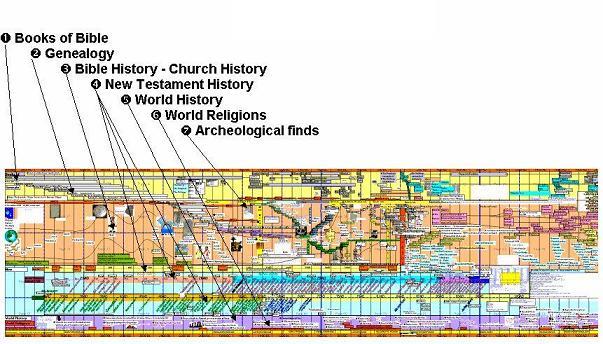
A Suggestion:
Try reading or listening to a whole book of the Bible with the timeline in front of you. If you find this too difficult, ask a friend or friends to do it with you.
It is an exciting adventure to discover God in a much deeper way. It is as if, it all miraculously falls into place: who God really is; how God thinks and works; when did the people and events occur, and in relation to all the other people and events…
Use Policy: Free for personal and church use. Not for sale or commercial distribution.
Author: Neil Baulch
How to Read the “Bible & Church History Timeline” — From Scripture to the Present
Purpose: explain how to read your Bible & Church History Timeline (from the biblical era through major church eras to the present), how its components fit, and how to convert the graphic into a reliable study/teaching workflow. Built for a conservative, grammatical-historical approach (ESV), it keeps Scripture central while situating later history as response to—not source of—biblical authority.
1) What this timeline is (and isn’t)
What it is: a panoramic map that lays out (1) the biblical storyline (creation → patriarchs → Israel → Christ & the apostles), (2) the formation and preservation of Scripture (revelation, canon, transmission, translation), and (3) key church-history epochs (persecution, councils, missions, reformations, revivals, global expansion). It uses bands, milestone pins, and color coding so you can see what happened and why it mattered for the Bible’s use in the church.
What it isn’t: an exhaustive chronology or an endorsement of every figure or movement shown. It is a learning scaffold—a way to locate people and events in relation to the Bible’s authority and the gospel’s advance.
2) The big picture: four stacked bands plus a storyline rail
Most readers grasp your timeline best by treating it as four long horizontal bands resting on a storyline rail:
- Biblical Era Band (top)
Creation → Patriarchs → Exodus/Sinai → Conquest/Kingdom → Exile/Return → Second Temple → Jesus & the Apostles.
Reading cue: This band anchors revelation and redemptive history. Every later band should be read as response to this one. - Bible Formation Band
Revelation → Inspiration → Canon recognition → Transmission/Preservation → Early versions/translations → Printed/modern editions.
Reading cue: Arrows run from God to text (inspiration) and from text to church (recognition, copying, translating). The church receives Scripture; it does not create it. - Church History Band
Early persecution & mission → pastoral/theological consolidation → councils & creeds → monastic/missionary movements → Eastern/Western developments → reformations & confessions → awakenings/revivals → modern global mission & Bible societies.
Reading cue: Milestones are placed under the biblical-authority stream to show how Christians guarded doctrine, carried the gospel, or (at times) drifted—prompting reform and renewal. - Doctrinal & Missional Themes Band
Short ribbons for: Trinity & Christology, Canon & Scripture, Justification & sanctification, Worship & sacraments, Mission & Bible translation, Israel/Church and eschatology.
Reading cue: Thin ribbons cross multiple centuries, reminding you that the same doctrine is clarified repeatedly in different contexts.
Storyline rail (bottom): century marks (or dated ticks). Use it to place any pin in time, then look upwards to see what it sits beneath (Bible formation; biblical era; doctrinal theme).
3) Legend—colors, lines, icons
- Colors by band (example):
Gold = Bible Formation; Brown: Bible & Church History; Blue = BNT Era; Purple = Contemporary History. - Icons:
Scroll/book = Scripture/canon/text;
Globe/arrow = missions/translation;
Gavel/columns = councils/creeds/confessions;
Church building = ecclesial developments (polity, worship practice). - Solid arrows = derivation/causal flow (e.g., Inspiration → Canon recognition → Transmission).
- Dashed arrows = influence/cross-link (e.g., a creed informing later confessions; a revival fueling missions).
- Superscripts/labels mark representative texts, councils, creeds, or translation lines.
Read the legend first so you don’t misread a doctrinal ribbon (theme across time) as a single-date event.
4) A 20-minute first pass (how to read the whole page)
- Start at the Biblical Era band. Trace Creation → Christ & apostles with the ESV references you’ve placed (e.g., Gen 12; Exod 20; Isa 53; Luke 24; Acts 1–2).
- Drop to the Bible Formation band. Follow Revelation/Inspiration → Canon → Transmission (Hebrew MT, DSS; Greek papyri/uncials → printed/critical editions) → Translations.
- Move down to the Church History band. Note clusters (persecution; councils/creeds; reformations; awakenings; missions).
- Scan the Doctrinal/Missional ribbons and notice where they thicken (times of controversy or renewal).
- Pick one century on the rail, and read upward through all bands to see everything happening at once (Bible in use, doctrines clarified, mission expanding).
5) Worked examples (three ways to use the timeline)
A) “Where did our English Bibles come from?”
- How to read:
- In the Bible Formation band, find Transmission → Early versions → Vernacular translations.
- Watch the arrows from Hebrew/Greek base texts into translation families (e.g., one line leading toward KJV/NKJV; another toward RSV/ESV; others toward NASB, NIV/CSB).
- Tie this to the Doctrinal ribbon for Scripture & authority—times when translation and textual decisions were front-and-center in church life.
- Takeaway: God’s word moved from God-breathed originals to faithful copies to transparent translations, so congregations could hear, read, and obey.
B) “How did core doctrines stay orthodox?”
- How to read:
- On the Doctrinal ribbons, locate Trinity & Christology and Justification & sanctification.
- Look down to the Church History band at moments of creed/confession or controversy/clarification (you’ve marked them with a gavel/columns icon).
- Look up to the Bible Formation band to remember: the Bible governs doctrine; creeds are summaries, not sources, of truth.
- Takeaway: The church confesses what Scripture teaches; when drift occurs, reform calls the church back to the text.
C) “Why do renewals often spark missions and translation?”
- How to read:
- Find Flame (renewal) icons on the Church History band.
- Follow dashed arrows to Globe/arrow icons (missions, translation).
- Note the Doctrine/Mission ribbon thickening where evangelism, Bible societies, and cross-cultural work accelerate.
- Takeaway: Renewal that is Bible-anchored tends to propel Bible dissemination and world mission.
6) Scripture anchors (why the timeline stays text-first)
Even in a history chart, Scripture is the norming norm. The diagram quietly encodes these anchors:
- Revelation & Inspiration: 2 Tim 3:16–17; 2 Pet 1:20–21; Heb 1:1–2.
- Canonical shape (OT/NT): Luke 24:44; 1 Thess 5:27; Col 4:16; 2 Pet 3:15–16; Rev 1:3; 22:18–19.
- Preservation confidence: Ps 119:89; Isa 40:8; Matt 5:18; 24:35; 1 Pet 1:24–25.
- Preaching, teaching, mission: Neh 8:1–8; Matt 28:18–20; Acts 1:8; 20:27; 2 Tim 4:1–2.
- Doctrinal fidelity: 1 Tim 6:3–5; 2 Tim 1:13–14; Jude 3.
When you teach from the timeline, read the relevant pericopes aloud so the text leads the history, not the other way around.
7) “The flow of authority” (a key diagram inside the diagram)
Your timeline likely includes (or implies) a small flowchart:
God → Revelation → Inspired Scripture → Church hears/receives → Confesses/guards/proclaims → Translates/sends → Hears/obeys again
- One-way authority: authority flows from God through Scripture; later history has ministerial (servant) authority.
- Checks & balances: when practice runs ahead of text, reform recalls the church to Scripture (“Ad fontes”—to the sources).
- Unity and charity: many secondary differences exist (polity, worship forms, eschatological details), but Scripture’s supremacy is non-negotiable.
8) Teaching with the timeline (templates you can reuse)
Template A: “A century in view” lesson (30–45 min)
- Pick a century tick on the rail.
- Read upward through all four bands.
- Ask: What Scripture practices were central? Which doctrines were clarified or contested? What mission/translation shifts occurred?
- Conclude with three applications (e.g., public Scripture reading restored; catechesis renewed; missionary prayer mobilized).
Template B: “One doctrine across time” (30–45 min)
- Choose a doctrinal ribbon (e.g., Scripture’s authority; Trinity; justification).
- Walk across the centuries, stopping at thickened segments or icons beneath.
- For each stop, read one governing passage and summarise what the church confessed in that moment.
- End with today’s practice: how will our church hear and do this doctrine now?
Template C: “From text to tongue” (20–30 min)
- In the Bible Formation band, start at Inspiration → Canon → Transmission.
- Drop to Church History: translation and mission moments.
- Finish with how to choose and use translations in your church (primary translation for reading; compare others for study).
9) Quality controls (how the chart avoids pitfalls)
- Avoiding hagiography: figures are servants, not heroes to canonize. Measure impact by fidelity to Scripture and fruit in gospel mission.
- Avoiding cynicism: acknowledge sins and failures without dismissing God’s ongoing providence and renewal.
- Keeping proportions: major doctrinal clarifications receive larger labels; secondary disputes are smaller so readers don’t lose the forest.
- Distinguishing levels: Bible → Canon/Transmission → Church practice are different layers; don’t let practice masquerade as new revelation.
10) A printable study loop (use with any pin on the chart)
- Identify the pin (event/figure).
- Read the governing Scripture(s) connected to that topic.
- Summarise the doctrinal theme in one sentence (text-first).
- Name the historical contribution/problem in one line.
- Apply: one action in worship, one in teaching, one in mission.
11) Representative Scripture index (ESV)
- Revelation & inspiration: 2 Tim 3:16–17; 2 Pet 1:20–21; Heb 1:1–2
- Canon & public reading: Deut 31:24–26; Luke 24:44; 1 Thess 5:27; Col 4:16; 2 Pet 3:15–16; Rev 1:3; 22:18–19
- Preservation & confidence: Ps 119:89; Isa 40:8; Matt 5:18; 24:35; 1 Pet 1:24–25
- Teaching & mission: Neh 8:1–8; Matt 28:18–20; Acts 1:8; 20:27; 2 Tim 4:1–2
- Guarding the faith: 1 Tim 6:3–5; 2 Tim 1:13–14; Jude 3
12) Final counsel for using the timeline
Keep the timeline beside an open Bible. Each session, pick one century or one ribbon, run the study loop, and finish with one concrete practice (e.g., restore public reading of Scripture, catechize on the Trinity, support a translation/missions project). Over time, your people will not only know the dates and names—they’ll see how God preserved His word and advanced His gospel through imperfect servants in every age.